June 5, 2008 Atapuerca to Burgos

As I opened my eyes in the morning I was surprised to see François, Françoise and Pierre standing next to my bed. When they saw I was awake they said, “Merci, Monsieur.” “Merci? Pourquois?” Why, I asked myself, were they standing around my bed at this early hour? Pierre then described to me how today was the day the Allies had planned to launch their invasion of Normandy. The French, Pierre said, were very grateful for the help of the Americans and on the eve of the anniversary of the actual Normandy invasion the three French people wanted to say thanks to me, an American. I was humbled — not because of anything I’d done, but because of the sincere gratitude expressed by these people who’d benefitted from something my country had done many years ago.

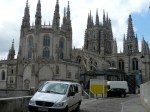
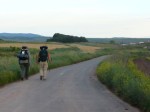
The three French people left before me and I began the long walk into Burgos. At the airport I took the option to the left, said to be a little shorter than the one to the right. Still, it was a long slog through industrial areas. Finally I reached the old city and walked through the gates toward the cathedral. I chose to stay at the Meson del Cid, a delightful hotel above the western cathedral plaza. That afternoon I scouted out a place to purchase new hiking boots and, at the urging of several European pilgrims along the way, I also opted to buy hiking poles which were supposed to ease the strain on my feet and legs. Though the cathedral was closed I did get a stamp for my credential at the cathedral museum and toured the exhibits there.

Once again it was nice to settle into a comfy hotel and enjoy a dinner at a nice restaurant. Burgos is a beautiful and historic city — the site of Ferdinand and Isabella’s famous interview with Christopher Columbus as they considered whether to finance his expedition across the ocean to India.

As I fell asleep I looked back over the 285 kilometers (178 miles) I’d walked over the past couple of weeks. My feet had healed up some from the blisters and with my new hiking boots I expected to have an even better camino in the miles ahead.
June 4, 2008 Tosantos to Atapuerca

I met two kind and friendly South Africans at Tosantos and enjoyed leapfrogging them as we walked down from Tosantos toward Villafrance del Montes de Oca. This little town is the last stop before a 12 km stretch that walks over a mountain ridge and then down to the ancient church at San Juan de Ortega. With no breaks for water or food and a tall climb, this is one of the more physically challenging portions of the Camino Frances. I had plenty of water and took my time, enjoying the walk.

I stopped briefly at San Juan de Ortega for lunch, then headed on in gathering rain clouds and a cool wind to the town of Atapuerca. There I discovered the main, private albergue was closed, so as I walked up to scout out the church at the top of town I chose a tiny albergue with an attached restaurant. The albergue had soft mattresses and, for the first time I’d seen on the camino, thick and warm quilts on each bed. I’d discover later that the albergue was unheated and the quilts would come in handy during the icy cold night.

Atapuerca is famous as the site of a major anthropological discovery of an ancient hominid species. A museum in town included anatomically correct wax figures of these people-like creatures and a helpful BBC documentary in English playing on a loop on a museum TV. After touring the museum I enjoyed dinner at the albergue’s restaurant, where I met Françoise, her husband François, and Pierre of France. With my high school French I introduced myself and did my best to understand their descriptions of their lives and why they were walking the camino. François had a handicapping condition which did not allow him to carry a backpack, so he pulled his things on a wheeled cart strapped behind him.

I snuggled in my sleeping bag and all of my clothes under the quilt and, after a time, managed to get warm enough to fall asleep. I’d decided to splurge again on a hotel for tomorrow, this time in Burgos where I would replace my hiking shoes with real boots and take a rest day after so much busy travel and walking during the last few days.

June 3, 2008 Santo Domingo to Tosantos

Back on the camino now I was ready to reintegrate myself into pilgrim life and was determined to make friends along the way toward Santiago. After an overnight at the Santo Domingo Parador I headed out to walk the path to Burgos that I’d seen from a taxi window over the previous days.

After Santo Domingo the camino rises up from the vast fields of grain toward the Montes de Oca. I walked along the path and took photos of the steeple at Grañon that rises just above a ridge, seeming to sprout from the earth like the grain itself. After Grañon I came to Belorado and considered stopping there at the albergue with a swimming pool. Instead I trudged farther, to Tosantos, and there had one of my most delightful albergue experiences.

As I walked into this three-story, parochial albergue in the quaint and tiny village of Tosantos I was introduced to Tomás, the hospitalero. He began to lecture me about the history of the region and about the camino. My college Spanish skills allowed me to catch about 1/4 of the words, but the general impression was that he was very excited about the camino and proud of his albergue. He instructed me to leave my boots on the main floor and choose a sleeping pad in the main sleeping room on the second floor, then told me all pilgrims were asked to help cook the evening meal and were invited before dinner to tour the cave above the town that held its statue of the Virgin Mary.

I finished my laundry out on the albergue’s grassy lawn, hung it up to dry, then joined other pilgrims in peeling potatoes and cutting up carrots for our dinner. At about 18:00 we headed across the highway to the parish church where a kind woman walked us up the hill to the cave chapel. The interior was quite chilly, and we pilgrims shivered as she gave us a lengthy explanation of how the Virgin is carried into town in the spring and returned to the cave in the winter (or vice versa). We were all happy to excuse ourselves and return to the sunshine outside and the warm stew awaiting us at the albergue dining room.

When we arrived we sat down to a delicious and plentiful meal of stew and salad, followed by cups of yogurt, all accompanied by loud conversation and the sounds of Taizé music played on the boom box on a shelf near the table. I learned from this experience that it is a great joy to share in cooking and eating a meal together with other pilgrims, and I appreciated the care and pride with which Tomás carried out his role as hospitalero.

May 30 – June 2, 2008 Santo Domingo to Copenhagen and back

May 30: I left Santo Domingo at dawn in a white taxi and watched out the window as future camino miles whizzed past. I saw several pilgrims braving the wind and light rain of this day, and once again I was amazed at the colors of the springtime grain fields.

I arrived at Burgos in plenty of time for my train and waited at a cafe as one of the oddest sights of the camino unfolded before my eyes. A group of young Spaniards escorted one of their friends into the train station. He was blindfolded and wearing a bright wig and ballet tutu. He had some kind of sock around his male appendage and it became clear he was getting married this weekend and his friends were giving him a pre-nuptial hazing. He took it “like a man” and the whole episode evinced chuckles from the assembled train goers.

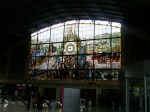
I boarded the train to Burgos, looking ahead to a five-hour journey and enjoyed every moment of this trip to Bilbao. Through fields and forests and across rivers — this was an introduction to the beauty of Northern Spain and I was glad for the opportunity to see this beautiful region. I arrived at the train station in Bilbao and spotted the gorgeous stained glass window above the train gates. Then I caught a taxi for Bilbao’s airport and my flight to Copenhagen.

My wife, Gail, an anesthesiologist and professor of bio-medical ethics, was to speak to the European Society of Anesthesiologists that weekend. It was a big event and her first European speech. When I arrived in Denmark I soon realized there were two Sheraton Hotels and I wasn’t certain at which one Gail was staying. I guessed which one and when I arrived at the lobby I asked the desk to call her room. Gail answered the phone and asked the odd question, “Where are you?” I told her, “I’m down in the lobby,” and she was ecstatic. Her friend, Pam, had joined her for her Copenhagen visit and for a couple of weeks of sightseeing between there and Rome, so the three of us spent the next days enjoying this amazing city and listening as Gail shared his outstanding speech with the European Society.

Since Gail is a doctor I asked if she’d be willing to take a look at the blisters on my feet. “No!” she said, “They’d be too gross!” Even without the support of My Own Private Physician the days away from the camino brought healing to my feet and by the time of my return to Spain I felt much better. My only regret was that I’d left my favorite baseball cap back at the hotel in Santo Domingo and I expected I’d never see it again.

June 2: After a great weekend in Copenhagen I said goodbye to Gail and Pam and headed back via plane to Bilbao. My friend Stefan had suggested that I needed a cell phone so he could send me SMS texts, so I obliged and purchased a cheap cell phone and some minutes as I waited at the Bilbao train station. I boarded the train back to Burgos and caught a taxi to Santo Domingo. As I checked in at the Parador I asked about my hat and, sure enough, they’d kept it safe for me. From then on I’d have a fondness for this hotel and the great Parador chain.

May 29, 2008 Nájera to Santo Domingo

It was clear to me now that Santo Domingo de la Calzada would be as far as I would get before leaving for the weekend’s trip to see Gail in Copenhagen. I set out from Nájera at first light, walking up the pathway through the red cliffs of this lovely, relaxed town.

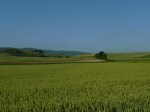
After Nájera the terrain begins to stretch out into vast fields of grain. In the spring these fields are vibrant in their hues of green and as I walked I soaked in the breathtaking beauty of this amazing region. After Cirueña, one particular stretch captured my imagination. It is a  small valley in which the camino follows a farm road down a hill, then turns to the right and gradually goes up the opposite hill. This gives one of the few vistas on the Camino Frances of perhaps a full mile of the camino itself. On this particular sunny, spring day the colors were amazing and I was thankful for the opportunity to walk in this picturesque land.

Over the last few days I’d come to know a Frenchman named Luc. He spoke only French and was patient with my attempts to communicate with him using my high school Français. I walked some distance with him over the previous days, and when I arrived at the big church at Santo Domingo de la Calzada I was surprised to see Luc with bandages on his face holding out his hat, hoping for donations from visitors to the cathedral. He told me he’d fallen at a nearby creek and hurt himself and in the confusion had lost all his money. I gave him some Euros and wished him the best, knowing the Camino and other pilgrims would also help.

I checked in at the Parador Hotel just across from the church and enjoyed this stay at what would be one of my favorite camino hotels. I arranged with the desk to get a taxi to Burgos early the next morning for my long trip to Copenhagen. For dinner I walked out to the new section of town along the main road, got some cash at an ATM, and began to look ahead to the many miles I’d cover off the camino in the next few days.

May 28, 2008 Logroño to Nájera

I believed I could make it over the next two days as far as Santo Domingo de la Calzada, before having to catch a bus or taxi to Burgos for my detour to Copenhagen. So with this goal in mind and all my English-speaking pilgrim friends ahead of me I set my sights on covering the distance.

Just after Logroño vineyards dominate the countryside. It’s clear to see how Logroño is the capital of the famous La Rioja region of Spain, known world-wide for its Tempranillo wines. Entranced by the vineyards I walked right through Navarette, not stopping even for a croissant. After Navarette the town of Ventosa seems best to embody this region. Set on a hill with its church tower dominating the countryside, Ventosa is what you imagine a Riojan town to be like.

After Ventosa I came to the eastern suburbs of Nájera, looking for the 100-bed albergue — quite a transition from the plush hotel of the night before. The albergue is located adjacent to the river park, very near the historic church built over a cave. I dropped my bag at an upper bunk in a large room with 99 other beds and headed to lunch and a tour of the grand church which is located just a couple of blocks away.

The church was not a disappointment. Its Gothic nave is surely one of the most beautiful in Spain, and its crypts contain sarcophagi of many of the kings and queens of La Rioja and Navarre who’d made their capital here in Nájera.

That evening I sat with a crew of English speakers in the albergue’s kitchen and recounted pilgrim stories, particularly how each had survived the hailstorm of the day before. One pilgrim woman had been caught in a freeway underpass as the swirling waters became nearly a foot deep. Though it was a great conversation I held back some, knowing that my detour would cause me to lose connection with yet another group of pilgrims. I began to look forward to my flight to Copenhagen in part to see Gail, but also so I could settle back into what was becoming the best part of pilgrim life — making friends over the course of many days and kilometers with other pilgrims from all around the world.

May 27, 2008 Viana to Logroño

As I left Viana I took stock of my condition and realized I was hurting badly because of blisters. After several days of rain and mud my hiking shoes were still wet and my feet showed the resulting damage. I’d learned to push through the pain each day, knowing that the pain would go away after the first half hour or so. But the pain returned after breakfast or lunch or a break for another half hour at a time whenever I started anew.

So rather than plan a long walk I decided instead to walk only the 8 km between Viana and Logroño. This short day would give me a rest, and a hotel stay would give me a comfy bed, a good shower, and hopefully an Internet kiosk where I could make my plans for surprising Gail in Copehagen.

I left Viana and trudged my way toward Logroño. As I came down the last hill into town I followed the directions of the Brierley guidebook and stopped at the delightful home of Feliza. This wonderful woman has hosted pilgrims for many years, offering toast and jam and cafe to all who come by, giving a kind word and a sello (credential stamp) from the cool confines of her living room. In spite of blisters I felt cheerful as I left her house and I walked through old Logroño with its charming buildings and found a comfy, modern hotel in the newer section of town.

After my shower I looked out the window to see that a massive storm of rain and hail was happening outside. I was stunned to see the gutters filling with hailstones, thick as snow, and I was thankful not to be walking outside in this weather.

I laid out my grimy pilgrim possessions on the floor of my spotless hotel room. After one week my hiking shoes were a mess, my socks were stained with red mud, everything was damp.  I looked at my feet and they were a mess. Some of my blisters now had blisters on them. Even so, I was proud that I’d now covered 136 of the 800 km of this walk, and I knew I would make it all the way.

After the storm I headed out of the hotel to find a barber shop and get my hair cut. The hailstones had piled up to one foot depth in the lower portions of the main plaza of the old city. Nearby I found a hair salon and, while he cut m hair, I had a great conversation with a Spaniard who’d lived in America.

Before dinner in the hotel dining room I made reservations on the train from Burgos to Bilbao and flight reservations from Bilbao to Copenhagen and back. My plan now was to walk as far as I could over the next couple of days then catch a bus or taxi to Burgos, from which I’d connect to Copenhagen to surprise Gail. I went to bed, warm and comfortable with visions of seeing Gail in Copenhagen and feeling a little guilty about all those other pilgrims who’d had to weather the storms of the day and try their best to dry out in their cramped and crowded albergues.

May 26, 2008 Villamayor de Monjardin to Viana

That night at Villamayor I announced to Stefan and Trevor my plan: my wife would be in Copenhagen to give a speech on the upcoming weekend and I would surprise her there. That meant I’d need to leave the camino for 3-4 days and make my way to Copenhagen. I determined that I’d make reservations at my next big-city stop, but as I described the plan to other pilgrims I began to understand the true cost of it. Yes, all the pilgrim women agreed it was very romantic to surprise my wife. But others realized that the detour would put me 3-4 days behind the friends I’d made. I’d already said goodbye to the faster American girls. Soon I would be saying good bye to my current crop of friends, Stefan and Trevor being at the top of the list.

After Villamayor I walked on and off with the two South Africans, coming to Los Arcos on my own. And who should be sitting at a cafe near the church but Stefan and Trevor? Along with them were other friends from Villamayor — a Spanish woman, two Scottish women, and Daniel of Ireland. We shared a long, early lunch together as I heard the sad news that Trevor’s tendonitis was making his walking very difficult. It was unclear whether or not he’d be able to continue and Stefan asked me privately what I thought he should do. As I said good bye to Trevor and continued on I wasn’t sure I’d ever see him again. Ultimately Trevor shadowed Stefan by bus, but then after several days flew back to South Africa.

I arrived at Torres del Rio on my own as Stefan held back to care for Trevor. Just after Torres I heard an odd sound ahead and soon was nearly overwhelmed by a vast flock of sheep and, amid them, a small sprinkling of goats. A solitary shepherd kept the sheep together and they all seemed content as they moved from one pasture, across the camino trail, to another one somewhere nearby.

I stayed briefly to write in my journal at a lookout high above the town of Viana, then picked my way downhill, found the municipal albergue with its 3-high bunks, and looked for a place for dinner. I dined with a man from the Canary Islands whom I’d met a few days before. Then I headed back to the albergue for a night’s sleep in the top level of the triple-level bunks.

May 25, 2008 Cirauqui to Villamayor de Monjardin

I was beginning to learn that blisters are worst just after you begin walking on them. After a half hour or so, they move from being excruciatingly painful to only painful. I knew I’d need to get new boots, but more importantly, to get off my feet in order to get them healed. As I left Cirauqui I stepped gingerly on my tender, blistered feet.

I hadn’t seen Stefan or Trevor for a full day now, and I wasn’t quite sure where they’d spent the night last night. The American girls were long gone, so I left Cirauqui feeling a little lonely. I thought, too, that if I walked quickly enough I might be able to catch up to Trevor and Stefan. I also decided to email the American girls to see where there were, with the slim chance that perhaps we’d meet along the way.

The miles after Cirauqui began to fade together, with the first goal being to find the town of Estella. It’s a reasonably large town, and by the time I arrived at its outskirts my main need was to get water and a restroom. I found both at a convenience store across a busy street from the camino. Since the trail doesn’t go through the heart of the city, I wouldn’t learn until my next camino that Estella is a very charming town with a lovely plaza and a nice retail center full of interesting shops. My goal was simply to get as far as I could that day, and I set my sights after Estella on the town of Villamayor de Monjardin.

Outside Estella I stopped at the famous Irache Monastery/Winery with its wine fountain, free to pilgrims. As a late starter once again I found that other pilgrims were ahead of me and I was by myself at this popular pilgrim stop. Unfortunately that meant there was no one from whom to borrow a cup, so I skipped the wine.

After Estella the path went through a stand of forest and I must have missed the yellow arrows to Villamayor because I found myself on an optional track to a destination some 6 km out of the way. Villamayor is surrounded by vineyards, so it is easy to see — a conical mountain with a castle at the top and a village at the base. I realized, though, that it was a mile or two across the vineyards from the route I was taking, so I cut across country and then across the highway to get to the town.

Exhausted as I climbed up toward the albergue I heard the welcome accents of South Africans and saw Trevor and Stefan sitting at a cafe just outside the private albergue. After a long day of solitude I was happy to see my friends. They helped me into the albergue, found me an empty bunk, and then we sat together for dinner at this albergue run by a Dutch evangelical group.

The group invited us to a chapel service after dinner and about half of the pilgrims there that night joined them in the dining room for a time of singing and devotions. I was impressed by the earnestness of the hospitalera who shared her testimony and I enjoyed singing songs as a young man led with his guitar. Best of all was knowing my two buds were here and feeling the joy of camaraderie and fellowship in this place so far from home.

May 24, 2008 Cizur Menor to Cirauqui

My blisters were quite obnoxious yesterday and it was clear to me now that my best solution would be to purchase hiking boots at the next available town. Stepping onto my feet was an act of will, with each step coming with excruciating pain.

I set out in the morning on my own, but as I made my way uphill to the Alto del Perdon, the heights above Pamplona, I came across Stefan and Trevor, my new South African friends. Trevor was suffering some tendonitis, though he’s obviously a very athletic fellow, and he was slowed down by the constant pain in his leg. We walked together up the steep hill, with Stefan providing some great ideas to make the most of my camino. Since this was his second time on this pilgrimage he suggested upcoming sites that I should be certain not to miss.

At the top of Alto del Perdon we looked out across the vast valley that lay before us, seemingly able to see as far as the next large town of Logroño. Fog rolled in from the north and at times the valley was completely hidden in the mist. At the top of the hill, as on many Spanish hills, were large wind generators. These, too, were often obscured in the clouds. The fog covered the trail and hid us from each other and the vast views.

After walking through the towns of Uterga and Obanos we were at the valley floor, walking among small farms through the towns at the outskirts of Navarre, getting ready to welcome the next province of La Rioja. As we came to the town of Punte la Reina, with its historic medieval bridge, we stepped aside as a Corpus Christi procession came by. Women wearing red and men dressed in formal clothes escorted a statue of the Virgin Mary down the street, accompanied by a marching band. What a great introduction to Spanish religious and cultural life!

Among the vineyard a couple of hours after Puente la Reina a beautiful hilltop city came into view — Cirauqui, my goal for the night. The path into town had turned to sticky, red mud and I nearly lost my shoes several times as I slogged my way through the mud. Heading up to the top of the city I came upon the private albergue, just across the plaza from the hilltop church. After laundry and conversation with other pilgrims, followed by de-mucking my shoes in the fountain by the church, I shared a delightful dinner in the restaurant downstairs. Before bed that night in a room with 5-6 other pilgrims in double bunks, I admired the view to the south over the green hills of La Rioja.