Unknown's avatar

About Sandy Brown

Pilgrim trek writer and guide from Seattle USA living in Lucca, Italy. See more at www.sandybrownbooks.com

Back on the trail — 700 kilometers to Rome

Stazione Piacenza. A welcome sight.

As the train pulled up to the station in Piacenza yesterday I finally felt that wonderful combinations of feelings — expectation, release, hope, joy, excitement, wonder — that mark the beginning of a camino. Ten minutes before the actual stop I was already up from my seat, pack on my back, standing at the door ready to jump off the train and …. walk. For the next month. Walk on to Rome.

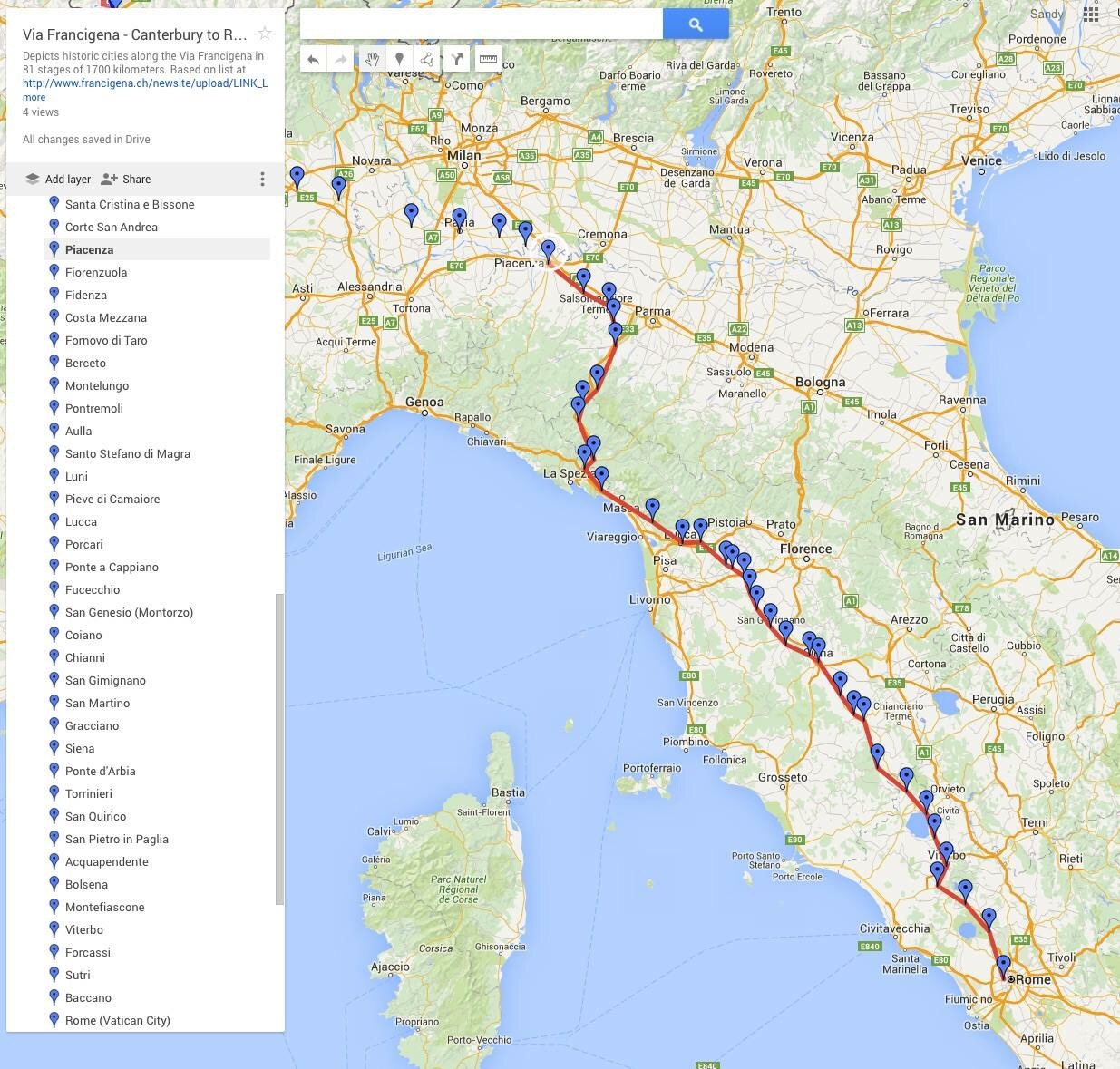
When I say “finally” arrived, that stands not just for the 24 hours of flights and layovers from Orlando here, and not just the three agreeable days spent in New Smyrna Beach, Florida, at the board meeting of our Salud y Paz mission org. It also means I’m finally here after years of knowing about and dreaming about the Via Francigena, the ancient pilgrim route from England through France, Switzerland and Italy on to Rome. With two months before my new job back home, I opted to spend one of them on as much as I could do of one of my dream walks. The whole walk is 1700 km (1050 miles), which would take more time than I can spare, but by my calculations I can do the last 700 km (405 miles) this month. And I’m excited.

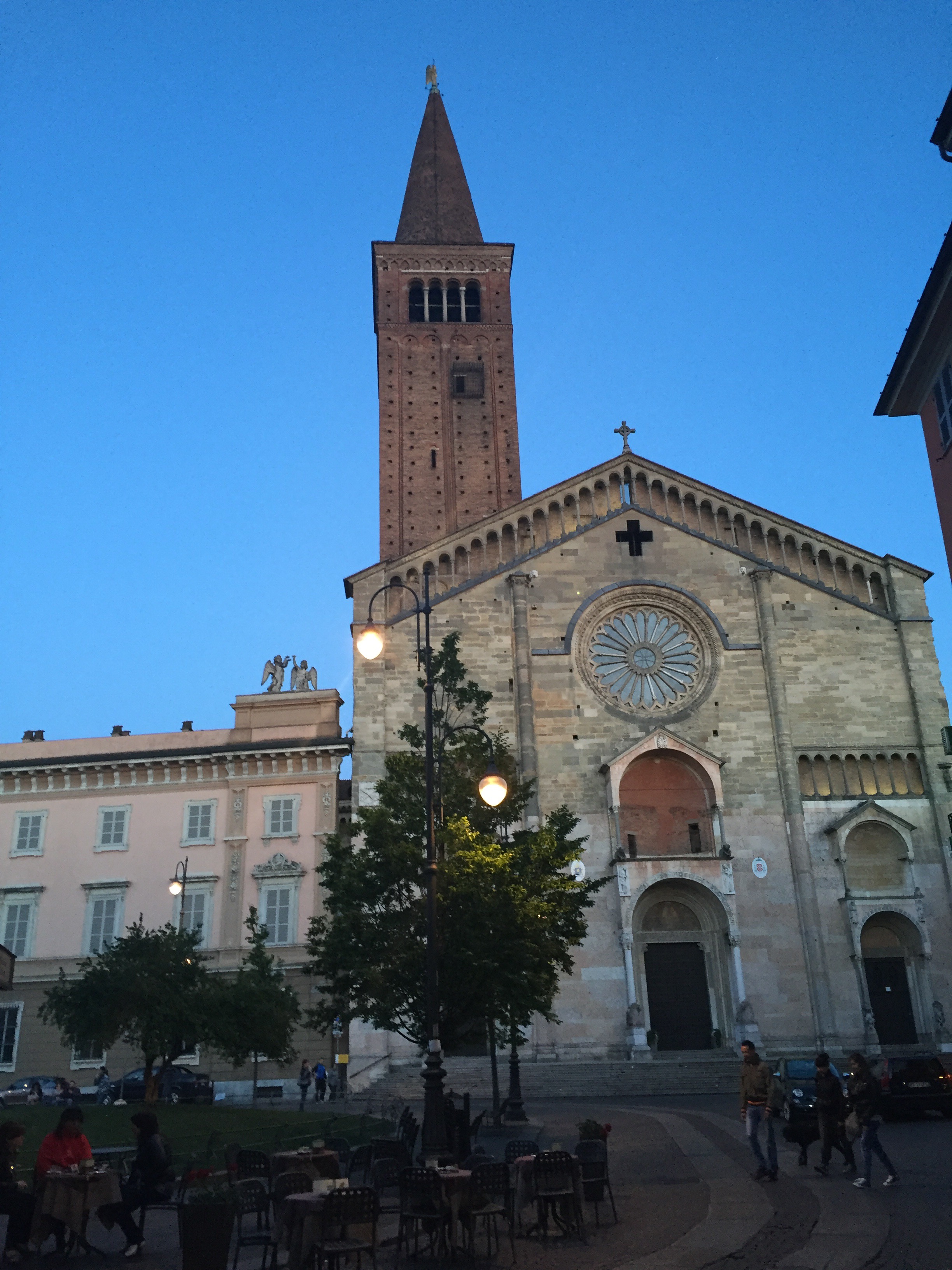
Piacenza’s cathedral after dinner last night.

Today I square away a few things in town. I’ll mail a package, but some food and water for inside my pack, enjoy the sights of this charming and historic town, then Wednesday morning I’ll slip out soon after dawn to feel the trail under my feet again, to watch the dew rise from the fields, to listen for church bells in the distance and hear the quiet lowing of cows and sheep as they begin their days.

I’m truly blessed to be a pilgrim again and with God’s help in 29 days I will rub the foot of Peter’s statue in the mighty basilica that bears his name.

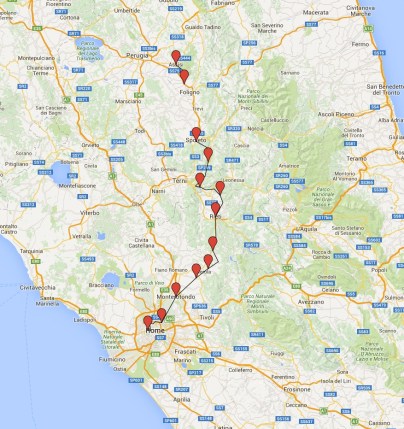
My itinerary — in red.

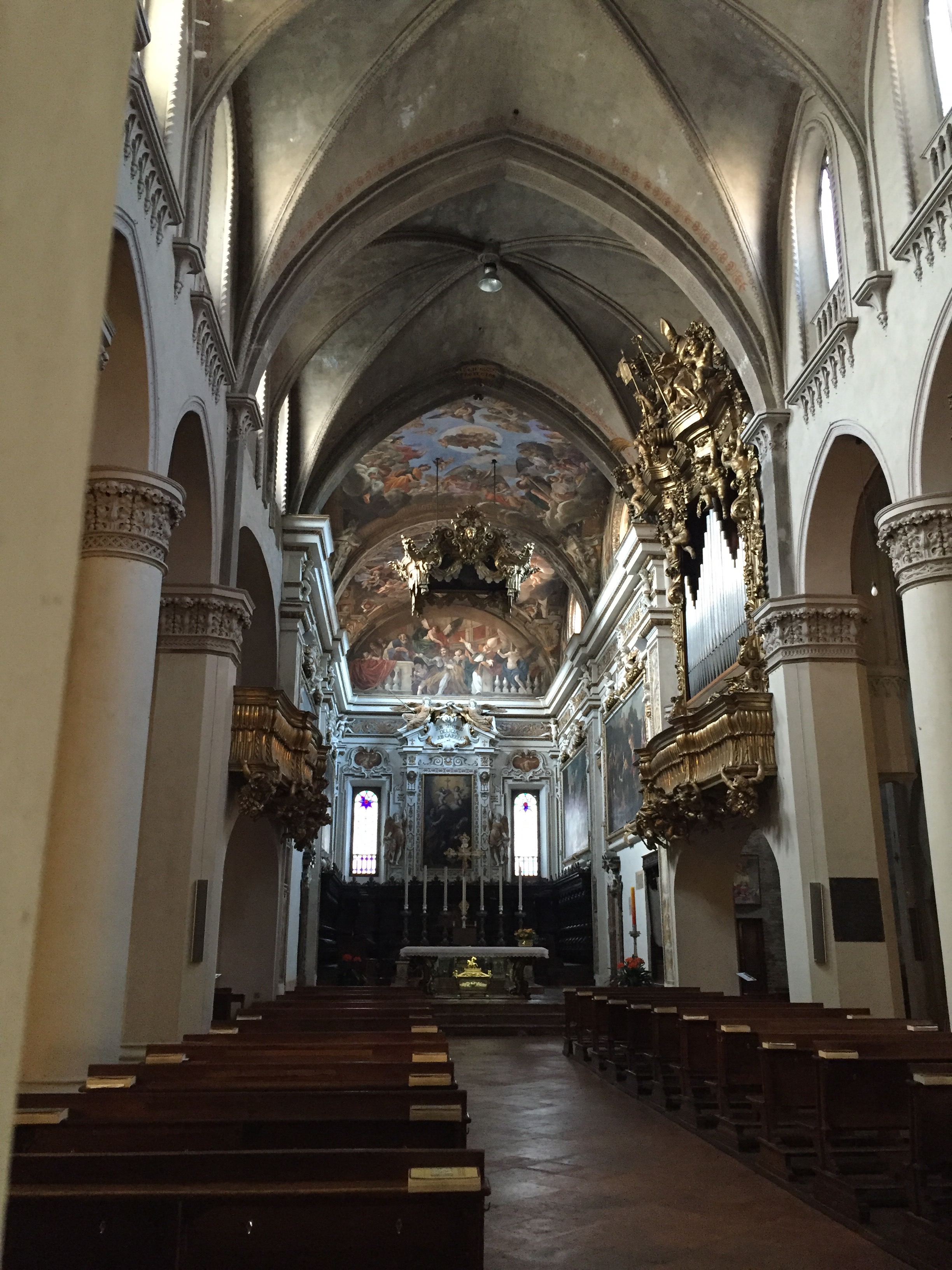
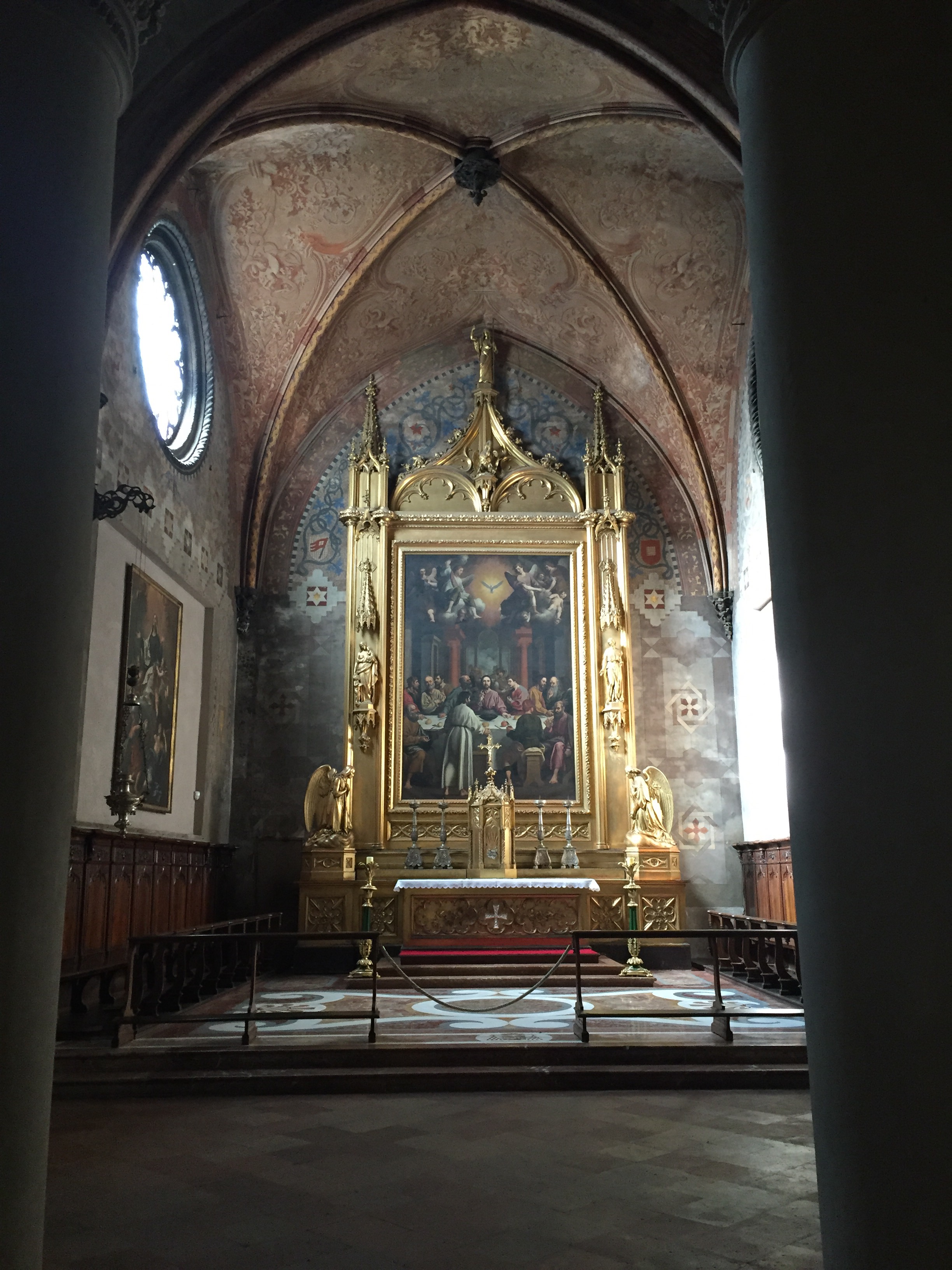
Photos from my day in Piacenza:

An incredibly detailed guide on how to set up and use your GPS on the Via di Francesco

Since putting The Way of St Francis guidebook together and publicizing that free GPX tracks are available for use by pilgrims, I’ve had many requests about how to set up GPS devices and smartphone apps with the GPX tracks. Rather than answer each one individually, I’ve decided to put together this blog post that will hopefully answer most people’s questions.

I should say first, though, that the whole purpose of my guidebook is to ensure you can walk the Via di Francesco without need of either a guide or a GPS unit. I worked hard to make very specific route descriptions, and I’ve double-checked the descriptions to make sure they’re clear and correct. However, you may want the added security of a GPS and I get that. So here’s how to get going.

A hiking GPS is not like the GPS in your car

Maybe most people already know this, but just in case you don’t, having a GPS unit for hiking is a lot different than having one in your car. In the car, once you’ve set your destination a nice voice guides your every turn until you arrive. Not so with a hiking GPS! In the GPS world that function is called “routing” and it’s a feature that doesn’t yet exist yet on the standard hikers’ GPS. Instead, a hiking GPS will simply have a map and a cursor that shows you where you’re at on the map according to GPS satellite coordinates. That’s not particularly useful, because you still don’t know how to get from Point A to Point B.

That’s where tracks come in. A “GPX Track” is A recording (or computerized plotting) of a specific route. While I was walking the Via di Francesco in summer of 2014 I recorded my track, which means that every several meters the GPS unit would automatically plot the latitude and longitude of my location. Then it strings the recorded locations together into a “track.” At the end of the day I would carefully preserve my daily tracks for later use in the putting the book’s maps together and to be able to share with other pilgrims. The tracks are very useful because they allow a walker to see precisely where I walked and follow that on the screen of their GPS or smartphone so they don’t get lost.

Hurray! So, all that’s needed is a GPS or smartphone and the GPX tracks, right?

Not so fast. Your GPS needs a good map to tell you where you are

If you buy an American-made GPS, you should know that it probably has great maps of the United States. Perhaps Canada, too. But if you’re walking the Via di Francesco, you’ll want to have a good map of Central Italy that includes roads, towns, topography and, importantly, hiking trails. That means finding a good hiking map that will work with your Garmin and then downloading onto the unit.

I’ve found that the best GPS hiking maps in Italy are all based on the Open Cycle Map source. When I walked in 2014 I downloaded that onto my GPS and it worked great.

Here’s where smartphone hiking apps have an advantage. Since their purpose is hiking, they often come with preloaded Open Cycle Maps! That’s a big plus, since it saves you the step of downloading the map.

So now you see the basic three steps:

  1. Make sure your unit either has a good hiking map already or download a good map for it.
  2. Download the GPX tracks (here are instructions)
  3. Learn how to use them

Option 1: Garmin GPS: Downloading the map and GPX tracks

Right now, a German website is the best place to find our Open Street Map.

  1. Go to the website: http://freizeitkarte-osm.de
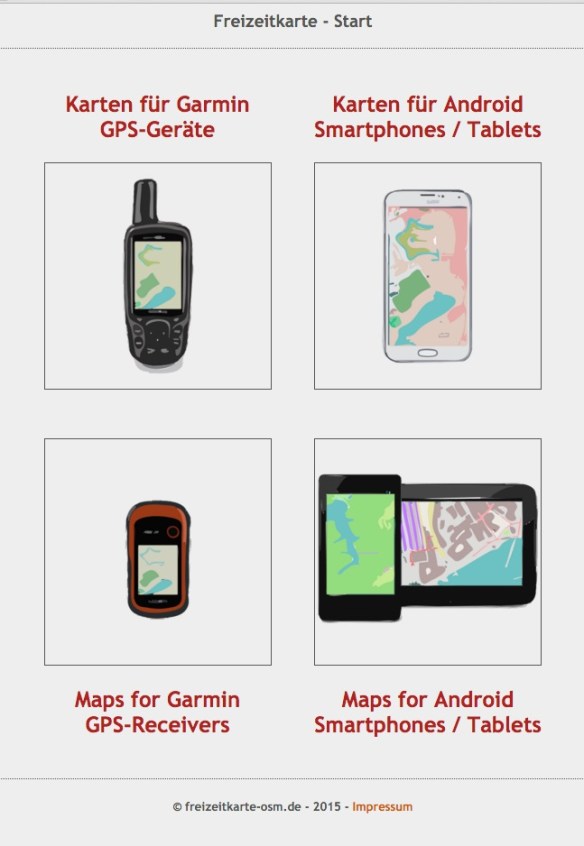
  2. Click on the the option “Maps for Garmin GPS-Receivers”: FreiCartaHomePage
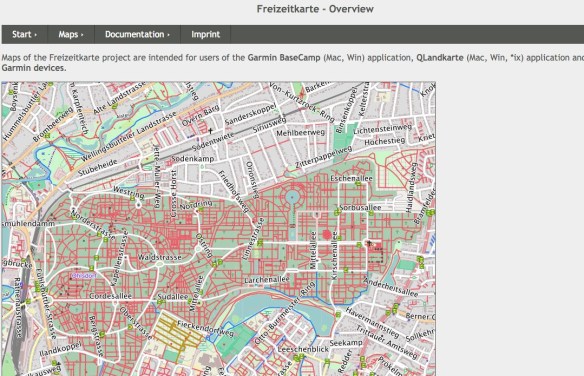
  3. That will give you an overview page that looks like this. FreizeitcartaOverview
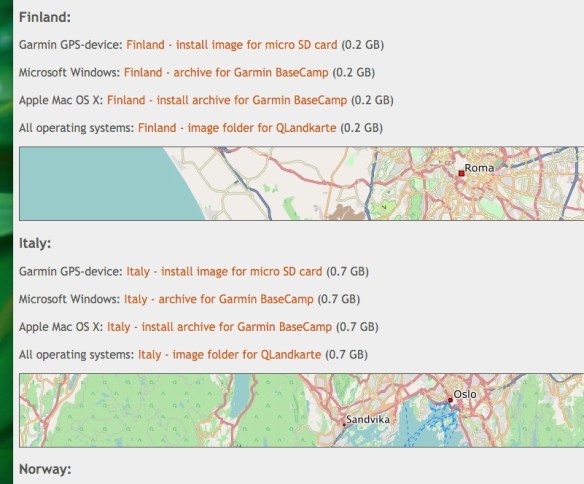
  4. Now click on the “Maps” tab and go down to “Other Maps.” Click on Italy. Going down the list, you’ll find Italy just after Finland right here: FreiZeitCartaItaly
  5. Click on “Garmin GPS-device: Italy-install image for micro SD card (0.7GB). A download to your computer now begins. The result is a file ITA_en_gmappsupp.img.zip. This is an archived file of the map image of all Italy. Once it’s downloaded, click on the file to un-archive it. You end up with a file folder marked “OFM(EU2016_SE_GPS” or similar. Open that file and look for the large file labeled “gmapsupp.img.” That’s our map!
  6. Now, plug your Garmin into your computer using the USB cable. Choose the option “Mass Storage” on the Garmin device. The Garmin is now like a flash drive — it shows up among devices in your file directory and is aptly labeled “Garmin.”
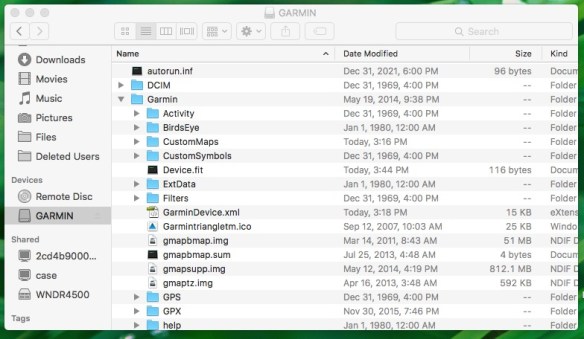
  7. Click on the device. You’ll now see a folder that looks something like this: FinderFolder
  8. Bravo. Now, look for that “gmap.supp.img” file you’ve downloaded onto your computer. Click and drag it into your Garmin. You can see where mine is, and it seems to work just fine there. The Garmin now loads the map into its flash drive.
  9. Once the download is complete. Eject the Garmin from your computer and unplug it. Turn on the unit. Go to “Settings” then “Maps” and look for the Freizeitcarta map. You should see it in the map list. Click there and you’ve got your map!

Great job. All that’s left is to load the GPX tracks. Since you’ve done the map already, the GPX tracks are easy. Just download them onto your computer, plug your Garmin into your computer again, and click and drag them to the file marked GPX in your Garmin. You can access these tracks once they’re downloaded and you’ve ejected and turned on your Garmin by going to “Existing Tracks” in the main desktop.

Option 2: Smartphone App: Using MotionX GPS and downloading the GPX tracks to your iPhone

There are literally dozens of smartphone hiking apps — too many to review — but I’ve focused on MotionX GPS because of its strong user ratings and because it already has the Open Cycle Map as part of its MotionX Terrain setting. MotionX GPS is an iPhone app, so if you’re on the Android platform you should look at something like Gaia or the dozens of other apps out there.

The process of loading GPX tracks on MotionX GPS is also quite simple. Here’s how it works:

  1. Download the GPX tracks you want to use onto your computer.
  2. Attach a GPX track to an email and send it to the email account that is on your iPhone. You should plan to use either the Apple email app or the Gmail email app. This won’t work if you just access your email through Safari on the iPhone.
  3. Open the email app on your iPhoneIMG_8232
  4. Press and hold on the attachment.
  5. Click “Open”IMG_8233
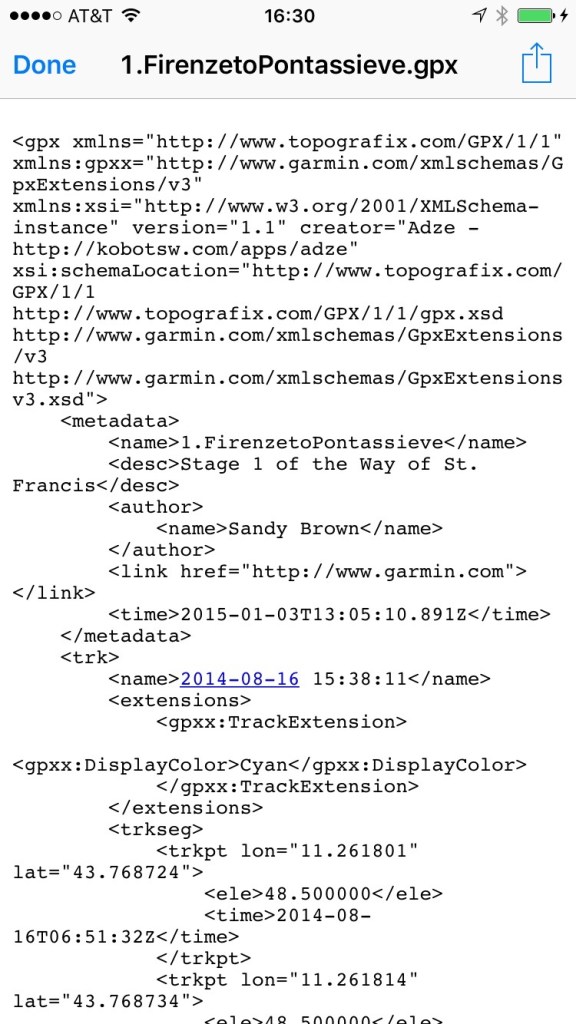
  6. You’ll see a screen of gibberish appear — that’s what the GPX file looks like in text format.IMG_8235
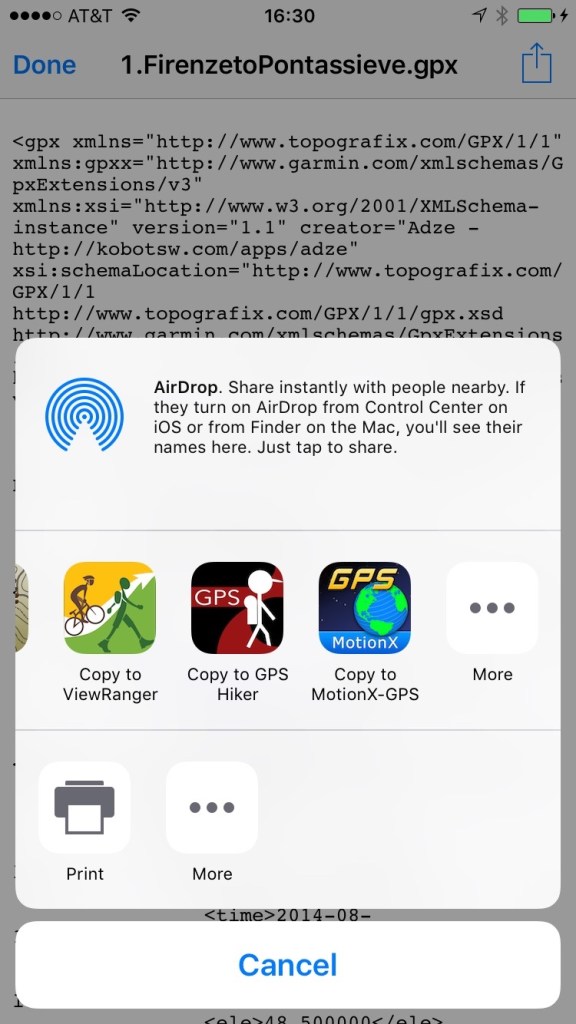
  7. Press and hold on the screen until you see the up arrow button. Click on that
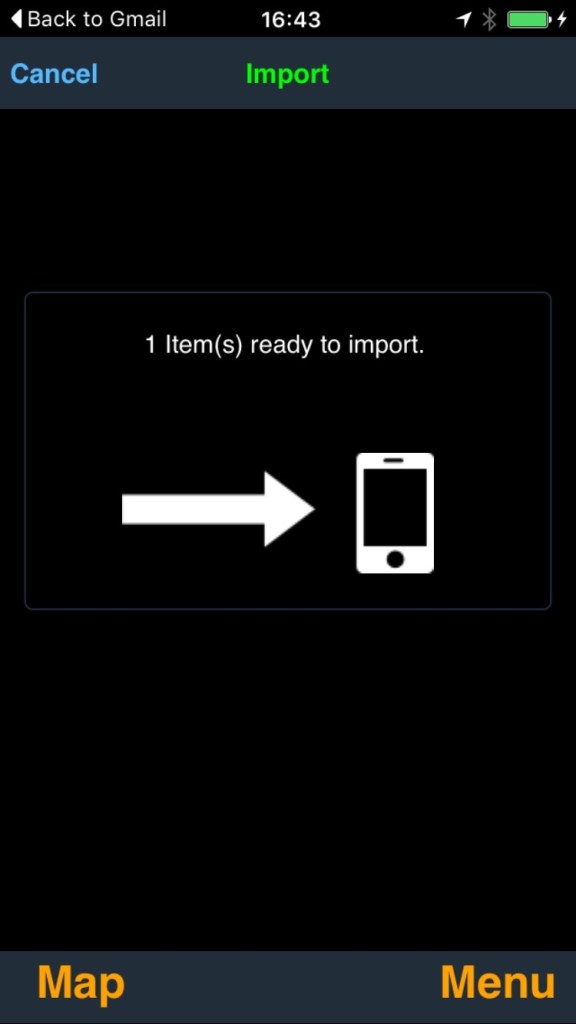
  8. Choose “open in MotionX GPS” and the program will tell you it’s ready to import the GPX track onto your phone. IMG_8236
  9. Click on the word “Import” in green letters.IMG_8238
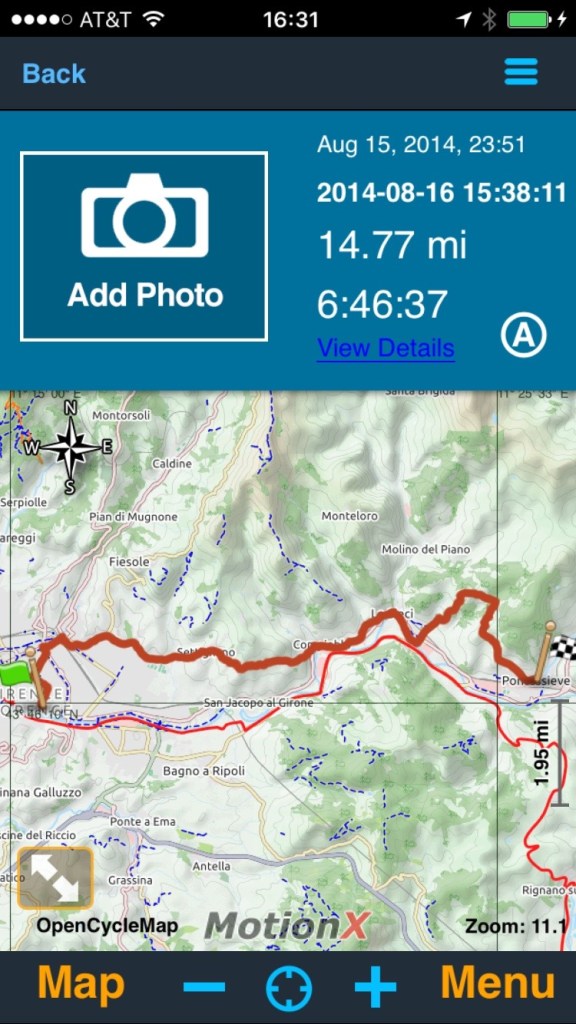
  10. When it’s done, click “Menu” and then “All Tracks.” Identify the track and click on it and you’ll see a map of the track. Here’s the track from Florence to Pontassieve (Stage 1). Voila!IMG_8237
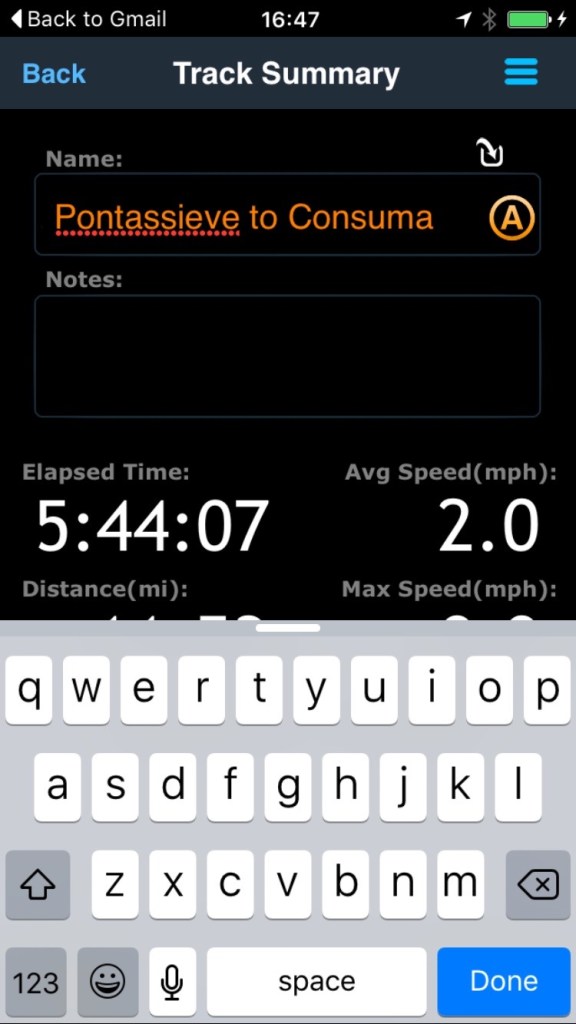
  11. If you’re a neatnik like me and want to keep your tracks organized, click on “View Details” and then type in the name of the track.IMG_8239

It’s also possible to send multiple GPX tracks at the same time, but the process is basically the same.

12. There’s still one more step. Unless you have a great international data plan, you’ll want to download the maps for the stages you plan to walk. Just follow the directions on the phone and do it with a good WiFi connection to save data.

You’re ready to go!

So, that’s the process. What you have now is a screen on your device that shows your  actual position on a map. As you walk you can refer to it as needed so you don’t get lost. One word of caution: these units can drain a lot of battery life. Bring along a power supply of some kind — an external battery, for instance — that you can plug in and juice up your battery when needed. In the case of the smartphone, turn off all unnecessary programs and processes, like WiFi and your cell signal (by putting it in Airplane Mode) and that saves  your battery life.

Questions? Most of this is elementary computer management, so please don’t contact me for computer questions. Find your local computer geek who can walk you through all this using the above directions. Most of all — enjoy!

How to order your Via di Francesco credential

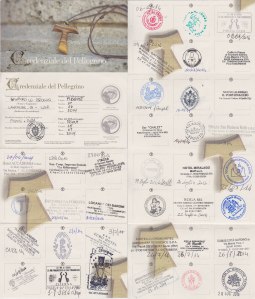
2014Credential

2014 Credential for the Via di Francesco from Florence to Rome

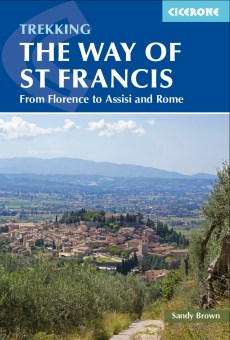
I’ve lately fielded several requests from people about how to secure a pilgrim’s credential for the Via di Francesco. Although I give pretty specific instructions in the guidebook, The Way of St Francis: From Florence to Assisi and Rome, the process has changed slightly and it requires a little Italian and some computer skill to get it just right.

First, what is a credential? Experienced pilgrims (and few others) know that a credential is a pilgrim passport that identifies the pilgrim, allows them to stay overnight in pilgrim-only accommodations, and, if they meet the criteria, to receive a completion certificate at the end of their walk. The pilgrim secures a stamp (tinbro) at or before the start of their walk and then has it stamped each evening at their place of lodging — one stamp per overnight as proof of having walked the previous day.

What credential do we recommend for the Way of St. Francis? There are three main routes to and around Assisi (we won’t go into details here), but the credential of the Via di Francesco is the only one that is officially approved by the Region of Umbria, the Conference of Umbrian Bishops and the Franciscan Family of Orders at Assisi. It’s also the biggest and prettiest, which means a lot since you’ll be lugging it around everywhere you go and it’ll be a keepsake from the walk. So for those and other reasons, this is the best option for walkers along the Way of St Francis.

You should know, too, that your completed Via di Francesco credential qualifies you for a completion certificate — a testimonium — in Assisi or in Rome. A lovely memento of your walk. I should say too that we’re working to make this process much easier. Credentials will be available in Florence soon, but the wheels of change move slowly in Italy!

So, how do you get it now? Here are the easy steps to follow:

  1. Start about two months in advance of your walk. Download the Request Form either right here (RichiestaDellaCredenziale-) .
  2. Print it out — one form per person.
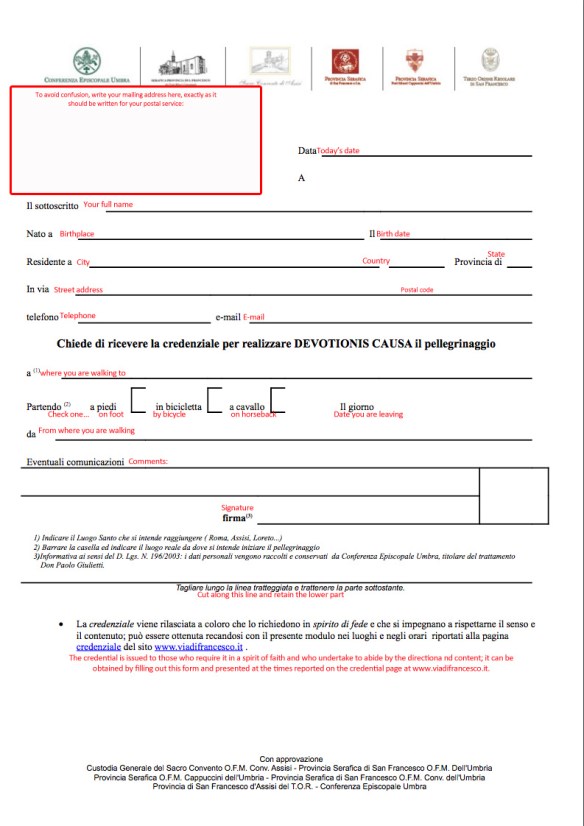
  3. Fill in the form(s). If you’re not an Italian speaker this is where the trouble begins. To help, I’ve created this handy translation of the form below (English in red). I recommend writing your mailing info in the upper left corner in the exact form that will satisfy your country’s postal service.
  4. VdF-Translated Credential2

    Translations in red. I recommend you add your mailing info in the upper left exactly as it should appear on the envelope.

  5. Fill in the form(s). If you’re not an Italian speaker this is where the trouble begins. To help, I’ve created this handy translation of the form at the right (English in red). Don’t forget to add your country and postal code since they’ll need all your mailing info.
  6. Once you’ve filled in the form(s), scan it on your scanner (or take it to FedEx/Kinko’s where they’ll put it on your thumb drive for you.
  7. Email the scanned form(s) to: piccolaccoglienzagubbio@gmail.com. Feel free to write your email in English, no problem. Every week the kind folks there answer emails like this, enroll pilgrims on the official pilgrim register, and send pilgrims all around the world their credentials for free. It’s a beautiful thing.
  8. If you would like to make a donation, the kind folk on the other end of your email will tell you how to transfer funds to their donation account. To initiate that, just write something like, “Can you send me information about how to make a donation to cover the cost of my credential?” They’ll send your their bank transfer numbers, which for security reasons I won’t post here. FYI this is commonly done in the EU and UK, but is rather expensive for people in the US or Australia.
  9. Your credential will arrive in the mail in about 6-7 weeks. The camino overseers there will move Heaven and Earth if necessary to get you your credential in time for your walk.

Also, you can simply pick it up at the pilgrim office in Assisi, if that’s where you’re beginning your walk.

That’s it! I hope this is helpful. Below are some photos of testimonia I received in Assisi and in Rome. Buon cammino!


Our September walk from Assisi to Rome is filling up! Here’s more info (and photos!)

RomePilgrimage2016Map

Map of our pilgrimage trek from Assisi to Rome, September 3-15

I’m thrilled to be offering old and new friends the opportunity to walk with Theresa and me from Assisi to Rome September 3-15 of this year. I’m working with my friend, Bret Thoman of St. Francis Pilgrimages, and we’ve put together a super itinerary for our group. You can download the PDF and registration form here to learn the details. Suffice to say, it will be the walk of a lifetime.

Since our brochure didn’t have enough room to show some of the most amazing photos of the walk I thought I’d post photos to whet your appetite! The pics come from either my 2013 or 2014 hikes. I’ve also added a little text to explain more of what the days’ journeys will be like.

Our Itinerary
IMG_7969

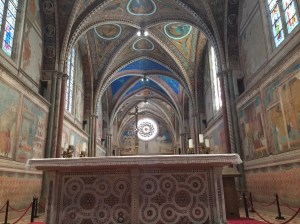
Inside the Basilica di San Francesco in Assisi

September 3: Arrival in Assisi. Meet Theresa and me along with fellow pilgrims at an orientation session in St. Francis’ lovely hometown. There’s a pilgrim mass each evening in the lower Basilica of San Francesco, so we’ll enjoy that before having a fine dinner together inside beautiful and beloved Assisi. If you’d like to explore Assisi a little more, you should plan to arrive a day or two early. We can help you make arrangements to have a guided tour of town, or you can simply walk and discover. Enjoy the churches, museums and castle of the town, or just enjoy the Italian sunshine and amazing views to the valley below.
DSC00217

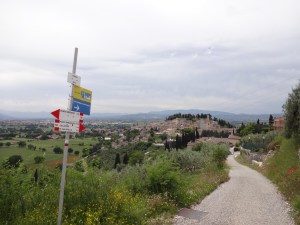
Walking downhill toward Spello

September 4: Assisi to Spello – 11 miles. Spectacular views of the Tiber River Valley greet us as we walk along the slopes of Mount Subasio to beloved Spello, a hill town famous in its own right. On the way we visit Francis’ beloved Carceri Hermitage then relax for lunch or a beverage in Spello. Since the scenery would be very similar for the next two days of the walk, we skip two stages ahead to sophisticated Spoleto, whose historic cathedral holds one of the few handwritten notes of St. Francis (Overnight Spoleto). Option: Avoid the first stiff climb up Subasio with a taxi ride to the Carceri Hermitage where you rejoin the rest of the group.
DSC00375

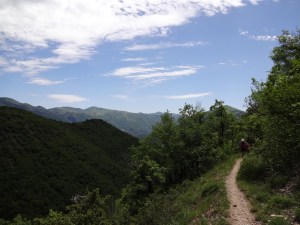
Dramatic landscapes on the way to Macenano from Spoleto

September 5: Spoleto to Macenano – 12.7 miles. Pass Spoleto’s medieval castle and cross its dramatic Ponte delle Torre bridge into a vast forest. A brisk 45-minute climb takes you to the Monteluco Franciscan convent, and then a long downhill wilderness trail leads you along dramatic gorges into the Valnerina recreational area. Freshen up at your hotel in convenient Macenano and walk to a sumptuous dinner at the ancient Abbey of San Pietro in Valle, a gentle 1.5km above Macenano. (Overnight in Macenano)

DSC04553

View from beautiful Labro

September 6: Macenano to Piediluco – 15.5 miles. We walk through farms and pastures to majestic Marmore Falls and serene Lake Piediluco, where St. Francis preached. A climb up to the tiny hill town of Labro gives a peek into life in a medieval village untouched by time. A private van carries you three miles from the shores of Piediluco to the hill town of Labro (Overnight in Labro).

IMG_4369

Sunrise in Poggio Bustone

September 7: Labro to Poggio Bustone – 10.5 miles. We leave behind high pastures and walk up to the St. Francis Birch Tree, where tradition says a beech tree protected St. Francis during a harsh winter storm. Walk downhill through lush forests to the hill town of Poggio Bustone, site of the spiritual transformation that began Francis’ ministry (Overnight in a comfortable Poggio Bustone pilgrim hostel). Poggio Bustone dangles on a steep mountainside and its narrow streets are little changed in centuries.
IMG_4413

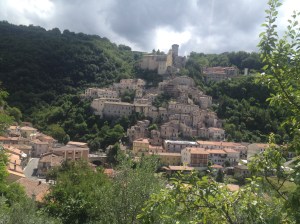
The hidden treasure of Cantalice

September 8: Poggio Bustone to Rieti – 11 miles. — A quiet and green walk through the gorgeous village of Cantalice and then the Franciscan sanctuary of La Foresta where legend attributes a key miracle to St. Francis. The day ends in nearby Rieti, capital of the Sabine olive-growing region of Italy and itself an historic Roman town (Overnight in a Rieti hotel). Theresa and I loved quiet and scenic Cantalice, with its winding alleys and hidden piazzas.

IMG_4444

A rest day in beautiful and scenic Rieti

September 9: Rest Day in Rieti. Central Rieti is a shopper’s paradise, but also has a colorful history since before Roman times. There’s lots to do in this town that is capital of the Sabine olive-growing region, and we’ll stay two nights at a lovely hotel in the heart of Rieti’s old city. The local area is steeped in St. Francis lore, as well, so we’re offering another possibility for those interested:

Option: Rieti/Greccio guided tour. A local expert guides you through the Underground Rieti Salt Road and takes us in a private van to the nearby Franciscan sanctuary of Greccio, the scenic mountainside convent where Francis and local villagers created the first Christmas nativity scene. (Overnight in a Rieti hotel).
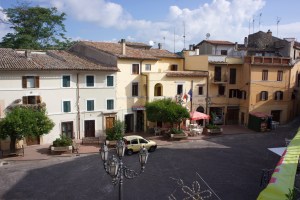
 

DSC04637

Tiny and quaint Poggio San Lorenzo

September 10: Rieti to Poggio San Lorenzo – 13.5 miles. Walk along the Roman Salt Road through quiet farms of the Sabine Region to the tiny, Roman village of Poggio San Lorenzo (Overnight in Poggio San Lorenzo). This is a mostly flat day’s walk and the scenery of woods, farms and olive groves is much different from the previous days’.


DSC04647

Olive groves among the rolling hills after Poggio San Lorenzo

September 11: Poggio San Lorenzo to Ponticelli –14.4 miles. A day of forested ridges, olive groves and sheep pastures with views to castles and quiet villages (Overnight in Ponticelli). The word “undulating” is best to describe the terrain here. With a combination of rocky soil, lots of sun, and regular rain, olive oil from the Sabine area is prized among Italian varieties. Most of the non-agricultural areas are protected forestland, meaning the day’s walk is quiet and far from automobile traffic.

IMG_4515

Orsini Castle dominates the area

September 12: Ponticelli to Montelibretti – 8.2 miles. Forests and olive groves punctuate today’s walk, with constant views of towering Castello Orsini on one of the nearby forested mountaintops (Overnight in Montelibretti). The Orsini family was a powerful, medieval clan of Roman nobles and their castles and secured the Sabine area and reminded visitors of the power of nearby Rome. Today the castle is restored as an opulent hotel, whose grounds include a lovely swimming pool and excellent restaurant.

DSC04701

Olive groves are replaced by wheat fields outside Monterotondo

September 13 Montelibretti to Monterotondo – 10.3 miles. With Rome near, the territory changes to olive groves and vast fields of grain as you walk through the Gattaceca Nature Reserve. In clear weather the first glimpse of St. Peter’s is visible in the far distance. Enjoy an evening stroll (passegiata) through the delightful Old City (Overnight Monterotondo).

180

Outside Monterotondo and less than a day from Rome and still in beautiful green valleys

September 14: Monterotondo to Monte Sacro – 12 miles. After half a day’s walk in the peaceful Marcigliana Nature Reserve you will follow sidewalks into the outskirts of urban Rome (Overnight Monte Sacro). The path carefully avoids the congestion of Italy’s largest city and allows a quiet walk through small and large farms. The transition to the outskirts of Rome is abrupt and for the first time on the trek we walk sidewalks next to busy streets — with ample gelato stores along the way!
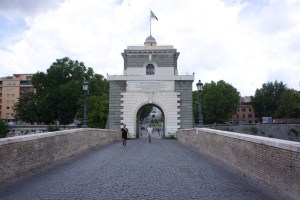
DSC04733

Crossing the Tiber in Rome on the Ponte Milvio

September 15: Monte Sacro to Vatican – 9.5 miles. Though Rome is bustling around, you will share quiet paths with bicyclists and strollers along the Ariane and Tiber riverfronts until rounding a bend in the Tiber at Castel Sant’Angelo for our final entry into glorious Vatican City. It’s the Holy Year and we will have reservations to walk through the Holy Doors of St. Peter’s Basilica. Pilgrims share a final dinner together at a delightful Roman restaurant (Overnight Rome). Will you plan another day or more to enjoy Rome?

We still have a few places available on the trip. I hope you’ll join us for what will certainly be an unforgettable trip!
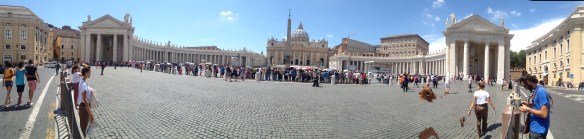
IMG_4647

St. Peter’s Square in iPhone Panorama mode
You’re invited to walk with Theresa and me to Rome this September!

After walking an annual pilgrimage in Europe for the last many years I’ve often been asked by friends, “When are you going to invite others to join you?” Well, the time has come! I’m inviting you to join me September 3-16 in a beautiful and holy walking pilgrimage from Assisi to the Eternal City of Rome! I’m hosting the tour, will walk it with you each step of the way, and am delighted to have the help and support of St. Francis Pilgrimages to make the ground arrangements and support our group. Since this year has been declared the Jubilee Year of Mercy it’s an especially meaningful year to be a pilgrim to Rome!

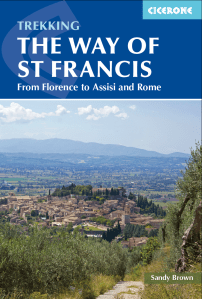
St Francis draft coverThis walk is very dear to me. I travelled it first with friends in 2013 and had a total blast. Jacqueline, Sebastian, Andreas and I explored the relatively undeveloped route with little help from guidebooks, which led to a contract with Cicerone Press to write a guidebook. I returned to the walk in 2014, armed with Italian language lessons, a friend’s camera, a new GPS given me by my church, a laptop, and a dictation app for my iPhone. Then my beloved Theresa Elliott joined me from Spoleto to Rome.
While I was in Italy I made some great friends among local pilgrimage supporters, including leaders of Sviluppumbria, which promotes economic vitality in the Region of Umbria. Led by Chiara dall’Aglio, Sviluppumbria sponsored a book launch on November 5 of last year in London. Since then, my guidebook, The Way of St. Francis: From Florence to Assisi and Rome has received great reviews and sets the bar as the first English language guide covering the entirety of this amazing pilgrimage trail.

Something that would make this path even more special would be to share it with you. Here’s how it would work: we meet in Assisi, enjoy an evening of exploration and then come together for the pilgrim mass in the Basilica of San Francesco. The next morning we walk up St. Francis’ beloved Mount Subasio, enjoying spectacular views of the Tiber River Valley below. We finish the day in the medieval village of Spello before taking our van 50km south to the lively and cosmopolitan town of Spoleto.

RomePilgrimage2016Map

Our pilgrimage route – from Assisi to Rome

We enjoy an evening in delightful Spoleto and the next morning head across the ancient Bridge of the Towers to the Franciscan convent of Monteluco. Overlooking a dramatic gorge along the way, before long we cross into the Nera River Valley nature preserve, staying in the tiny village of Macenano. The following day it is up to the Marmore Falls, followed by serene Lake Piediluco, and then an overnight in picturesque Labro. We walk to the remote and peaceful Birch Tree of St Francis, then on to Poggio Bustone, site of Francis’ spiritual transformation. We rest in Rieti, then begin the final days in our walk to the Eternal City. Our time ends with our arrival in Rome and application for our official Pilgrim Testimonium, a certificate of completion granted by the Vatican to all, like us, who have walked more than 100 kilometers to get there. Here’s our route on Google Maps. Oh, and I forgot to mention that we will walk through the Holy Doors at St. Peter’s Basilica, open only in Jubilee years like this one.

12208264_10206956301419224_4998568863205843862_n

Theresa and I at the London book launch on November 5, 2015

Amazing! Of course there are also some costs for this walk of a lifetime. It’s important that all participants be strong walkers since we will frequently walk on mountainous trails, occasionally with difficult footing. That means training and advance work to be certain we’re able. A good pair of hiking boots or shoes is essential. We walk rain or shine, so a well-equipped backpack with rain gear is a must. Of course there is the financial cost, too. It’s $2,150 for the ground portion of the trip, which includes all hotels, breakfasts and dinners each day of our journey. We’ll also send you a free copy of my book and will work individually with you to assure you are prepared for the journey.

We will need eight pilgrims to make this happen. I hope you will be one of our band of trekkers! Oh, and did I mention that Theresa will be joining us, too? Another of the many great reasons to come along!

If you’re ready to join in this unforgettable journey, please download and return the AssisitoRomewithSandyBrownRegistrationFlyer. Any questions? Feel free to write a comment and I’ll get right back to you. Thank you, and buon cammino!


2015 Updates complete for The Way of St Francis guidebook

Here's my itinerary - by car and train - to update the Way of St Francis guidebook this month.

Here’s my itinerary – by car and train – to update the Way of St Francis guidebook this month.

I’m just back after spending three weeks (Nov 18-Dec 8) researching updates to The Way of St Francis: From Florence to Assisi and Rome. It was great fun to retrace my 2013 and 2014 footsteps, but this time with a car. During the three weeks I revisited almost every town on the itinerary as well as several important Franciscan sites I hadn’t had the opportunity yet to visit, such as Montecasale, Greccio, Fonte Colombo and Montefalco.

The result is a link on the Cicerone website update page that includes helpful new information on several parts of the walk:

  • Introduction to Florence – more info on visiting the Basilica of Santa Croce
  • Stage 2: Consuma – lodging update
  • Stage 6: Santuario della Verna – more information on pilgrim accommodation
  • Stage 8: Pieve Santo Stefano – Montecasale update
  • Stage 10: Entry update to Citta di Castello
  • Stage 12: Gubbio – additional visit info
  • Stage 13: Biscina – new hostel for pilgrims!
  • Stage 15: Assisi – scheduling information, pilgrim office info
  • Stage 17: Foligno – new accommodation
  • Stage 18: New entry info to Spoleto, including revised GPX track
  • Stage 21: New entry to Piediluco, including revised GPX track
  • Stage 22: Clarification after Labro, clarified approach to Poggio Bustone and new GPX track
  • Stage 23: Rieti – new accommodation
  • Stage 24: Poggio San Lorenzo – new accommodation, including info on a convent and hostel
  • Stage 25: Ponticelli – new agriturismo
  • Stage 26: Montelibretti – new accommodation; Monterotondo – new accommodation information at the Duomo
  • Stage 27: Monte Sacro – new accommodation

Ideally, people will access the update page and carefully replace old information with new before taking the walk. Here’s a direct link to the new info also: WayofStFrancis2015updates (pdf).

As always, many people contributed to supply information, including Gigi Bettin, Salvatore Accardi, Rita Giovanelli and  others. Also, it was great to meet up with friends like Feliciano, Alec, my language teachers at Comitato Linguistico and Graziella. I enjoyed making new friends, too, like Jorge Fernandez and Simone Minelli. And as always Jacqueline Zeindlinger had important suggestions. Thanks, all, for your help!


An Italian sojourn to update “The Way of St. Francis”

After the book launch in London on November 5, Theresa, Madison and I headed to France for a holiday. On the 18th I put them on a plane at Charles DeGaulle airport and headed down to Italy to research updates for The Way of St Francis and check in with Italian friends. As I write, I’m in an Airbnb apartment near Castel Ritaldi, more or less near Trevi, and am nearing the end of my work.

Here are a couple things I’ve learned about the Via di Francesco while here in Italy:

  • More pilgrims are walking this trail — Everyone agrees that they’re seeing more pilgrims. Simone Minelli in Gubbio counted over 2,500 helped by his organization this year. Feliciano in Poggio Bustone himself housed over 1,500 pilgrims. That’s great news for the trail. More pilgrims means more infrastructure as people come to recognize it for the delight it is. According to Feliciano, it is mostly German, Dutch, Austrian and French pilgrims. Just a few Americans and no English. Let’s fix that!
  • Signage is improving — The Region of Lazio has made an investment in new signs, and according to Gigi Bettin Umbria is not far behind. Today I saw sparkling new signs pointing the way along the Holy Valley of Rieti walk, now being identified by Lazio as part of the “Via Francigena di San Francesco” and “Via di Roma” group. In a couple of days I’ll investigate whether trail maintenance has improved south of Rieti.

St Francis draft cover.jpgMy book updates will soon be posted to the Cicerone update site. So far I’ve put together a new and improved description of the approach to Poggio Bustone, recorded the new entry to Piediluco, updated accommodation for Consuma, Santuario della Verna, Sansepolcro, Foligno, Ponticelli, Montelibretti and Monte Sacro.

In between updates I’ve rented a car and explored a bit, something that’s not so easy when you’re on foot as I’ve always been while on pilgrimage. So I’ve now added some Franciscan sites to my repertoire, including Montecasale, Montefalco, Greccio and Fonte Colombo. With those done, I’m pretty sure I’ve now visited all the major St Francis sites in Italy.

It was great to see friends like Alec who hosted me overnight in 2014. I checked in with Chiara, Gigi and Beatrice in Perugia and while there had a chance to visit Comitato Linguistico (my language school) and my house mother, Graziella and her son, Luigi. I really enjoyed meeting Bret and Catia and their two kids in Loreto for an American Thanksgiving dinner.

I also connected with the people of Italy Magazine who’ve agreed to publish a couple of articles from me in the next months. I’m about halfway done with research on two articles and I have an idea for a third, so some writing to do yet.

The best part of this trip, though, has been getting to see some of the friends I’ve made over these couple of years of visiting and writing in Italy. I’ve put together a slideshow below of people and places I’ve seen so far. Just one week left in Italy, then it’s back to Seattle. I love this place, but I miss Theresa, my boys and my home town.

Book launch in London brings Italy, UK and America together to promote the Via di Francesco

Presenting The Way of St. Francis at its launch party in London, 5 Nov 2015

Presenting The Way of St. Francis at its launch party in London, 5 Nov 2015

Late Tuesday night, November 3, Theresa, Madison and I jumped on a plane to London to join in the book launch for The Way of St. Francis. After a long flight via Chicago and a short night in our London hostel I dragged myself out of bed and onto the Tube to do a quick drive-time radio interview with Premier Christian Radio. Then it was off to the book launch with Stefan Karol of Karol Marketing who was handling the event.

Radio interview for Premier Radio's drive-time show.

Radio interview for Premier Radio’s drive-time show.

We arrived early and after a cup of coffee at a nearby Starbucks (it’s hard to actually leave Seattle), we headed to Foyles Bookshop, which turned out to be a perfect venue for the event. Atop five floors of books is an ample conference room, looking out through a glass wall to a comfy bookstore cafe a half-story below.

While Stefan’s staffers helped Foyles set up the room I peeked out toward the bookstore’s cafe and was delighted to see the arrival of the Italian contingent of Gigi Bettin, Chiara dall’Aglio, Beatrice Morlunghi, and Bishop Paulo Giulietti. I’d never met Beatrice, who was instrumental in arranging the event, and it had been 17 months since I’d seen Gigi, Chiara and now-bishop Giulietti, so we exchanged many hugs and lots of laughter and joy.

The event would not have happened without the strong support of Chiara, head of marketing for Sviluppumbria, the economic development agency of the Region of Umbria, Italy. Sviluppumbria sees the Via di Francesco pilgrimage route as an important program that will drive tourists and visitors to Umbria. Chiara, Gigi and I had met over Proseco one afternoon in the summer of 2014 in the old town of Perugia while I was researching the guidebook. Gigi had already been helpful in consulting with me on its itinerary, and Chiara immediately climbed aboard the project, saying that afternoon to Gigi and me, “Let’s help market this.” True to her word, Chiara set up the entire launch, made possible with Svilluppumbria sponsorship, and planned it to work with my schedule and to coincide with the Nov 2-5 World Travel Market in London.

It’s hard to imagine a better event.

From left, Gigi Bettin, Chiara dall'Aglio, Beatrice Morlunghi and the Very Rev. Paulo Giulietti.

From left, Gigi Bettin, Chiara dall’Aglio, Beatrice Morlunghi and the Very Rev. Paulo Giulietti.

After my reunion with the Italians, Jonathan and Lesley Williams of Cicerone Press arrived. Jonathan is publisher and overseer of the print project, and Lesley is marketing director of the family-owned company that now boasts over 350 guidebooks covering outstanding hikes, treks, climbs and pilgrimages around the world. Jonathan had given The Way of St Francis the green light back in December 2013, nearly two years ago, and Lesley had overseen the UK participation in the event, working with the Italians and the UK pubic relations team to ensure its success. With their arrival we were ready to begin.

By 11:00 a group of 60-70 journalists and student journalists had arrived in the upstairs conference room that by now was set up with display banners, gift bags stuffed with Umbrian delights, a video screen and projector, and ample copies of the book. Jonathan introduced Cicerone Press and the book, I spoke for 30 minutes about the Via di Francesco and the book project, then I was followed by Mauro Agostini of Sviluppumbria and finally by Don Paulo Giulietti, who oversees the consortium of public, private and religious organizations that run the Via di Francesco. Afterward I answered press questions and signed complementary copies of the book for attendees.

Slide detailing distance, regions, stages and sections of the Way of St Francis (Via di Francesco)

Slide detailing distance, regions, stages and sections of the Way of St Francis (Via di Francesco)

After the launch, Theresa, Madison and I were treated to lunch by Jonathan and Lesley. Then Theresa and Madison, exhausted from the flights, headed back to the hostel for a rest before dinner. I took a quick walk to Trafalgar Square to catch some air (and try to remain awake) then met Jonathan and Lesley again to discuss the book over drinks with leaders of the British Confraternity of St. James, the organization that supports pilgrims walking the Camino de Santiago de Compostela. Gosia Brykczynska, Sheila and Russell McGuirk and Alyson Raju joined us for a lively discussion. Sheila, Russell and Gosia had walked from Assisi to Rome last year, so they were thrilled to share their experiences. I asked many questions about details of their walk and they later sent notes with accommodation information — one of the important aspects of ongoing research about this still-developing pilgrimage.

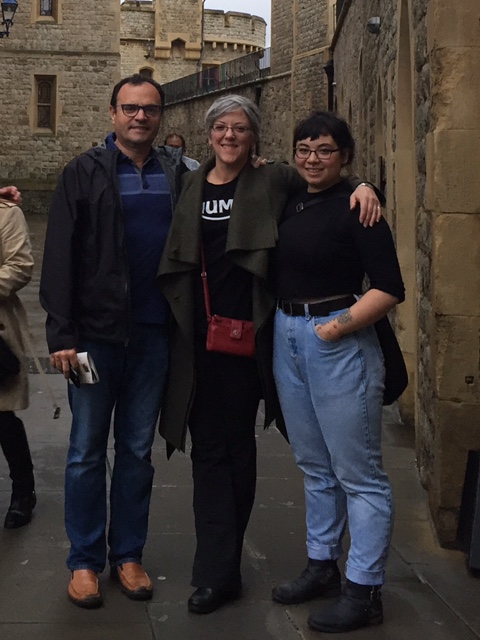
Sandy-Brown-Theresa-Elliott-Madison-Dizon-Tower-London

Theresa, Madison and I tour the Tower of London the next day.

A now-rested Theresa and Madison rejoined Jonathan, Lesley and me, along with their daughter Maddie, over a delicious dinner at the Pig and Goose Restaurant atop The George Pub in the Blackfriars neighborhood. By the time dinner was over I was beginning to fade — too many flights, interviews, talks and walks. I went to sleep, though, knowing that the book had received a serious and splashy launch and was well on its way to becoming known as a worthy and welcome guide for pilgrims on the Via di Francesco.

Heading into the weekend, Theresa, Madison and I would welcome my camino friends — Sebastian, Martin and Jacqueline — for a tour of London sights. We all welcome the opportunity to relax and enjoy life a little after a whirlwind book launch.

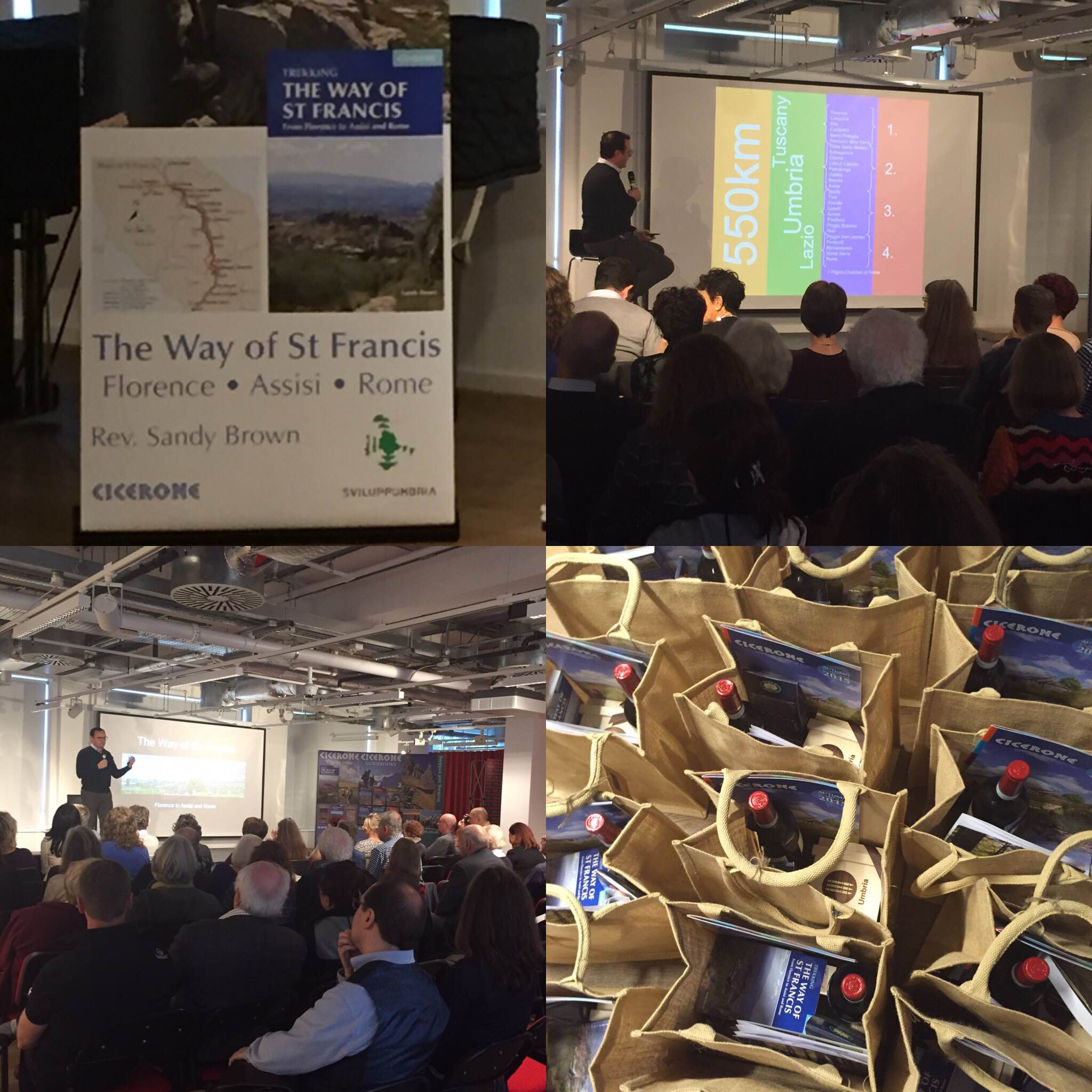
sandy-brown-way-st-francis

Clockwise from upper left: Banner for the event; me with the overview slide; gift bags with wine, complementary book and Umbria delights; me introducing the book.