Unknown's avatar

About Sandy Brown

Pilgrim trek writer and guide from Seattle USA living in Lucca, Italy. See more at www.sandybrownbooks.com

Which Way to Witch Way?

To find the Via delle Streghe (Way of the Witches), just go behind the  freestanding sign, then under the Ristorante La Taverna sign. Look for #13.

My Perugia room is on the Way of the Witches. Just go behind the freestanding sign, then under the Ristorante La Taverna sign. Look for the unluckiest number you can think of if you’d like to find the apartment where I’m staying. Ring the bell and you may find me here. (The black line in the middle is a sign that the photographer was too lazy to stand up and move around the narrow rope holding down the sun umbrella adjacent to his lunch table.)

I was sad to say goodbye to my gracious host, Alec, and his lovely guest house this morning, but it was time to head to Perugia and find my new abode. Months ago when I chose to study at Comitato Linguistico in Perugia, I knew I’d want to live with an Italian family rather than find a simple (i.e. lonely) studio apartment. The goal was to get as complete an immersion into Italy as possible, and everyone seemed to agree that living with a family is the best means to that end.

After driving to the Perugia Airport to drop off my rental car I took another €30 cab, this time into the heart of Perugia. The day was very sunny, and as the cab driver zipped through the Perugia suburbs I knew right away I would enjoy this town. He drove me to the top of the hill, just a few blocks from the cathedral, at the foot of the pedestrian mall, dropping me at the start of Via Luigi Bonazzi, the pedestrian mall at the center of the old city.

First impression of central Perugia: sweet. The city is mouldering in a charming way, like most Italian towns. The buildings are of stone or plaster-covered stone and where the plaster is painted it is stained, faded or peeling. The pedestrian mall has a Sunday flea market on one end and in the length going to the cathedral is dotted with the shaded, outdoor eating areas of a dozen or so restaurants. Waiters (no waitresses) stand at the doors of their establishments, ready to help anyone who’d like some food to accompany their people-watching. It’s afternoon, so many of the stores are closed, but clearly the gelato emporiums are open since motorcyclists, carabinieri and grandmothers have cones of the chilly delight in their hands as they walk by.

The cab driver pointed me to the Via delle Streghe, location of my room. I’d looked up the meaning of the street name back in Seattle and had to chuckle when I learned it meant, “The Way of the Witches.” I’ve come a long way from being a Methodist pastor one week to living on Witch Street the next. After finding the street and the doorbell I was to ring at 3:00, I settled down for a noon lunch at a restaurant across the street.
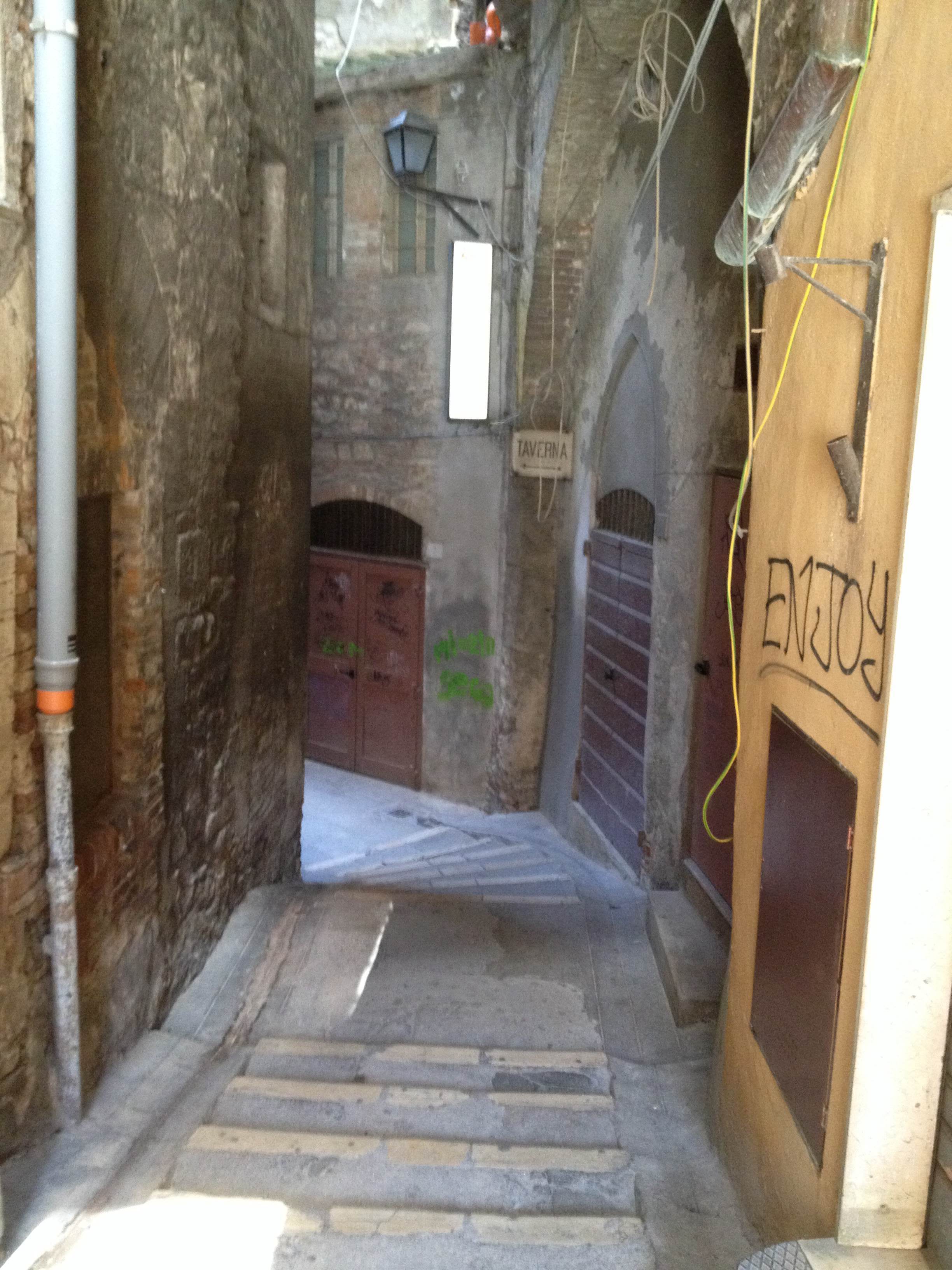
The Way of Witches -- Is it a narrow street or wide stairway?

The Way of Witches — Is it a narrow street or wide stairway? Either way I plan to follow the sage advice of the graffiti artist.

Four twenty-something students from the U.S. sat at the table next to me and I couldn’t help but overhear their conversation — “got drunk last night . . .  woke up with a hangover . . . couldn’t find my cigarettes this morning . . .  that boy’s cute.” While I’m in Perugia will I miss conversation in English? Maybe not.

A little later a group of 30 or so English-speaking students strolled by, with a teacher or tour guide pointing out helpful stores — Vodaphone, the bookstore, etc. Obviously Perugia is earning its reputation as a university town that specializes in teaching foreigners the secrets of the Italian language.

The waiter at the restaurant is nice enough to let me chill out at one of his tables for the 3 hours I’ll need until my room is ready. I enjoy a meal of mixed salad and Margherita pizza as I wait, watching the crowds. Theresa Elliott will be interested to know that there was not one local woman with grey hair who passed by in three hours. Apparently the hair of Italian women comes only in black, brunette and blonde whether they are 18 or 80 years old. They are also smartly dressed on this Sunday-take-a-walk afternoon.

Because they notice a photo I’ve posted of my arrival, I connect on Facebook over lunch with some of the local Italians who work for the Umbrian Tourist Office on the St. Francis camino. Gigi, a young fellow who lives in Assisi looks forward to a meeting later. Chiara, a woman closer to my age, asks if I have plans today. An American pilgrim, Kenneth, is in Assisi now, but we’ll meet while he’s here, preparing for his Franciscan walk.

A comfy room for the next 4 weeks.

A comfy room for the next 4 weeks.

The time to walk the Way of Witches finally arrives, so I ask for the bill and head down the wide stairway to find the house number. It turns out “my” building on the Way of Witches is a mid-1960’s, brick, multi-story apartment house, hidden from view by the much more quaint 16th and 17th century buildings on the pedestrian mall. A modern apartment has some advantages and I ring the bell to the gate with a sense of excitement.

Soon I hear a voice from a balcony above. “Sandy! Four!” and I see a woman I’ll soon know to be Graziella, my hostess, waving four fingers at me. I go through the building door, up a tiny elevator, and find a smiling and gracious Graziella and her former tenant, Katia, awaiting me at the door of a spacious and airy fourth floor apartment.

Graziella shows me to my place, a large bedroom on the back side of the apartment. She then tours me through the bathroom (tub with handheld shower in the Italian style) and describes in detail everything I should know. Sadly, she speaks only Italian so I don’t understand a word she is saying. I respond in Spanish and pretty soon we’re having a rudimentary conversation about me not eating meat and how I like eggs, croissants, coffee and Nutella® for breakfast. I go to the living room and reintroduce myself to Katia, who’s from Finland and speaks very good English. We go through the same details all over again, this time and with Katia’s words I start to understand. Here’s the key, always double lock the front door. Here’s the cat, keep your bedroom door closed. Breakfast is whatever time you want it. Dinner is 8:00ish.

Graziella, left, and Katia.

Graziella, left, and Katia. Witch Way is not named after either of these kind ladies.

We have a few moments for pictures and I take one of Graziella and Katia in the living room. I adjourn to the bedroom and begin to unpack my few possessions into the closet and bureau. I brought several books, but as I unpack I realize how few pants I have, plus just a few t-shirts. Today is Sunday and the stores are closed, but maybe I’ll get a pair of shorts tomorrow. I have a tiny bag of laundry and I make a mental note to learn the Italian word so I can ask Graziella about it later.

I can already tell that this adventure is going to be, well, an adventure. Tomorrow I’ll go to Italian school for the first time and hopefully meet some people. I’ve scoped out the comfortable side chairs near my bed where presumably I’ll do my reading. I spread out my electronics on the desk to start recharging my various batteries. I logged onto the WiFi and, all these things accomplished, I begin to relax, feeling instantly sleepy. These 4:00 mornings can’t last much longer. I need a good night’s sleep and an end to this jet lagginess of the last days.

Later on I’m sure I’ll meet my Facebook friends Gigi, Chiara and perhaps Kenneth. I’m sure other surprises await, but for now I’m glad to have found my new, temporary home so I can dig into this work of studying Italian here on Witch Way.

View from my window, above which street?

View from my window, above which way?
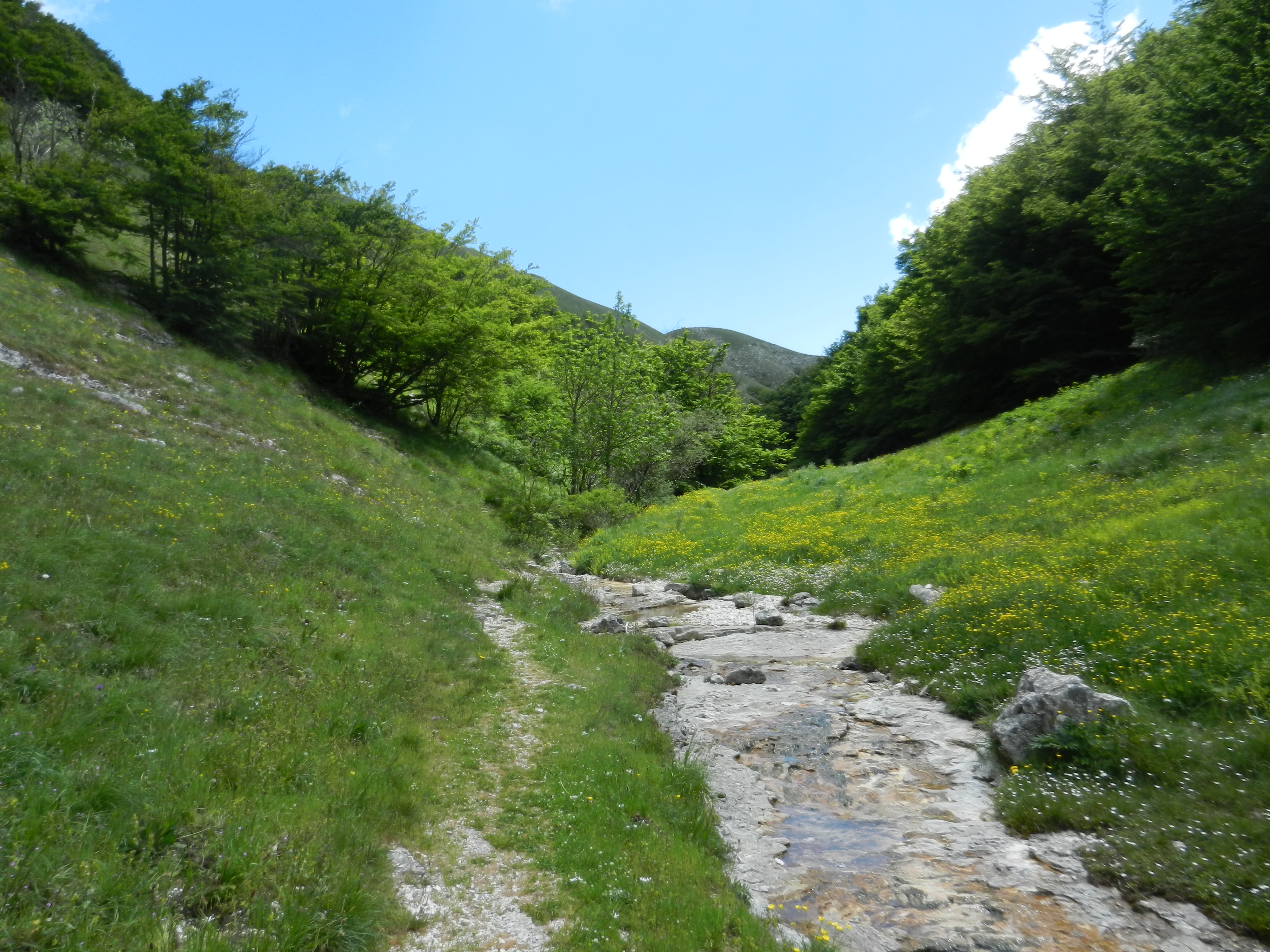
Like a Walk in the Park

Sentiero Italia. Or was it CAI #3? Or #10Bis?

Sentiero Italia. Or was it CAI #3? Or #10Bis?

As soon as I can I’m going to stop waking up at 4:00 in the morning. Although it’s nice to spend a little time over email and also to connect back home where it’s early evening, it’s tough to be awake, hungry, and have to wait four hours for breakfast.

Mirko, left, with John. Today's hiking buddies.

Mirko, left, with John. Today’s hiking buddies.

Such is the hard life of an Ordained Writer (formerly Ordained Minister). This morning I dutifully waited the four hours until breakfast and, when it finally, arrived, was not disappointed in the spread. Mueslix, toast, yogurt, coffee, orange juice, jam. Oddly, no Nutella®, but I’m not complaining. I settled in at the outside breakfast table, with my host, Alec, talking about hiking maps for the local area. Alec mentioned that another guest, John, was planning a day’s hike with a professional local guide and suggested I might want to consider joining them.

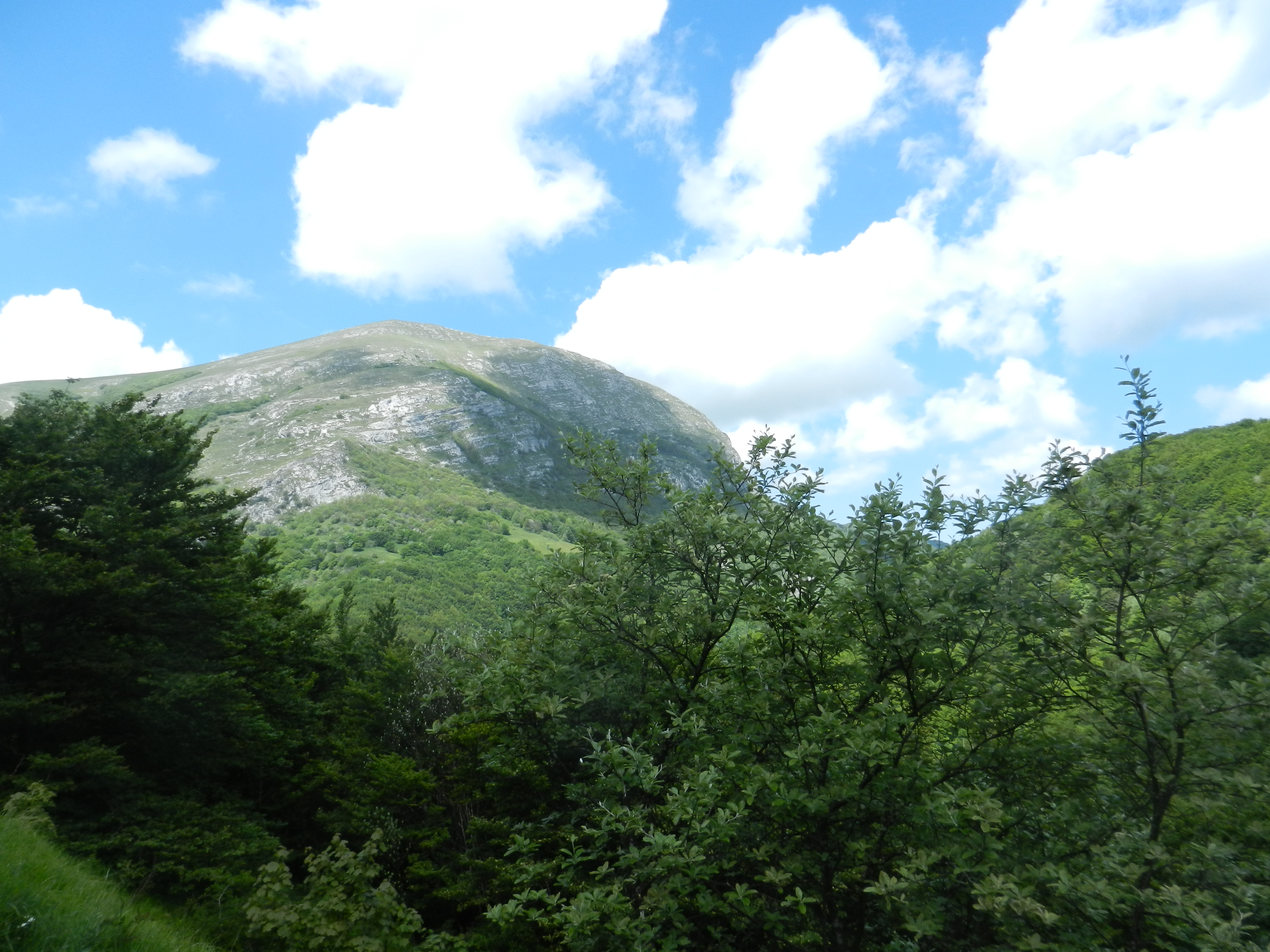
When John arrived he agreed, and the two of us set out for Gubbio where we were to meet our guide. John works in Italy for the U.S. State Department and is on a mini-vacation from his office in Rome. Once in Gubbio we met up with Mirko, our guide. Mirko is a local farmer who trained as a geologist, and to supplement his income he took up guiding. He’s also into spelunking, i.e. exploring caves, and he shared with us that the peak he chose to show us — protected in a nature park — has an old Italian name of Monte Cucco that possibly means “Hollow Mountain” due to the 30 km of caves inside.

From here the mountain does not seem hollow.

From here the mountain does not seem unusually hollow.

We agreed to a 3-4 hour hike and set off on what turned out to be Sentiero Italia. This “Grand Italian Trail” covers 6,166 km as it snakes its way across, up and down the Italian peninsula plus Sicily. For folks from the Western U.S. it would be something like spending time on a portion of the Pacific Crest Trail. Walking on the “S1” gave me a chance to ask Mirko about Italian trail marking, a matter I’d been curious about since last year when I noticed a variety of markings on the Via di San Francesco. According to Mirko, all red and white striped trails are marked by the Club Alpino Italia and numbered by locals based on the trails’ destinations. The Sentiero Italia is the “Interstate Highway” of Italian trails, always marked with the red/white stripes and a black “S1” scrawled in the middle. Mirko described the difficulty of creating maps for the many Italian trails, given the large number and the fact that the trail system in Italy is maintained mostly by volunteers. As we branched off the S1 we walked along Trail #3, #17, and then #10 BIS. The latter is like “10 plus,” according to Mirko, because the trail numberers ran out of numbers and needed to find something between #10 and #11.

Mirko showing how to walk in a limestone creek bed. He also showed us how to fall down a short bank.

Mirko showing how to walk in a limestone creek bed. He also showed us how to fall down a short bank.

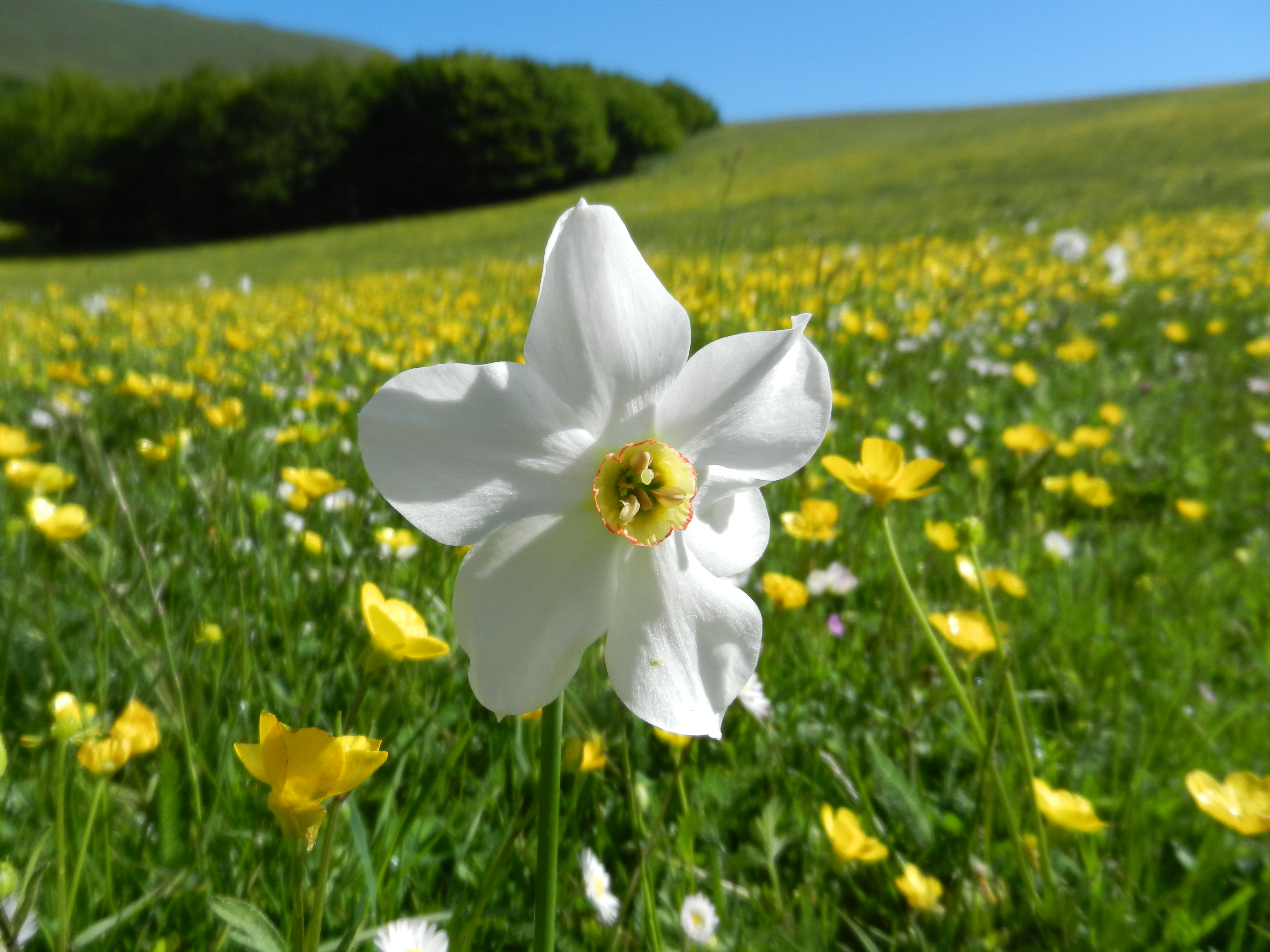
We walked through forests of beech, then along meadows filled with wildflowers. Mirko seemed to know them all. He mentioned to us that he’d recently identified 85 different varieties of orchids within this nature preserve. We walked along a limestone lined creek bed and enjoyed finding tiny worms and leeches in the clear water. Mirko assured us that we could drink the water since its purity was proven by the presence of the tiny squirming creatures. I politely demurred and instead sipped from my clear plastic disposable water bottle.

Mirko was a fine guide, but the economic difficulties of the region were apparent as he showed us the bottoms of his hiking boots. They were worn completely smooth by four years of hiking. I found myself wishing I could help him get a new pair and I worried, with good reason it turned out, that his boots would be slippery in the wrong conditions. Mirko was very earnest, and his geological background and love of plant life showed themselves as he described the sights along the way. Fortunately he wasn’t hurt when he slid a few feet down a damp bank, landing on his backside.

True to his word, the hike ended back at the trailhead in about 3 or 4 hours. Unlike trailheads back home, this Italian one was equipped with a fine restaurant. We enjoyed plates of tagliatelle ai funghi, a local specialty, before heading back to a challenging afternoon of sunbathing by the pool at the guest house. Later I will force myself to enjoy a barbecue and some local wines with the other guests, followed by a viewing of the evening’s promised meteor shower.

Narcissus. At least that's what Mirko said.

Narcissus. At least that’s what Mirko said.

Simple Task: Get to Perugia via Gubbio

May 23 & 24, 2014 — Rome to Gubbio

Yesterday’s taxi fiasco could have been averted by following the simple rule I learned in my first international trip: never agree to a taxi ride in an un-metered taxi without first negotiating the price. If only I’d followed another well-known rule of travel yesterday I would have saved a couple of hours of frustration. The rule? Never step onto a train without knowing for sure where it’s going.

These are on every breakfast table in Italy and each packet is the equivalent of eating two hazelnuts.

These are on every breakfast table in Italy and each packet is the equivalent of eating two hazelnuts!

The day started well and ended well. I awoke early in La Girandola Hotel B&B near the Termini Station in Rome and cruised the Web while waiting for breakfast to be served in the eating area outside my room. This allowed me to research the top cell companies in Italy to see where and how I could get a SIM card for my iPhone. I discovered the TIM company is Italy’s largest cell provider and they have a store right in Termini Station. I also reserved my train ticket to Perugia, where I will get to the airport and pick up a rental car for a ride to the guest house where I’ll relax for a few days before language classes. I also bought my train ticket online — Rome to Foligno to Perugia. Simple.

Breakfast time finally arrived (8:00 a.m. seems late when you wake up at 4:00 a.m.). “Ahh, yes,” I said to myself as I scanned the breakfast table. “Nutella®. I’m back in Italy.” One croissant and “the equivalent of four hazelnuts” later I was off with my bags to Termini. I picked up my new TIM SIM card and 10GB of monthly Internet (so I can use my phone as a hotspot for WiFi when necessary) and grabbed my train tickets from the machine with 45 minutes left to spare before my 9:35 train to Foligno.

Waiting for the train at Termini Station in rainy Rome.

Waiting for the train at Termini Station in rainy Rome.

On the train my mind went back to this same trip last year with Sebastian, my camino friend of 2011. The route is notable for the many tunnels, which themselves are notable for the terrain, which itself is notable for what it means for pilgrims — to walk to Rome requires you walk over all those mountains that the trains go under. Indeed, Sebastian, Jacqueline, Andreas and I had walked those mountains in a quad-building pilgrimage that had taken us to Rome and was the genesis of the book I’d be writing this year.

Two hours later the train arrived in Foligno, a flat, industrial town in the shadow of the Central Apennine range famous for gorgeous hill towns like Spoleto, Spello, Trevi and Assisi. At the station I checked the “Departures” board to see where I’d catch my Perugia train and dutifully went to Line 1 to wait. While I was grazing the glass cabinet of pizza slices and croissants in the adjacent cafe I heard the announcement, “[unintelligble]…[unintelligible]….Perugia….[unintelligible][etc.].” I sprang for the door, ran down the stairs and across to Line 3, jumped on the train, settled in, and immediately realized — it was going the wrong direction.

My first mistake was I hadn’t trusted my own reading of the Departures board. My second mistake was that I hadn’t realized that Italian train announcements always begin with where the train is coming from, rather than where it is going to. Not to mention that I hadn’t even learned any Italian prepositions yet, so I don’t know the difference between da and verso.

With some newfound humility I climbed off the train back at Spoleto and saw on this station’s Departures board that I would have to cool my jets for an extra hour before I could get back to Foligno. Out of curiosity I called a cab to see what the fare would be to end my train adventure and get right to my rental car. The polite cab dispatcher offered the ride for a mere 100 Euros (about $140). An extra hour wait suddenly seemed ok.

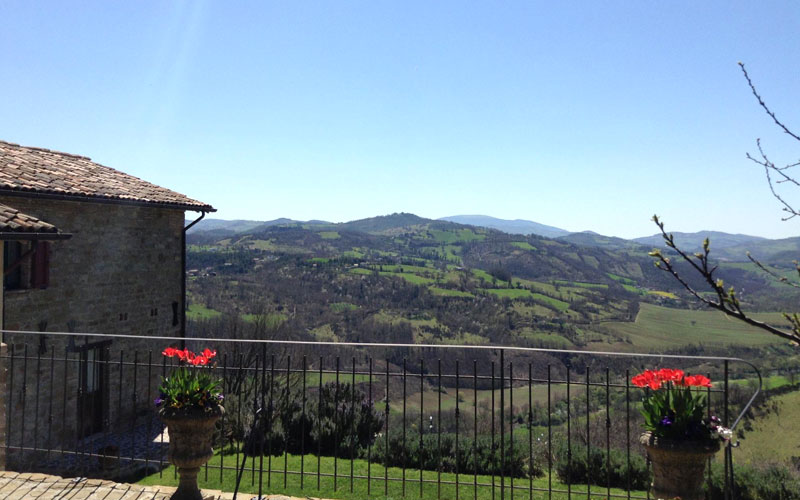
Guesthouse near Gubbio, with views toward Lake Valfabbrica. Gorgeous Umbria.

Guesthouse near Gubbio, with views toward Lake Valfabbrica. Gorgeous Umbria.

At 1:00 I was back on the train to Foligno, then after realizing the Perugia Airport is actually closer to Assisi, I transferred instead to St. Francis’ town, where I caught a 30 Euro cab to the airport. I picked up my rental car, and drove about 45 minutes to my delightful Gubbio guest house — at the end of a 4 km strada bianca (gravel road) with an amazing view of the Val di Chiascia. Highlight of the trip? A stop at a roadside cafe for a croissant — filled with delicious Nutella®. Oh, I also saw one large and beautiful deer I’d startled as I drove down the gravel road, plus a red fox who scampered across the gravel in advance of my tiny, white Citroën C1 rental.

Here in the countryside I’m deprogramming from travel for a couple of quiet days while awaiting the start of Italian classes in Perugia and my home stay there with the Bertolini family. During this green and calm time I’m gathering my thoughts, reading and taking notes from the books I’ve carried from Seattle. My mind is moving from the busy past weeks in Seattle to the upcoming walk I’ll begin after language classes end next month.

Layout of Umbria's Via di Francesco from the www.viadifrancesco.it site

Layout of Umbria’s Via di Francesco from the http://www.viadifrancesco.it site

As I drove yesterday I saw out of the car window the familiar blue and yellow way marks of the Via di San Francesco walk. The walk I’ll write about is all around me here outside of Gubbio. It stretches many miles north into the green hills around Sansepolcro and Santuario Della Verna and south past Assisi and across to the Nera River valley. The area is beautiful, and I’m happy to call it my home for these three months of learning, walking, writing and adventure.


Here are some photos of the lovely agriturismo I stayed at these days:

Emerging from a Self-Induced Travel Coma

As I sat with Don Crawley at Sea-Tac Airport on my way to Italy he said, “Wow, you’ve had a lot going on in your life.” Don’s right, and it’s clear I haven’t had a lot of time to sort through it all. The after-effects of the many changes appeared at different times yesterday.

The most obvious change, of course, was leaving Seattle to go to Italy. My arms felt like they were glued to Theresa as we hugged at the Departures driveway at SeaTac Airport. I didn’t want to let this great woman go. She’s become very important to me since we met on October 31st last year and I’m really not ready to put our relationship on hold with so much yet to discover. This whole Italy plan was hatched before we met and I’m not sure I could’ve passed up a summer with Theresa if I’d known about the possibility as I got the wheels rolling for this Italian guidebook adventure.

With Don at Gate S12 at SeaTac Airport - day of departure.

With Don at Gate S12 at SeaTac Airport – day of departure.

After passing through security, my friend Don Crawley was waiting for me with a cheerful smile. He had noted via Facebook that we’d be at the airport at around the same time — Don going to Los Angeles on business. while I headed to Italy. We sat together over coffee and a pleasant chat while we awaited my plane which would be the first to leave. We began plotting a future rendezvous — Don is cooking up a holiday in France this summer while his wife, Janet, is teaching a class near there and we’ll meet in Florence for a guys’ holiday in the city of Michelangelo.

As we talked, Don may have noted that I had already started to succumb to what I’ve come to call my “travel coma.” My speech starts to slow down, my eyes take on this drowsy look, and my brain begins to operate at partial capacity. It’s something like going into shock after an injury, but a travel coma for me is an odd deadening of senses that somehow helps me deal with the discomforts of being jammed into a small seat for hours at a time while changing time zones, languages, currency and cultures.

Inside the Reykjavik airport.

Inside the Reykjavik airport.

After saying goodbye to Don the coma began to take hold. The flight to Iceland took off at 4:30pm Seattle time and arrived at 5:30am Reykjavik time, but somehow there was never a sunset. Our jet took us north quickly enough that we squeezed dusk and dawn together somewhere above the Arctic Circle. By the time I got to Iceland I’d slept just a touch. I grabbed a sandwich, and orange and some chocolate milk for what I guess was breakfast and then stepped right onto my London flight. The couple next to me must’ve enjoyed watching my head bob up and down as I drifted into and out of sleep in the window seat.

I briefly emerged from my coma as I arrived in London and I realized right at Passport Control that due to the lack of a pen I hadn’t filled in my Arrival Card. I borrowed a pen in line and quickly filled it out with a quick scan and some scribbled responses. Then, when I arrived at the passport desk, the immigration officer asked one of those innocuous but deeply meaningful questions.

“What is your occupation? You left the space blank.”

How could I tell her that I wasn’t sure anymore? I’d just retired after 34 years of ministry as a pastor and was heading to Italy to study Italian and write a guidebook. Not only that, but I hadn’t had time to consider all the consequences and was in a jumble of feelings in the purgatory between the past and present.

“I’m self-employed,” I blurted out.

“Self-employed doing what?” she said in her British accent.

I thought for a long second and then said, “I’m writing a guidebook.”

“OK, you could just put down, ‘writer,'” she said as she filled in my occupation for me and stamped my passport.

And there it is. If anyone asks, I’m a writer. The lady at the desk said so, and I’m not going to argue with her. The vocational transition occurred in a 10-second conversation. Goodbye, pastoring. Hello authoring. The pastoring took four years of seminary, a handful of interviews, psychological testing, much fervent prayer, and the laying on of the hands of two bishops. Becoming a writer took a book contract and the quick decision of an Immigration Officer. Both were conferred on me by others, came after a period of waiting and involved paperwork. So my new vocation sounds official and, at least for now, the appellation will have to do.

IMG_3591

Inside Terminal 5 at Heathrow after being ordained a writer.

After being ordained a writer I stumbled my way between Terminal 1 and Terminal 5 of Heathrow and boarded British Airways for Rome. Following more dozing in the window seat, bathed in the sunlight-that-should-be-nighttime we landed at Fiumicino Airport. Italy at last.

I boarded the train for Termini Station where I’d reserved a B&B for the night and am pretty sure I had a pleasant conversation through the drowsiness of my coma in French, Spanish and English with a retired couple from Montreal in the seats across from me. Then I made my stupid mistake.

I was on the curb outside Termini Station, still partially comatose, when I suddenly realized I didn’t know where my B&B was located. I vaguely remembered it was close to Termini, but without an Italian cell phone plan, my usual guide — Google Maps — was unavailable. A man yelled “Taxi!” and I ignored him, but then impulsively turned around, threw my bags into his car, and told him where I was headed. He took me on a whirlwind drive for about 10 blocks — right back to a point at the train station about 2 blocks from where we’d started. Then he demanded 25 Euros.

Hotel Girandola Bed and Breakfast. Just a block from Termini Station.

Hotel Girandola Bed and Breakfast. Just a block from Termini Station.

I just laughed. Then I said “No,” and handed him a 5 Euro note and some change. He complained loudly in Italian. I smiled and  politely stood my ground — I wasn’t going to pay this scoundrel another cent. After he drove off in a cloud of probable profanity (speaking words I may not learn in my upcoming Italian studies) I wandered a couple of blocks away and found my B&B — right across from the train station, not a block from where I had picked up the cab.

I buzzed the door at the B&B, found my simple, cozy room, had dinner nearby, and headed to bed to sleep off my coma and begin my Italian adventure as a writer. Ciao, Seattle. Bongiorno, Italia.

The Future is Now

CGRLaunch

Answering questions of the press at our launch of The Center for Gun Responsibility last Monday

The last days have been a whirlwind: finishing a list of 42 projects that all had to be done before I could leave, moving all my things (a few into storage and the rest to Theresa’s place), preaching my final sermon at First Church, enjoying a grand retirement celebration, speaking at a press conference for our new non-profit, the Center for Gun Responsibilitysaying goodbye to my now-former roommate, Luke Brown, and preparing my documents, backpack and duffel bag for the big trip to Italy. I leave from Seattle tomorrow and I won’t be back for a few months. In fact, I don’t even have a return ticket yet since I’m not sure exactly how long it’ll take me to research The Way of St. Francis.

The emotions are coming in waves. A wave hit on Sunday as I walked out the door with my robe in hand, knowing I’d preached my last sermon at First Church. It was a tugging in my chest and a brief tear. Then another wave hit as I stood in shorts and t-shirt and said goodbye to the staff in a brief visit to the office today. It was a tightness in my throat and a deep sadness in my heart as turned and walked out the door. Then tonight at dinner with Theresa another wave washed over me. I’ll miss her for almost two months until she joins me in mid-July. I looked across her in the light of the candles she’d lit on her patio table as we shared a last supper. I know tomorrow will be an emotional day as she drives me to the airport and I kiss her goodbye and I say farewell to my Seattle life and become a pilgrim again.

That’s the part that gives me the most joy as I look ahead. Yes, I’ll be a student of the Italian language for the next month in Perugia. Yes, I’ll be an author as I write this guidebook for Cicerone Press. But, yes, I’ll be a pilgrim again. Starting on June 26, after language study in Perugia and a quick trip to see friends in Vienna, I’ll be a pilgrim once more. I’ll walk 600 kilometers from Florence to Rome, arriving around July 31 in the Eternal City.

IMG_3522

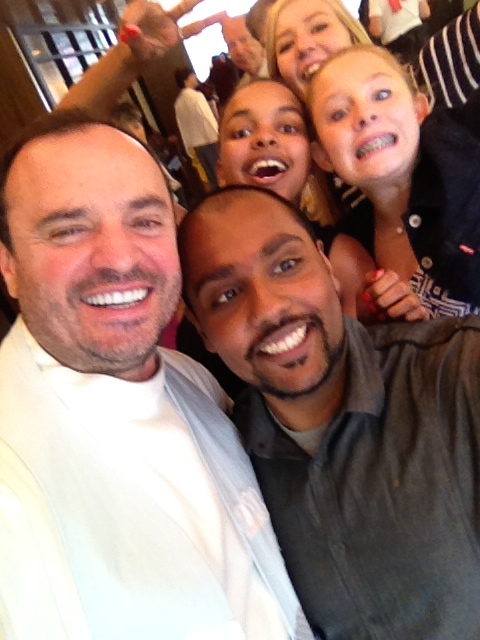
One of many “Selfies with Sandy” from our goodbye festivities over the last weeks at First Church. With Justin Prasad, Reeni Gray and Nadia Gelle.

To be a pilgrim means to travel deliberately and with reverence toward a clear goal. In Spain or Italy I’ve been a pilgrim — for a month every year but one since 2008 — logging over 3000 km on dusty roads, through mountain passes, in rainstorms, in thundershowers and sunshine, with other pilgrims or alone, looking for the saints, sleeping in strange beds or under the stars, eating too little food and drinking too much wine. And I’ve cherished every moment.

I love the rhythm of pilgrim days. Morning light appears out of a strange window above me as I awake in an unfamiliar bed. The road pulls me from warmth and comfort of bed out into the fresh morning. If there’s a cafe there’ll be a slow coffee and a quick croissant. Then an uphill morning. Every morning is uphill, even if the elevation points downward. The first kilometer is cold, then walking warms up my legs and I start to see the day before me. I enter an odd mental and spiritual state between quiet and rapture as I walk, a state that is interrupted only as I look for way marks to assure myself I’m walking the right way. Then lunch — either from the pack or from a restaurant or cafe along the way. Then back to the road as it pulls me downward — the afternoon is always downhill — toward the day’s goal. Then there is a conversation, a bed, some laundry, a meal (again, too much wine) and a blessed night of rest. And then…. repeat. And repeat again. Repeat it three or four dozen times until the grieving begins on the last days when the pilgrimage is nearly complete, which is followed by the grieving that is mixed with joy at the pilgrimage goal, which is followed by the same grieving that begins again after the return home when the feet have stopped aching and the last year’s pilgrimage begins to fade into memory and the next year’s pilgrimage slowly and quietly begins to beckon.

Most pilgrims I know aren’t satisfied with just one pilgrimage. After they’ve tasted the depredations of pilgrim life they beg for more. After a second pilgrimage there’s no happiness until the third. And so it goes.

IMG_3585

These people in body suits just appeared from nowhere

Today between two of my errands I saw another pilgrim — another soul enriched by the joy of walking. I stopped at Starbucks near the stadiums and paused to take photos of a group of people dressed in colorful body suits and dancing in the streets. This sort of thing always happens in Seattle. Anyway, I turned and was stunned to see Ed Tennyson standing there. Ed is another long-distance pilgrim who’s walked the camino many times and who has become a friend and colleague in all things camino over the last few years. He’d walked from his home in West Seattle and was heading to REI — a 20 mile walk round trip. A normal pilgrim day whether he is in town or on camino. We laughed and hugged, he wished me well on my upcoming adventure, and then he turned to continue his walk. As I watched him walk away I realized how I — or rather “we” who bear the name pilgrim — must look to others. A little hunched, a little weary, a little slow, a little contemplative, a little ecstatic.

It’s still a month of language classes away before I actually begin to walk, but I am ready. I am really ready to really walk. It feels right to walk while writing a guidebook for others who will come after. It’s right because I will have to watch carefully and fall in love with it in words and photos and maps. It feels right because it is about sharing this walk with others.

ED&Ellie

Ed Tennyson with wife Ellie on a recent pilgrimage

I know, too, that as I walk I will be doing the pilgrim work of contemplation. It’s been quite the year — separation, moving, divorce, dating, signing a book contract, building a new relationship, retiring, choosing to run for office next year, working hard on important justice topics, rooming with Luke, loving Theresa …… so much. I’m ready to walk, to think, to pray, to write and to be in the new way that God is calling me to be.

I said to Theresa on Sunday afternoon that I felt like I’m stepping into the future right now. “No,” she said. “You can never step into the future. You are always in the present you know.”

“No,” I wish I’d said. “The future is now.”

Starting to pull together many little pieces to form “The Way of St. Francis”

Every day I gain a better appreciation of the challenges an author faces as he or she begins to pull together a book. In particular, I’m coming to appreciate how guidebook authors gather a huge quantity of information and sift it together to create a useful guide.St Francis Walkjpg

Many pieces of information will need to come together for my upcoming book, The Way of St. Francis, due to Cicerone Press at the end of this year. The first is identification of the route itself.

Last year I walked from Assisi to Rome with friends and I loved every step. It was great to see sites related to St. Francis of Assisi, and of course it’s alway fun to walk with fellow pilgrims Sebastian, Jacqueline and Andreas. Beyond our walk form Assisi to Rome, though, as you can see on the map to the left there’s more to the St. Francis walk in Umbria. From Umbria’s perspective the goal is clear — Assisi. The tourist department of Umbria has selected two very specific tracks to the hometown of St. Francis. From the north– starting in Tuscany actually, at Della Verna, a walker can proceed south to Assisi. Walkers can also trek from Rieti to Assisi, approaching it from the south. It makes sense that the Umbria tourist office would focus on walks that stay primarily in Umbria, with Assisi at its heart. St. Francis’ home town attracts over four million tourists each year, after all.

Even with this clear, central track there are choices to be made before I begin my book. In the “northern” route to Assisi the map shows an option. One can either walk to Perugia on the way to Assisi, or straight from Valfabbrica to Assisi, bypassing the capital of Umbria and the many historic and culinary sites in the ancient city, known now as the “Chocolate Capital of Italy” (it’s also a sister city of Seattle!). Choosing to take this option is not a big obstacle, but one choice among many. I’ll walk both routes and make a final decision about including the Perugia option this summer.

A second choice is what to do with the southern loop, which is a circular route through “The Holy Valley” of Rieti, an area filled with important and interesting St. Francis sites. The challenge of a loop through the Holy Valley is obvious — anyone who walks through to Rome only has the choice of one or the other side of the loop. So there’s another minor dilemma to solve. Last year my friends and I walked through Poggio Bustone, the east side of the loop, and weren’t disappointed. It’s a lovely town and important to St. Francis pilgrims.Cathedral in Florence

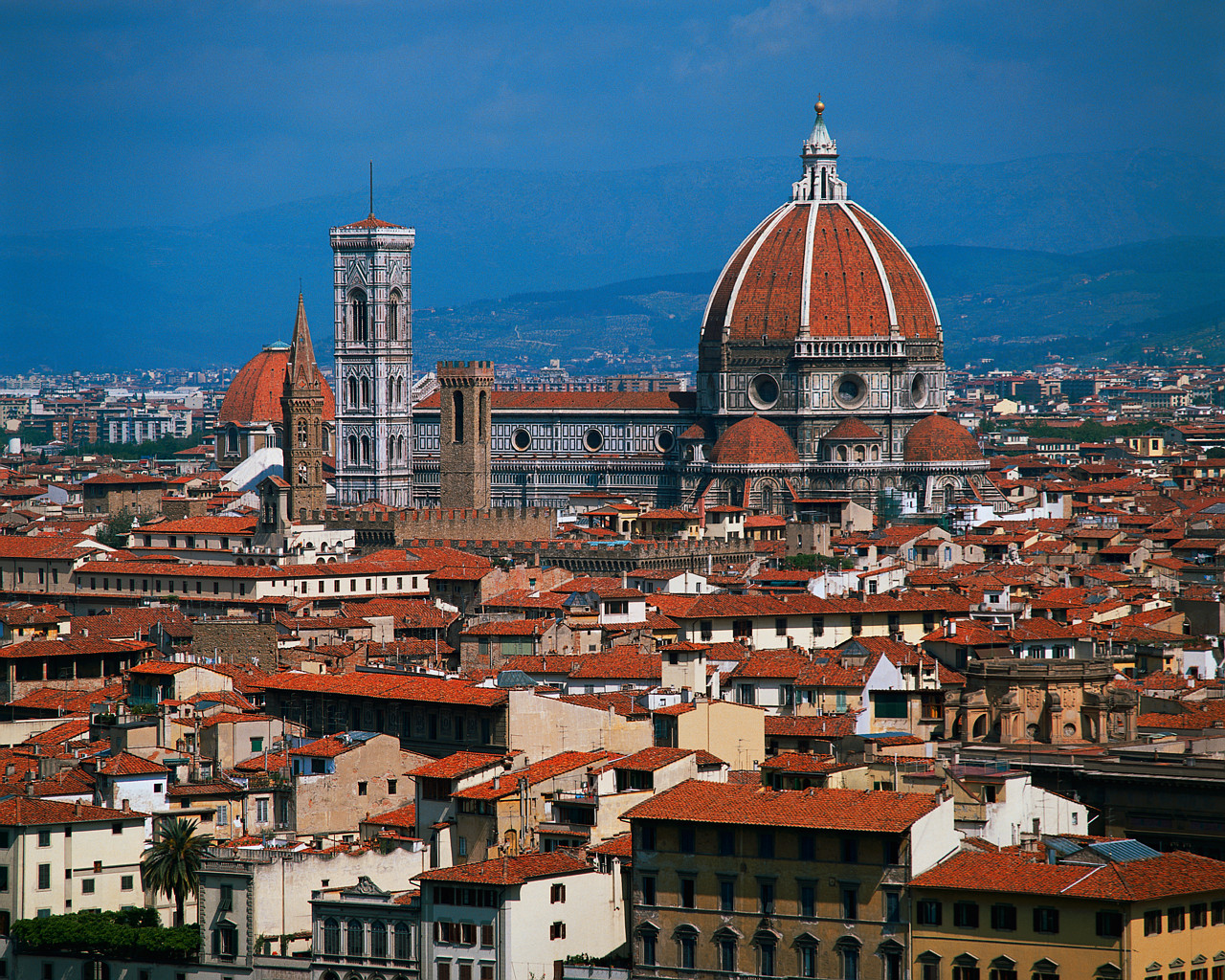
The bigger challenge actually is how to connect this central, Umbrian itinerary to Florence in Tuscany on the northwest and Rome in Lazio on the south west. To me it makes great sense to start in Florence, a city rich in examples of Renaissance art and architecture. Also, it’s much easier to get to Florence than to the tiny and remote sanctuary of Della Verna in eastern Tuscany where Umbria’s itinerary begins. And it makes sense to end in Rome, which is one of the major pilgrim destinations of the world. Many Santiago de Compostela pilgrims feel disappointment when they arrive in Santiago, a mid-sized town with only a day or two of fairly minor sites to explore. Rome, in comparison, is nothing short of spectacular. For religious pilgrims there are too many saints’ relics to see in a brief visit, not to mention absorbing the Vatican City and sites of Ancient Rome. So I’m following the lead of a recent German language guidebook and will include the entire Florence to Assisi to Rome walk in my upcoming tome. This creates a 30-day pilgrimage from, through and to three of the most wonderful cities in the world.

With this choice the itinerary is almost complete. To connect the northern Umbrian sites to Florence we can fortunately rely on the fabulous hiking trail known as the Grande Escursione Appenninica (GEA), which is one of the major Italian mountain trails, covering part of the distance between Florence down to the northernmost St. Francis sites in the Umbrian itinerary. Sadly, there’s not a clearly marked trail from Florence to the first walking stage and the German guidebook puts pilgrims on a short train ride for the first day. When I arrive in Italy I’ll start looking for a good walking route that connects Florence to the little town of Camaldoli for connection to the GEA path. I may have my Austrian friend, Jacqueline, along for a few days to help with that effort. It’s about six days on foot from Florence to Della Verna.

Connecting to the route to Rome has its own challenge. I’ll need to decide what to do with the “loop” — get to Rieti through Greccio or through Poggio Bustone? Though I enjoyed Poggio last year, going that way deletes two important sites from the itinerary (Greccio and Fonte Colombo). I’ll check those two out this summer, too, to see if it’s worthwhile to travel that way somehow. In addition, there’s one day on the Lazio portion without a good overnight stop, so this summer I’ll scout out an overnight at Farfa Abbey instead of going through Ponticelli as the Lazio itinerary suggests. This adds a day, but potentially gives an interesting and inexpensive overnight just three nights out of Rome. To confirm my choices I’ve already made contact with the tourist offices in Umbria and Lazio, both of which are very interested in spreading the news about these walking paths.

st-peters-basilica_6809_600x450

The joy of planning this guidebook is knowing that pilgrims who choose this route have ahead of them a memorable and beautiful pilgrimage. To me this route should be of particular interest to experienced pilgrims who’ve already walked the Camino de Santiago and are looking for a new and challenging walk. The Way of St. Francis has some clear highlights — Florence, Assisi and Rome — that in my opinion surpass the wonders of the Camino de Santiago. It has some disadvantages, too. The route is “young” and the infrastructure is “almost” there. This makes it something like the Camino de Santiago must’ve been in the 1980’s before the height of its reemergence today, when over 250,000 pilgrims walk it each year.

Exclusive of the relatively primitive infrastructure this route has something that makes it very special. A shining light along every step is the memory of St. Francis of Assisi. Even 800 years later his name brings a smile to the faces of local Italians, and his simple words of love and faith and unity with creation are satisfying words for our hungry souls.Itinerary

I’ve already begun an online study of accommodations on the various routes and have a master list of hotels, hostels, restaurants and cultural sites to visit. On May 21 I’ll fly to Rome, head to Perugia for a month of language classes, and walk this new/old route and its various options twice, carefully noting the best paths, accommodations, food sources and notable sites to visit. Tens of thousands of words, thirty-five maps and 150 photos later I’ll be ready to send The Way of St. Francis to Cicerone Press for publication. I hope it will be a good resource for pilgrims who seek a walk of spirit and adventure and joy.

Hey, Mom. A book contract just arrived in the mail!

Cicerone-delNorte001Wow, this fall has seen a lot of changes in my life. My marital status changed to “separated,” I moved in with someone I’ve loved for the last 26 years (my 26 year old son), I sold my car. and I’ve signed a contract to write a book. The first item includes more complexities, sadnesses and ambivalence than I could possibly explain in a blog post. The second item is a great joy. Who’d have thought that I’d live in a great apartment with one of my favorite people in the world who just happened to be looking for a roommate at the same time as me? The third item is a challenge. I’ve had a car since I was 16 and even bike-friendlyish slash transit-equipped Seattle isn’t the easiest place to get around in without a car. The final item is a delight — researching and writing a book will give a little structure and meaning to my private life in 2014.

Here’s how it all happened. Last July I wrote a review of a Cicerone Press guidebook for my blog and for the Internet Camino Forum I help moderate. I made contact with the editor so I could run the review past the book’s author. Then on a whim I asked her if the press she works for ever works with new authors. The answer was “yes,” and soon I was in contact with the publisher himself. He asked for my qualifications and a synopsis, was interested, and then asked for a writing sample, a detailed outline, and sample photographs. While I was at my sister’s house in Hawaii in September (taking a break from  my marriage breakup) I researched my potential itinerary, drafted the writing sample and chose the photos I’d use. When I returned from Hawaii I sent in my submission — and earlier this month it was approved. I had a conversation with the publisher over the phone, and then a couple of weeks later a contract arrived in the mail.

My book will be a walking guide to “The Saint Francis Way,” a 550 kilometer walk from Florence, to Assisi to Rome. As I discovered last year, there’s no guidebook in English for this route and it’s a truly spectacular walk — every bit as amazing as the Camino de Santiago — and it ends with a genuine apostolic tomb (or two, or three) at the finish!

Early next year I’ll begin researching the walk by reading books on St. Francis and doing Internet surfing about important sites along the route. Next summer I’ll walk the full route, carefully taking notes, GPS readings, and photographs. When I return I’ll gather these together and, by the terms of the contract, will have them in publishable form to Cicerone Press by December 31, 2014. The result will be a book very much like the one in the photo above, only with the name “Sandy Brown” as author and the title “The St. Francis Way.”

San Damiano window with St. Francis preaching to all creatures.

San Damiano window with St. Francis preaching to all creatures

I love how this project will combine some of my favorite things — helping people discover the joys of pilgrimage, learning and explaining history, sharing stories of spirit and faith, and of course walking in Europe. As I look ahead it sends my mind back to the mid-1990’s as I was researching and writing my doctoral project. Lots of work, a tight, self-imposed deadline, and the reward of learning and growing. It also sends my mind back to last summer as I walked from Assisi to Rome with my dear friends, Sebi, Jacqueline and Andreas.Jacqueline has already been a big help as she sends me notes about the strategies revealed in the German language guide for this walk.

Over the next weeks I’ll make more detailed plans about schedules and flights. There’ll also be a lot of research to do about GPS mapping hardware and software. The next step will be convincing friends to join me and walk some of this amazing pilgrimage. After that, some language study, and then….next year, in Rome!

New Camino del Norte Guidebook Fills Unmet Pilgrim Need

You may know that I help moderate an Internet Camino forum. It’s a great way to keep abreast of developments in all things Camino. A couple of months ago I found myself gently corrected when I made a bold statement, “There is no good Camino del Norte guidebook in English.”

40138986_8395871

Gérard du Camino’s French guidebook to the Camino del Norte.

I’d shared the results of research in this topic in an article entitled, The Hunt for a Good Camino del Norte Guidebook, in which I compared English, Spanish and French guidebooks. In advance of my 2012 Camino del Norte, after comparing what was available in languages I might understand, I dusted off my 5 years of high school French and bought Le Chemin du Nord, by Gérard du Camino. It proved to be a great choice — very thorough directions, maps, and accommodation info.

The problem, of course, is: what if you’re an English speaker who doesn’t understand any French?

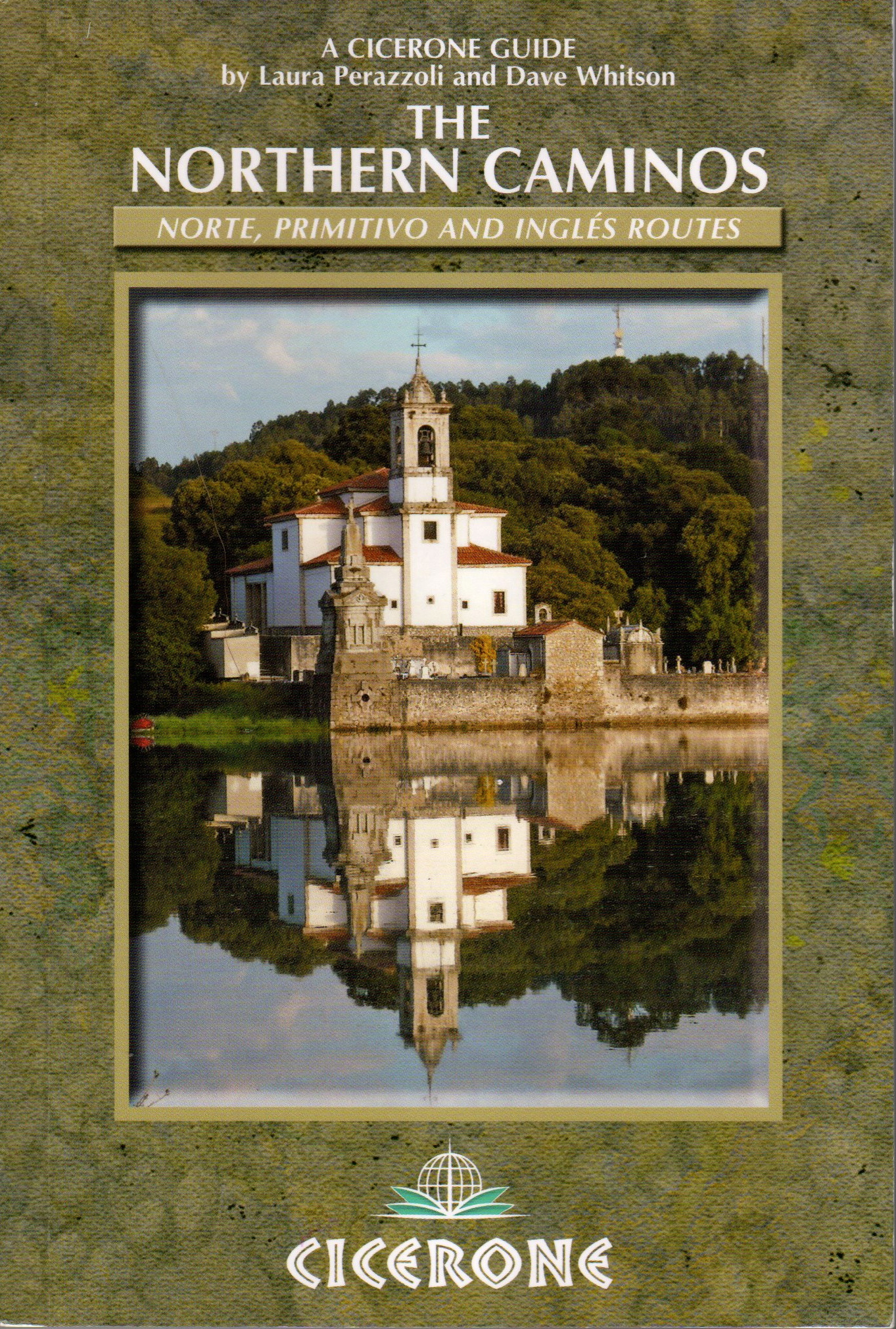
Enter a new book, The Northern Caminos, by Dave Whitson and Laura Perazzoli. It was Whitson who noticed my Camino Forum post and alerted me to his new creation. After reviewing this new guide, I’m pleased to say a pressing need has been met. Whitson and Perazzoli have created a guidebook that will be a big help to English readers who choose the Northern caminos of the del Norte, Primitivo, and Inglés. The guide offers real to-scale maps (hear us, O John Brierley), good historical and cultural background, and a warm and readable style that quietly assures pilgrims that they’re in good hands.

Cicerone-delNorte001

Whitson and Perazzoli’s new guidebook to the Northern pilgrimage routes to Santiago.

That’s not to say I fell in love with this guidebook. There are a few details that I hope will be amended in a second edition. One of the most helpful planning tools a guidebook can offer is a chart of each day’s elevation profile. It’s a big help to know when you’re just about to reach an 800 meter climb, or when you’ve finished your ascent and can rest and prepare for the climb down. Unfortunately, this guide offers scant elevation help, giving only total ascent and total descent stats for each day.

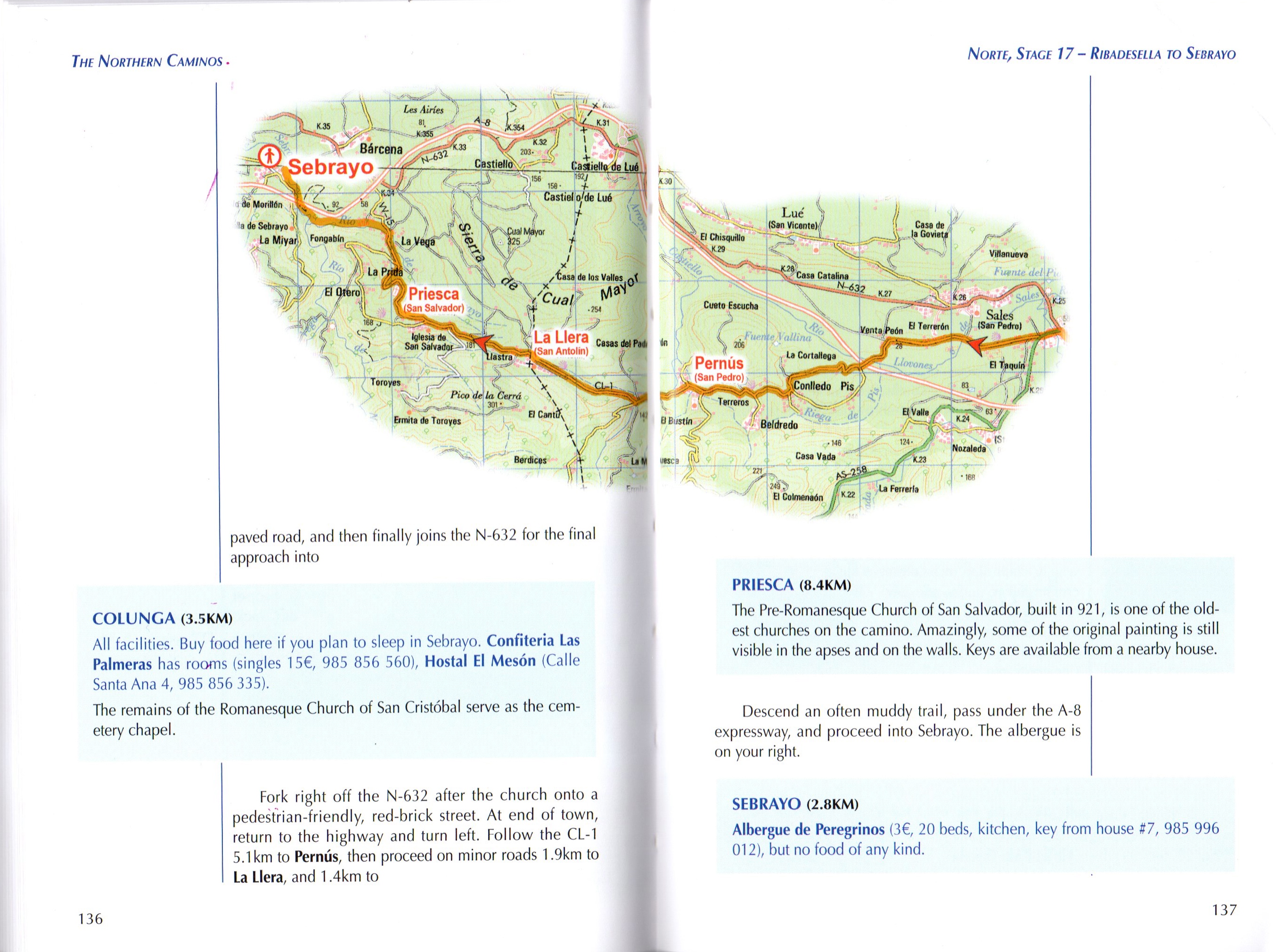
The authors’ descriptions can be so sparse as to be unhelpful. The Ribadesella to Sebrayo stage, a 31.5 km march that ends disturbingly at the Sebrayo albergue that has no grocery store or restaurant nearby, is a good example. A word of warning about this important detail at the beginning of the chapter could be very helpful for pilgrims. Instead, we learn in the chapter’s last phrase: “Sebrayo: Albergue de Peregrinos …. but no food of any kind.” In contrast, the French guide warns upfront that “revitaillement” (resupply) must happen at Ribadesella.

(In truth, I discovered in 2012 that there’s a grocery truck that stops by the Sebrayo albergue each evening to provide pilgrims necessary ingredients for assembling dinner in the albergue’s kitchen. Also, after a walk of about 1.5 km across a small valley to the road behind the albergue pilgrims will find a bar/cafe happy to serve a simple meal.)

Cicerone-delNorte005

Lots of blank space on many pages.

A mildly annoying feature of this new guide is the rather generous use of white space. When a person is carting a camino guidebook across hundreds of miles it’s great to know it’s jam-packed with as much info as possible per kilogram. Hopefully the next edition will ditch the artsy white space and fill it instead with other helpful content  that pilgrims would rather carry.

There are a few other quibbles. I’m not sure why the book’s La Caridad to Ribadeo Stage (p. 168 ff) recommends a southerly route through Brul rather than a route to Tapia that would follow the scenic coastline through Santa Gadea toward Ribadeo. Whitson and Perazzoli suggest that the waymarking is not sufficient, but their book could provide a detailed description that would adequately guide a pilgrim even without excellent way marks through an uncomplicated coastal walk. On this stage I’d certainly take the Tapia option and then follow the coastline toward the Ribadeo bridge.

Flaws? Well, sure. But these guidebooks are often revised in subsequent editions, and they become better and better over time. What we have now is a very good start, and Whitson and Perazzoli are to be commended — and thanked — for a great contribution to the needs of English-only del Norte pilgrims.

Getting a Testimonium at the Vatican is Fun (but not easy)

When a person arrives in Santiago de Compostela there’s not much confusion about how to get the “Compostela,” the completion certificate issued by the Cathedral Office. Pilgrims go to the special building near the cathedral, stand in line, present their credential, are asked a few questions, and then are issued their certificate. Presto!

At the Vatican, it’s not quite so easy.

When we four pilgrims arrived at St. Peter’s Square our first question was, “where do we get our Testimonium?” We asked various police officers, who told us to stand in line at the metal detectors and then go inside to the Sacristy for our certificates. So, we dutifully stood in a line of several hundred people, inquired as to where the Sacristy is (it’s off the West Transept of the basilica). When we arrived in this ornate room, complete with a beautiful, stone dome of its own, we met a man behind a desk who asked for our credentials and then stamped them with the Vatican’s “tinbro” (stamp). When we asked about our Testimonia, he at first didn’t know what we were talking about, then told us the Testimonium office is only open 9-Noon. Since it was after 4:00 we let it go to the next day.

Our little group divided in two, with Jacqueline and I heading to shopping and Andreas and Sebastian wanting to get to their rooms for a shower and comfy rest. As Jacqueline and I walked, we asked a few folks who looked like they knew what they were doing about how we would get our Testimonia. They directed us to the pilgrim desk at the Tourist  Office just off St. Peter’s Square. Sure enough, when we arrived there the kind woman seemed to know what we were talking about. She copied our credentials and promised she would mail us our Testimonia.

The next day, unbeknownst to Jacqueline and me, our colleagues went to the official pilgrim office inside the Vatican and secured their Testimonia! “Go around the metal detectors,” they said, “then go to the police station, then through the Swiss Guards, then to another police station, then through security, then walk down the road, turn left and then right and go into the building. They’ll give you your certificates right there.” IMG_2461

So the next day, Jacqueline and I did just that. After four security checks, including one with the guys in the flashy pantsuits, we arrived at the official pilgrim office. We were asked to have a seat behind a desk and surrender our credentials. In a few moments the kind man returned with stamped Testimonia, tucked into an official Vatican envelope. On our way out we asked how many pilgrims come for their Testimonia each day. Only five to ten, we were told. No wonder no one seemed to know where to direct us.

In spite of the difficulty in finding our way to the right office, it was still fun to see “behind the scenes” at the Vatican during our little foray into this tiny city-state. It’s been a month and no sign of any duplicate Testimonia in the mail, so I’m glad we took the extra time and asked around a little more so we did finally get our certificates.

IMG_2525

We did it! Jacqueline and I succeed in securing our Testimonia, proof that we walked the walk! The Vatican office is just behind us.

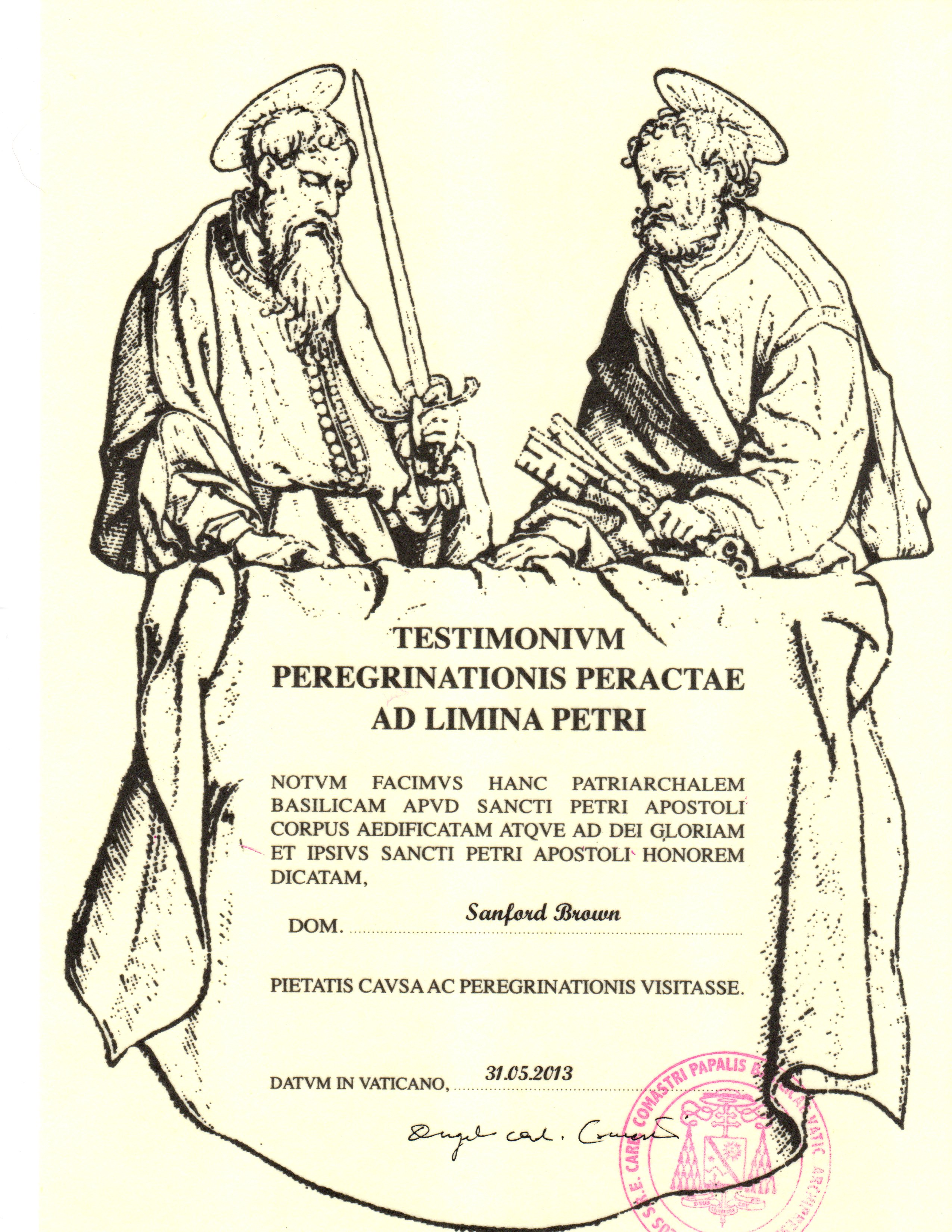
Testimonium from the Vatican following our 2013 Cammino di San Francesco

Testimonium from the Vatican following our 2013 Cammino di San Francesco.

Final Wrap-Up of Cammino di San Francesco 2013

May 30, 2013 — Rome

20130530-184257.jpgOur last full day together in Rome –goofing off in front of Trevi Fountain
It’s been an amazing camino, with the best as always being the times spent with fellow pilgrims. I’d happily walk anywhere in the world with Sebastian, Jacqueline and Andreas. We’ve become a close family that has grown stronger through daily reliance on each other and mutual trust and affection. I’ll miss these three tomorrow when I head to the airport.

Last night was a highlight. A Seattle friend, AJ Boyd, is doing a doctorate at the Pontifical Institute here and is living in a church-owned residence just above the Colliseo. He invited us to join him for a walk in the gardens, for dinner there and to meet the community of lay students with whom he lives. We could immediately tell this was a dream of a place, and when we sat down with the 40 or so students for dinner we were all reminded of the blessing of community life. If I were a little earlier in my earthly pilgrimage I’d have to find a way to study in a place like that, with friends like those.

One of my reasons for blogging my caminos is to share with potential pilgrims the lessons I’ve learned in order to help them on their way. As I prepared for my first camino I appreciated online forums and camino seminars, but the most helpful and enjoyable lessons came from those who took time to write down their adventures and share them in books and blogs. Hence my daily blog posts, aimed toward friends and family, but also future pilgrims who one day will travel these paths.

In that spirit, here are some statistics, reflections and practical notes about our 2013 pilgrimage from Assisi to Rome.

Overall Statistics and Impressions
The walk from Assisi to Rome was 235 kilometers (146 miles), which we accomplished in 13 days of walking. For Camino de Santiago veterans, the 18 km/day average seems light, however this is a much more difficult walk, in terms of terrain, in directions and in lack of infrastructure. There are many very significant uphill/downhill stretches and the uphills in particular eat up the time. It was not unusual to have an 18 km day that took 8 hours to walk. We often compared the 690 meter ascent on the first day out of Assisi to the climb over the Route Napoleon that begins the Camino Frances, but in reality it is about half the elevation gain. Still, almost every day there were similar stretches, with the result that this camino feels more difficult. Basically a person climbs from mountain to mountain each day. In the first week, by the time you get to Piediluco, the boundary between Umbria and Lazio, you have climbed 2800 meters (roughly 8400 ft). This is Route Napoleon, Alto de Perdon and Cruce de Ferro all rolled into one week. The next two days after Piediluco feature nearly 1000 meters more to climb, which gets you to the halfway point between Assisi and Rome.

So, pilgrims should be prepared for an aggressive walk, more physically challenging than the Camino Frances, but with its own rewards, as I hope my daily reflections point out.

Daily Itinerary and Lodging
Here are the places where we stayed along the way. Note that in all cases, even the hostels, beds came with sheets and blankets. This allowed us to leave our sleeping bags at home, which helped us keep our pack weight quite low — mine was about 6 kilos (13 pounds).

Our lodgings ranged in price from 25e to 50e per person per night. Here are our overnights:

AssisiCamere Carli. This is a pensione near the top of the town, off Piazza San Rufino. Just below is a cute shop owned by the same man, and adjacent is a separate cafe for breakfast and snacks.

Spello — It’s nice to find something right on the trail, and that happened to us as we walked through Spello and found Il Cacciatore midway through town. This is a pleasant hotel with a great, green view to the south. The restaurant is super and rooms were pleasantly warm.

Trevi — As we walked into Trevi we had no idea where we’d stay, so we stopped at Tourist Info where we heard about a four-star hotel with a special room for pilgrims. Soon we were climbing the spiral staircase to our room at Hotel Antica Dimora alla Rocca. The young owners are doing a great job with this grand, old hotel.

Spoleto — Toward the top of town, just a block or two below the Duomo is Hotel Il Panciolle, where we had a nice view room and a fine dinner in the restaurant below. Unfortunately there was no heat in our room and no laundry service available. Still, we’d come back here again for location and to enjoy the nice staff.

Ceselli — This remote little town is a surprising place to end a stage of this camino since there is only a tiny store/bar open for only a few hours each day. There’s no hotel, but thank heavens there’s Case Vacanza Il Ruscello where the owners kindly drove us 4km to the next town so we could buy groceries to cook for ourselves.

Arrone — Again we had no idea where to stay, but when we asked for suggestions in this town where everyone was very helpful we were directed to the Case Vacanza Fiocchi where we were shown to an enormous 3-bedroom apartment at an excellent price. The staff washed our clothes and we hung them out to dry. A good night’s rest in our biggest accommodation of the camino.

Piediluco — We walked the entire length of this lakeside town before being referred to La Locanda dei Frati Hotel above the town’s main church. The hotel rose from the rubble of a medieval monastery, which gives it charm, and we enjoyed a delicious dinner in the hotel’s restaurant.

Poggio Bustone — The first actual hostel of our stay: La Locanda Francescana. Feliciano and his partner have a nice hostel and a good restaurant a few blocks away. Laundry service was available, but without a machine to dry. Without heat in the building that meant two days for our clothes to be ready to wear. Still, we loved the hospitality of our hosts and the cleanliness of this super hostel.

Rieti — Jacqueline went ahead by bus, so by the time the rest of us arrived she had us set up at the Grand Albergo Quattro Statione just off the main piazza. Breakfast in the morning included eggs — perhaps the best breakfast of our walk. And it was warm inside. The elegant style in this grand old building and the great location make it a winner.

Poggio San Lorenzo — We saw signs for many miles, then realized we should have immediatrly followed the arrows to Agriturismo Santa Giusta. This stone farmhouse a few kilometers from Poggio San Lorenzo has several rooms and a large dining room. The food was excellent but we wished for more heat as well as laundry service. The staff was very hospitable and this was only choice near PSL — so we took it and didn’t regret it.

Ponticelli (Salaria) — This is another example of lack of infrastructure on this camino. The stage ends at Ponticelli, a lovely town with no lodging options. Several agritourismos are within a few km of the main piazza, but we opted to catch a 15-minute car ride with our Dutch friend to the Salaria Hotel. Here we had access to heat, a laundromat and a nice restaurant. We liked the “hotel” experience after many days in farmhouses and hostels.

Monterotondo — While catching a quick gelato and wondering where we’d stay, a Google search led us to a delightful B&B just a few quick blocks from the main piazza. La Cupella has about four rooms, each with a renovated bathroom, and a great rooftop breakfast room with views of the town. Jacqueline loved having a heater that worked and everyone loved the showers.

Monte Sacro — The Domus Citta Giardino appeared on our left as we walked the last steps to the piazza in this Roman suburb. A relaxing garden, a nice shower, and a nearby laundromat made this a great choice.

Rome — Near the Vatican and reasonably priced, the Hotel Santa Maria Alle Fornaci met our needs very well. The dorm-like hotel is run by the Trinitarian Fathers and presents a Spartan but clean and handy option. The walk to the Vatican is just 10 minutes and a nice laundry within two blocks will wash your clothes.

In spite of the occasional lack of infrastructure we loved our Italian camino. In comparison with the Spaniards, the Italians have a higher quality standard for food and each day seemed like a new adventure in great cooking.

And of course we enjoyed becoming familiar with St Francis, the famous friar of Assisi. He daily reminded us of the life of trust and simplicity that leads to joy in the presence of God’s beautiful creation.
20130530-031208.jpgInterior of the Church of St John in the Lateran
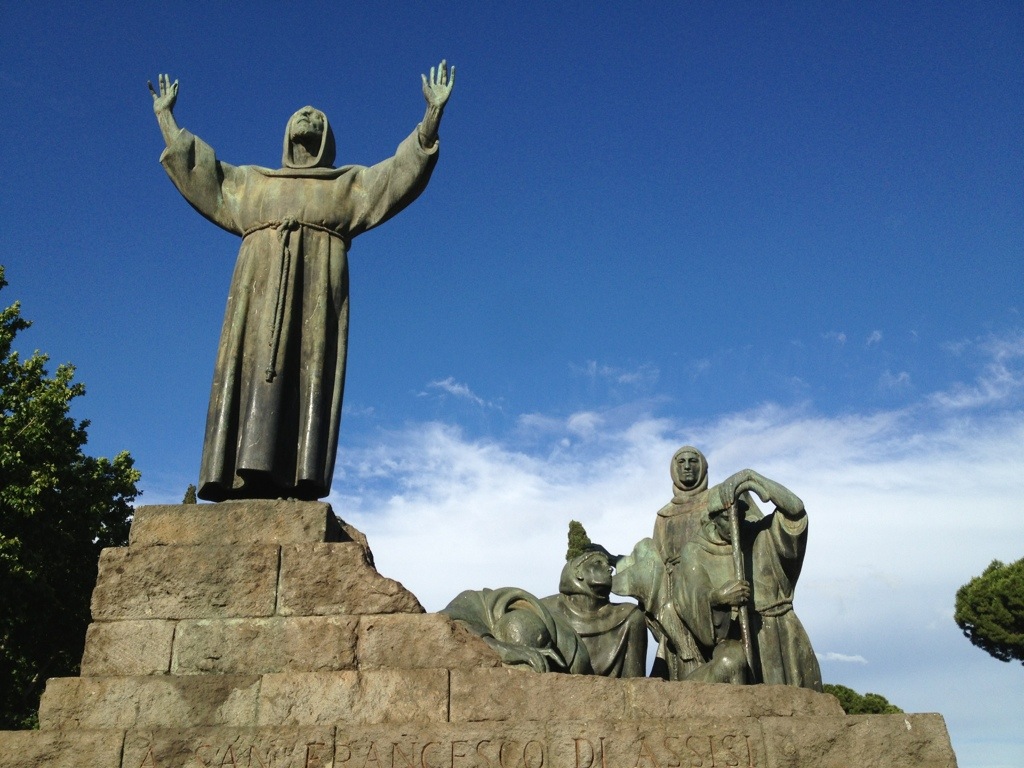
20130530-031237.jpgFrancis monument opposite Lateran church

20130530-031304.jpgFour pilgrims in front of the Colisseo