Ten days out, chomping at the bit

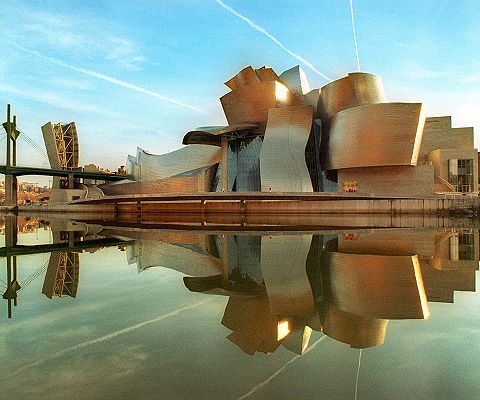
The Guggenheim in Bilbao, with titanium exterior (a style copied from First Church Seattle?????)

Hardly an hour goes by when I don’t think about my impending camino. I’ve taken a gamble and ordered new boots, which hopefully will arrive this weekend for their first break-in walk. If they don’t work, I’m back to my old boots which have at least another camino left in them. I’m also getting ready for the start of tomorrow’s big sale at REI, where I’m planning to buy some new technical t-shirts and hiking shorts. I’ll check my Camelbak bladder to make sure it’s fit for duty, and I’ll lay out my gear in the bedroom and probably back and re-pack my backpack over and over in the next few days.

The best part of this year’s camino will be meeting friends from last year. My German firefighter buddy, Sebastian, will join me for the first few days outbound from Bilbao. Then at the end, my buddy Martin, who teaches English in Logroño, will join me for up to two weeks. Both guys are super companions, each a lot of fun in their own way.

As I make plans for the walk it’s clear just how different the Camino del Norte is than the much more popular Camino Frances. The first stop out of Bilbao generally is the town of Portugalete. Problem there is that the only albergue is open only in July and August since it’s an adult school. So, Sebastian and I will make a long day and do two stages in one, heading to the albergue at Pobeña. This gives us a 32 km day, but we can shave off some miles by walking the industrial route along the river in Bilbao to Portugalete. Sebastian’s a good walker and the added advantage of this plan is that we’ll walk along the seashore part of the way to Pobeña.

Whoa — The Camino del Norte is Sounding Hard

Una's boots on the Camino del Norte

I knew the Camino del Norte would be difficult, but in her blog my Internet Forum friend, Una, describes shares a cautionary tale that gives me pause.

I wonder who thinks that a pilgrimage walk is a great way to get away from home and enjoy a few weeks walking in Spain. Well, I don´t blame you. But the only words I can think of to call this post and message is Muddy. Forest mud, river mud, sandy mud, wet mud, red mud, yellow mud, mud that sucks the very soul from your body and makes you wonder why you thought a Camino in April in Northern Spain is a good idea.

So it has been raining. We walked to San Sebastian and stayed in a Youth Hostel there. We took a high track through a muddy forest into Orio. The path was quite beautiful and the views over the sea were amazing. I thought I might get a swim but the waves on this coast are for surfers. In Deba we stayed in a little room beside the beach, the facilities were very basic, and the Walrus, the Carpenter and the little puppy were sleeping there too, all men who snored! I will have nick names for most of the peregrinos by the time I finish in Santiago. I walk with an Irish woman, a Spanish woman from Valencia and a young Portugese fireman who is deeply religous. We four are now in Gernika in a room with a French couple in a very dear youth hostel.

Today the guide book said take the road if possible as there might be mud but the yellow arrows kept leading us into the river, mud, forest and we couldn´t seem to stay on the road. It was very scenic and it was not raining this morning, but is now.

Last night we slept in Ziorta Monastery, what a treat, a Japanese man was the only other person there, we were given a good supper of soup and bread, attended Vespers and got our first pilgrims blessing. We did get Mass in Deba on Saturday night. Mass in the Basque language is hard for the Spanish to understand, let alone the Portugese or Irish but we enjoyed the Misa as it was our first. Unlike the Camino Frances there is not the same opportunity to attend local mass at night as the alberques are on the outskirts of towns.

Just four weeks and three days away from my own Camino del Norte. I’ll certainly be watching Una’s blog to see how the trail goes. Meantime, today’s weather report in Bilbao, where I’ll be starting, shows almost exactly the same temps and conditions as Seattle: 60 degrees and cloudy/rainy.

A True Pleasure to Meet Msr. Gérard du Camino

Msr. Gerard du Camino's pilgrim center near Paris.

In a previous post I lamented how difficult it is to find a good guidebook to my upcoming Camino del Norte, along Spain’s northern coast. A kind fellow pilgrim named Ron Joy recommended the French camino guidebooks of one Gérard du Camino. My French is better than my Spanish, so I thought I’d give it a try. I found Msr. Camino’s website and ordered his guidebook of the Camino del Norte.

What a treat to receive a personal email a few hours later from Monsieur Gérard Rousse, a.k.a. Gérard du Camino, sending his greetings, announcing the mailing of the guide I ordered, and inviting me and all pilgrims to come to the pilgrim center he has created at Montrouge (near Paris) to talk about the camino. He gave the address of his pilgrim center, its hours, and asked that I call before I drop in.

Assuming a good experience with his guidebook I think next time I’m in Paris I’ll take him up on his offer. Thanks, Monsieur Camino, for your prompt reply and for your hospitality. What a nice example of pilgrim hospitality.

Credencial Arrives — Countdown to Camino 2012 Begins

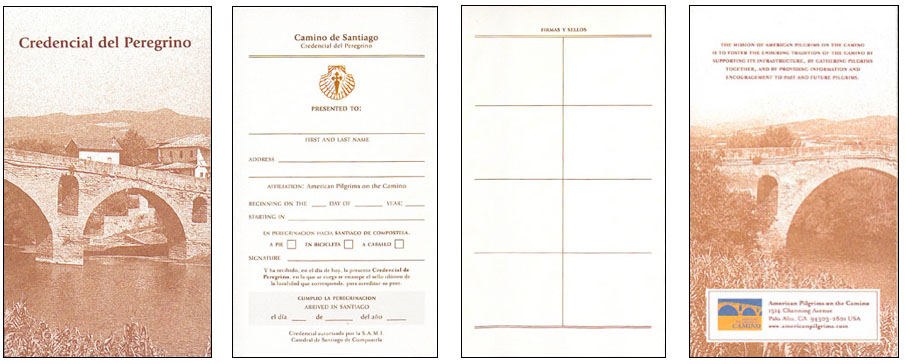
Credencial from American Pilgrims on the Camino

It’s the fourth time it’s happened, but I still get the same excitement each time. An envelope arrived in the mail, marked “American Pilgrims on the Camino.” I opened it up with some anticipation and I held its contents in my hands with satisfaction and delight. My 2012 credencial had arrived!

To walk the Camino de Santiago and stay in local hostels (called albergues or refugios in Spanish) a pilgrim must have an approved credential (credencial in Spanish). This functions like a passport — at each albergue along the way the credencial is presented to the hospitalero. It is inspected and then stamped with the unique stamp of that albergue and then dated. As a pilgrim walks day after day the stamps fill in the blank spaces on the credential (see below) and then, on arrival at Santiago de Compostela, the completed credencial is presented at the cathedral, where it is inspected and (after confirming a minimum of 100km of walking or 200km of biking) the pilgrim receives a completion certificate — the compostela.

Approved credenciales are available at many locations, but most commonly pilgrims apply for a credencial from their national pilgrim confraternity. For people from the U.S. this is American Pilgrims on the Camino. This fine organization holds educational events around the U.S., trains people to volunteer in albergues, and supports local pilgrim chapters, like our Seattle group.

Though it’s possible to carry a generic credencial with no obvious country of origin, I like to carry the American credencial. Americans are a small percentage of pilgrims on the camino — perhaps 3% of the total — and it’s fun (and sometimes a little risky) to engage people about international relations and American politics. It starts (and sometimes ends) lots of conversations. I remember in 2008 how most everyone I met on the camino had some opinion about the U.S. elections. We Americans sometimes don’t really understand how the U.S. president is the closest the world has to a worldwide leader. People were amazed that the U.S. had progressed enough to consider electing an African-American, and most admired what that said about America.

So . . . .  eight weeks and a few days until I put my credencial to use in Bilbao and then each day for the next month on the Camino del Norte. Exciting!

The Hunt for a Good Camino del Norte Guidebook

The great Consumer Eroski online Camino Guide

As I plan for my May/June walked along the Camino del Norte I’m looking through guidebooks and thinking I may abandon the traditional guidebook for an Internet guide instead. This great resource from Consumer Eroski, a Basque retail giant, helped greatly on my 2010 camino. Giving up the paper is easy. Trusting in my Spanish to interpret the directions is not. Still, in 2010 I used the daily itinerary as a Spanish vocabulary study guide and it worked out great. Even better, there’s an iPhone app that includes all the same info. If it included a GPS feature and local maps it would be spectacular.

My fall back will be the Walker guides, available at the online bookstore of the Confraternity of St. James in London. The two volume set for the Camino del Norte was last published in 2010, perhaps meaning it is based on 2009 info. So I wonder how accurate it will be after a few years on the shelf. Amazon seems to have it available through related dealers, but it’s unclear whether that includes one or both volumes.

It’s always possible to just walk without a guidebook, but I’d be anxious about missing available services in this particular camino that has such a thin infrastructure. Some of the walks, according to the Eroski guide, are in the 35-40 km range, the distance required to get from one albergue to the next. That’s a lot of miles to cover in a day with no guide.

Very happy to hear my buddy Sebastian, of Germany, will join me for the first few days of Camino 2012.

Good news came yesterday. Sebastian, my German firefighter friend from Camino 2011, will join me in Bilbao for a few days. That’s is great news! Sebastian is much fun and it’ll be great to walk with him again as a pilgrim brother. The pressure will be on for us to find a bottle of the infamous “Cilantro” liquor that accompanied us on our pilgrim way last year.


Planning my Camino del Norte for this Spring

Map of the Camino del Norte. I'll begin in Bilbao

After flirting for a time with a month long walk on the Via Francigena I decided what I really wanted was another Camino de Santiago. The primary benefits are: more pilgrims to have for company and more albergues and other services along the way. So, Camino del Norte it is, and I’ll arrive in Bilbao to begin there on May 28. Wish me a buen camino!