Blogging with the Amazing Lost and Found iPhone

The amazing lost and found iPhone 4s.

Although I’m back from Spain there’s part of me that is still there — my beloved iPhone 4S. When Jacqueline and I arrived at the airport in Santiago (her flight left just an hour after mine) I put my hand in my pocket to pull out my iPhone and, “Holy Cow!” my iPhone was gone. I checked all my pockets. I checked my backpack. I checked my jacket pockets. Gone.

Jacqueline and I thought through where I might have left it. Yes, I had it out at the cafe where we’d had lunch with the German/Dutch couple. Yes, I’d had it for photos at the cathedral where I’d prayed before the bones of Santiago. But that’s the last time I remember having it. Had I left it at the hotel where we’d caught the taxi? Or had it fallen out of my pocket in the cab?

Over the last weeks I’d come to rely on my iPhone in a big way. Before I left Seattle in May I’d paid for an International Data Plan, an International Calling Plan and an International Text Messaging Plan from AT&T. This would allow me to blog directly from my phone with the help of the great WordPress iPhone app. I would be able to take photos on the tiny camera, write text on the tiny keyboard and upload text and photos whenever I had a good 3G signal.

And it worked! I blogged every day, posting a selection of photos from the over 700 pictures I took in my month of walking. The 3G signal strength was usually good, especially near highways and in cities. Other pilgrims got used to seeing me in the late afternoon or late at night after lights were out, typing away on the tiny keyboard. I shared the blog’s URL with many pilgrims and the text and photos became an easy reference for others as they thought back through the places and people they’d met.

Plus, of course, I could check email from home. Gail, my mom, and my sister wrote regularly to the special email address I’d set up in order to avoid contact with my work emails and other personal, non-emergency communications. I received tons of texts from other pilgrims, and also used web search to find out information about places I’d be walking through. The Map feature was brilliant, with its GPS getting me out of trouble many times. I even made an occasional cell phone call. Other than the cost of the various data and calling plans (not cheap) the biggest price was making certain I had access to an electrical outlet each night so I could charge up my little white slab of amazing electronic wonders.

In short, I found the iPhone to be indispensable. Which meant that when I lost it I was in shock.

My first thought at the airport was, what confidential info is on it? I never used the 4-number lock code available for the iPhone because it was too awkward to punch in the code every single time I wanted to use it. So I quickly went through the various items and realized there really was nothing that would endanger my bank accounts or reveal other important personal information, except giving someone access to my email for a brief time.

I then called the hotel, my favorite Santiago nesting place, the Hotel Altair. I’ve loyally stayed there four times since 2008 and their staff has graciously remembered me and my various visits. I asked them to check the hotel lobby and bathroom to see if I’d left the phone there and, if not, to call the taxi service they’d arranged for us earlier that day. They soon called back to say they hadn’t found the phone at the hotel and that the taxi driver was at lunch and was not available. Drat.

Jacqueline then had a great idea: send a text message asking the person with the phone to take it back to the Altair. Brilliant. We put together a text message and sent it off. Then I remembered another great feature of the iPhone — the “Find My iPhone” function of iCloud that allows the phone’s owner to lock the phone, send a text message and make the phone ring loudly so whoever has it realizes it’s in their possession. The only problem? No Internet at the Santiago airport.

By now it was time to catch my flight, so I said goodbye to Jacqueline and stepped on my plane to Dublin. When I arrived I found an Internet kiosk and went to iCloud to “Find My iPhone.” Amazing! I located it on a satellite map in Santiago near the polymedical clinic, which proved it had fallen out of my pocket in the cab and was in the possession of the driver. I locked the phone with a 4-digit code, sent a text message, and rang it several times in hopes the taxi driver would hear it and find it. Then I jumped on my flight to London.

When I arrived in London and found another Internet kiosk, Voila! The taxi driver had returned my phone to the hotel, which is shipping it back to me tomorrow. I’m deeply grateful to Conchi and Pepa of the Altair staff, and to Jose Manuel, the taxi driver who found the phone and returned it. Without their help I’d have lost all 700 of this year’s camino photos — far more valuable to me than the replacement cost of the phone itself.

The star of the show was the iPhone. It took my pictures, posted my blog, checked my email, texted my friends, searched the Internet for important information, helped me find myself when I got lost, made calls for me and, when it was lost, helped me find it. Thank you, you clever people at Apple.

Postscript on July 5, 2012: So happy to receive my iPhone via UPS today from Spain. A very big thanks to the good folk at the Altair Hotel. Thank you!

Things Scatological

Day Eleven: Llanes to Ribadesella — So far the waymarking in Asturias is not impressive. Last night as I was hunting for dinner I saw one of the blue and yellow Asturian way markers, so this morning I went back to that point, assuming I would find the route. Nope. So I got out my Google Map app on my iPhone and followed its “beta” walking directions out of town. Apparently “beta” walking directions mean they are actually driving directions, because I was immediately on the main auto road out of town.

I walked along the shoulder until the town of Poo and, pun intended, directions got even crappier from here. I saw a scallop arrow on a tiny street, followed it, and once again ended up at an intersection with no marker for where to go. So again I resorted to the iPhone map, which emptied me out along with Poo itself onto the AS-263 highway, a busy two lane road with no shoulder and apparently no speed limit.

I learned that the most dangerous times for a pedestrian to share a narrow, shoulder-less road are: a) when the sun is at your back, b) when there are lots of slow trucks, and c) when it’s Friday and everyone is in a hurry to get out of town for the weekend so they are madly passing slower cars. Today, all three conditions applied, so I found myself simply hoping that God would get me out of Poo alive.

I suspect that EU-enforced austerity measures have led Spain to lay off their roadside maintenance crews. The result is that the tall, unmown grass at the road’s edge is annoying and dangerous. The grass and weed stalks are scratchy on the arms and legs, forcing the pedestrian farther out onto the road to avoid them.

After a harrowing transit on the roadside I found myself in Celorio and back on the camino. Here the track joined back up with the GR-E9 and hopped from gorgeous beach to more gorgeous beach. I took a second breakfast (my first being some leftover fruit and pastries) from the dining room of a pretty hotel (in the next village of Barru) with a spectacular view of a small, sunny and beautiful beach. I thought to myself, “I could stay here for a day ….. or a summer,” but I dragged myself onward from my sunny reverie.

Back on the now well-marked trail (courtesy of the GR system) I was passed by two colorful Italianos and then passed a middle-aged French couple. In a few moments I heard the sound of rapid talking and turned to see Amelia, Julien and Florian (from the Mad Men motel) approaching. Julien stayed behind at first to visit in his native tongue with the French couple and Amelia and Florian and I enjoyed our reunion and continued ahead.

The remainder of the day was spent in the delightful company of these three youngsters. Amelia, 28, is from California and has a degree in Government from Skidmore. She’s hoping to be a counselor of some sort and plans to begin a PsyD degree this fall. Julien, 28, is a physical therapist in Quebec and he had taken the option of a 20% pay cut that allows him 7 months’ vacation every few years. Florian, 20, is Dutch and presently in college. He worked recently for a circus in Amsterdam. Amelia serves as “mom” for “the boys” and ensures they all have enough to eat. She settles any disagreements and determines the schedule for the day. It’s a cozy, familial arrangement that benefits them all.

We walked together on green, shady paths with gentle inclines to the town of Nueva, where the bartender of a shaded cafe on the main street allowed mis amigos con su comida to join me at my table. While I devoured a tiny racion of chicken sandwich (kitchen closed at the early hour of 12:30) they unwrapped a meal of bread, cheese, chips and jam while Amelia apportioned each his allotment of ham.

Before leaving, Amelia excused herself to use the restroom, at which time the men teased her about needing plumbing to do her business. She responded, “oh yes, for you men the world is your toilet.”

True. Accepted pilgrim protocol when the need arises is for pilgrims, male or female, to find a private bush. We each carry our own role of toilet paper for just this moment. Obviously men have it a little easier most of the time out in the bush, but Amelia’s sharp reply to the men brought a smile to my face in a day that had already contained some scatological thoughts.

With abundant conversation amongst us four the kilometers quickly ticked away. Amelia and I worked to impress the other two with our fluency in American culture, at one point singing through the songs of Wizard of Oz, Dorothy’s — I mean Amelia’s — favorite musical.

When we arrived at Ribadesella, since the three were going another 5 km, we exchanged emails, at Amelia’s kind suggestion, took pictures, and said our goodbyes. I hope I’ll see the three again soon, before they head off this track to the Camino Primitivo.

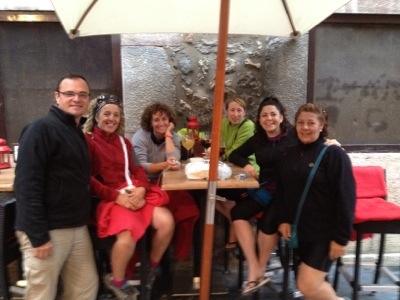
An added bonus to the day: as I was searching for a hotel I stumbled into Begona, Anna, Pilar, Annabelle and Nuria. This is their last day on the camino and I’m sad to see them go. At their suggestion I took a room at their hotel and perhaps tonight I’ll see them again and say my goodbyes to them, too.

Post script: After shower and a nap who should I see but Amelia and the boys, who choose to stay here in Ribadesella after all. Now there’s more chance of conversation tomorrow with these great young folks.

20120608-193743.jpgNarrow road out of Poo. Look out for your life!

20120608-193830.jpgAhhh, the beaches.

20120608-193854.jpgCafe for lunch.

20120608-193902.jpgJulien with giant sandwich.

20120608-193915.jpgWalkers.

20120608-193926.jpgWalkers, Two

20120608-193933.jpgFrom left: Florian, Amelia, Julien.

20120608-193801.jpgMorning by the sea.

20120608-202142.jpgCaminoist (for Shannon)

20120608-213350.jpgLas 5 amigas conmigo por un ultimo foto.

One Day to Go — Time to Pack

Here’s what I’m bringing this year (plus my backpack)

Even after three caminos I’m finding myself debating exactly what gear to bring on this year’s walk. I leave tomorrow — just 25 hours from now — so decision time is at hand.

There are a few things I know are handy, but they add extra weight — and weight is the bane of pilgrims and long-distance trekkers. Some items I know I can buy if and when I need them.

Here what I’ve settled on for my Camino del Norte (2012):

  1. Hiking towel — lightweight, dries very quickly. I’ve used this one on pilgrimages for years.
  2. Liquids — these will ultimately go in my toiletry bag, but for airport purposes they’re in a transparent, plastic sack. They include liquid soap, toothpaste, eye drops and sun block lotion
  3. Toiletry bag and toiletries — this has my dry toiletries, and ultimately my liquid ones once I arrive. Toothbrush, nail clipper, dental floss.
  4. Airline tickets, directions, other papers — these stay in an outer compartment in my pack for each access.
  5. Guidebook — also in an outer compartment.
  6. Camelbak water bladder — 2 liter size. Dry until I arrive, then I fill it with trustworthy tap or bottled water
  7. Gloves — Sometimes I only need these once or twice, but when I do, they’re nice to have. Super lightweight.
  8. Toilet paper — goes in an outer compartment in the pack for when nature calls and no indoor plumbing is available.
  9. Rain cover for backpack — into an outer compartment.
  10. Rain jacket — I find it easier to use a Gore-Tex style rain jacket than to have a bulky poncho that is hard to get over my pack and catches the wind.
  11. Warm fleece — I’ll wear this onto the airplane. For cool days and mornings.
  12. Hiking boots — my trusty Treksta Assault GTX boots
  13. Passport and credential — these two important items stay in a waterproof bag in an external pocket for easy access.
  14. Sleeping bag liner — treated with Permethrin. Keeps the random bed bug away.
  15. Camp shoes — super lightweight North Face shoes with comfy, padded soles. For a break from boots after hours.
  16. Blister kit — includes small scissors, needles, thread, band-aids, Compeed, moleskins
  17. Sleeping bag and inflatable pillow in stuff sack — very lightweight, down bag good to 40F and super lightweight inflatable pillow. I also have a tiny LED flashlight attached to the zipper of my sleeping bag in case I need it.
  18. Clothes bag — Having a light “cube” bag allows my clothes to stay together in my pack. Clothes include 3 pair hiking socks, 3 pair sock liners, 2 hiking shorts, 3 technical t-shirts
  19. Airline clothes — my long, lightweight hiking pants, collar shirt, 1 pair undershorts, belt. These items ultimately go into the pack, but the long pants (along with my fleece) help me stay warm in cool airplanes and airports.
  20. Tech bag — charger, plug adaptor, charging cord for phone, charging cord for camera, extra camera battery, telephone, waterproof bag for telephone.
  21. Mylar foil emergency blanket — won’t ever hike without this. A survival blanket that I can use if weather requires or in case of injury where help might not arrive for hours.
  22. Sleeping pad — this is a luxury item. I take it out for when I’m enjoying my afternoon siesta. Also there for the odd time in which I might need to sleep outdoors — it happened once.
  23. Not shown: writing pad and pen, magazines for on the plane (thrown away when done), credit card, debit card (for ATMs), baseball cap, sun hat.

Total weight: 16.2 pounds. Well within the 20 lbs (or 10% of bodyweight) recommended. Ooops, almost forgot my scallop shell.

OK. I think I’m ready!

Camino Pilgrims Come from Many Nations

Fig. 1 - All nationalities who received compostelas -- the Spaniards are by far the greatest numbers.

Here’s the last of my installments on the Cathedral of Santiago’s pilgrim statistics. As you will recall, the Cathedral publishes online stats about pilgrims who’ve received their compostelas during the prior month. The statistics includes some revealing details. The chart in Fig. 1 shows the percentage of Spanish pilgrims each year since 2005. In most years Spaniards comprise more than 45% of all pilgrims. In the Holy Year of 2010 this number increased to over 60%, while pushing down the percentage of non-Spaniards who walked that year. The next highest group is “Other” (not listed on the legend) which comprises a variety of the less-than 10 ten nationalities. The largest single nationality below that is Germans.

Fig. 2 - Non-Spanish nationalities. "Other" is the largest percentage, with Germans the largest single non-Spanish nationality.

Fig. 2 spells out the non-Spanish numbers a little better. “Other” is still the largest group, meaning these nationalities include too many individual countries to make the top groupings, but countries when combined equal a large percentage. The largest groupings of these nationalities are from Japan, Korea, Australia, Mexico, Poland, and Belgium.

The largest single non-Spanish nationality represented on the camino is German. In fact, the top four non-Spanish nationalities are pretty clear in the stats — Germany, Italy, France and Portugal, in that order. Well below these nationalities are a third tier: USA, UK, Canada, Brazil, Ireland, and Holland. So the profile of the “average” pilgrim is pretty much a Western European, with folk from other continents a much smaller percentage of the total.

Not shown is another interesting stat: Spanish pilgrims flood the camino in July and August, when they comprise roughly 2/3 of all pilgrims. The percentages of non-Spanish pilgrims, particularly German, nearly double in the shoulder months of May/June and September/October.

Pilgrim Starting Point Stats

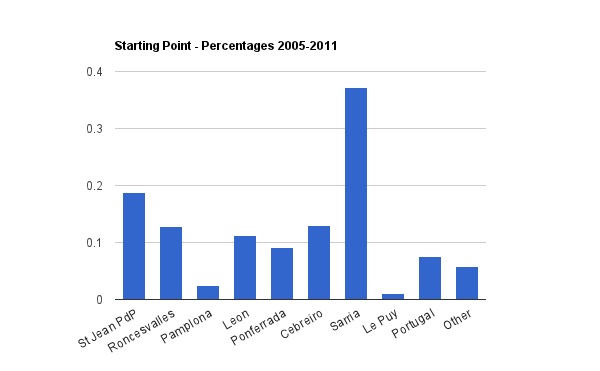
I’ve had a great time poring through the Cathedral of Santiago de Compostela’s statistical pages and have come up with some interesting lessons. Fig. 1 shows the large percentages of pilgrims who start at Sarria, the minimum (100 km) distance required to earn a compostela in Santiago.

Fig. 1 - Many starting points for the Camino, but biggest by far is Sarria.

The fact that fully 37% of pilgrims begin in the last 100 km confirms that the Camino Frances gets more crowded the closer a pilgrim gets to Santiago.  It’s also surprising how spread out the starting places are, and how many people begin in places like Leon, Ponferrada and O Cebreiro.

Interestingly, Sarria is the most frequent starting point by far for pilgrims who finish in all but four months — May, June, October and November. This suggests that local, short-walk pilgrims flood the Camino Frances during the high summer months, while long-walk pilgrims make up larger numbers in the shoulder months of spring and autumn.

Fig. 2 - Sarria is by far the largest starting point for pilgrims in all but four months.

A caution with these stats from the Cathedral at Santiago — they reveal only the eight largest starting points each month. The result is that some important starting points like Astorga, for instance, sometimes show significant numbers but sometimes aren’t recorded at all since they don’t make the top eight consistently. Astorga and other, smaller starting points are included in “other” in each chart.

I’ll look in future postings for country of origin among pilgrims to see how or if that has changed over the years.

Learning from the Cathedral of Santiago’s Statistical Pages

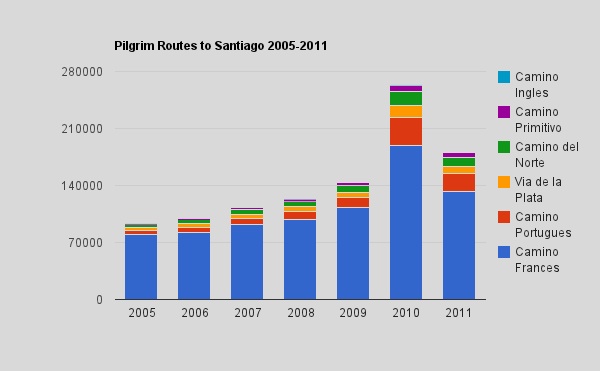
Fig. 1 -- Numbers of pilgrims by route on the Camino de Santiago

Over the last couple of days — partly out of a desire to rest some from a busy Easter season — I’ve been poring over statistics offered by the Cathedral of Santiago about numbers of pilgrims. It’s a fascinating bunch of raw data and I’ve learned a lot about when people go and which routes have grown most.

As you can see in Fig. 1 pilgrimages on the camino have steadily increased during this time, with a big bulge coming in the 2010 Holy Year. There’s no reason not to think that this steady increase will continue for the foreseeable future until the next Holy Year, during 2021, sets another new record.

It’s interesting, too, to see which pilgrim routes are growing the most. As you can see, the second most-popular route is the Camino Portugues, followed by the Camino del Norte, which was about half as popular as the Camino Portugues in 2011.

Fig. 2 - March totals 2005-2012

From November through May the Via de la Plata has more pilgrims than the Camino del Norte, but in June through October the Camino del Norte doubles the Silver Way in pilgrimages. This makes sense since the southern route is much hotter in the summer, while the northern route is too cool for comfort in the winter and spring. It’s interesting, too to see the effect of Easter. In the years 2005 and 2008 Easter was in March, hence the large increase of pilgrims in March of those two years in Fig. 2. Otherwise March shows the same steady increase as other months have since 2005. Note, too, how the Via de la Plata is much more popular than the Camino del Norte during this springtime month.

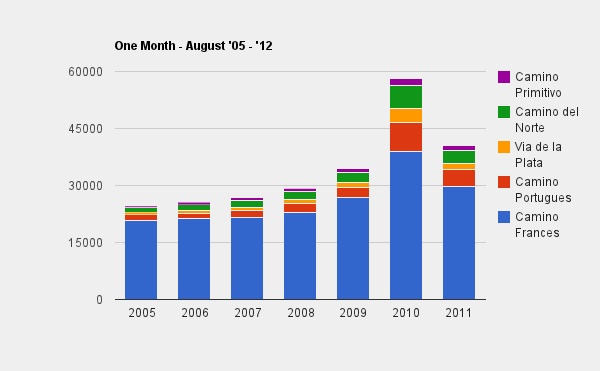
Fig. 3 - Month of August 2005-2012

Another interesting chart is for the month of August. Note in Fig. 3 how the Camino del Norte exceeds the Via de la Plata in size, nearly doubling it during this summer month.

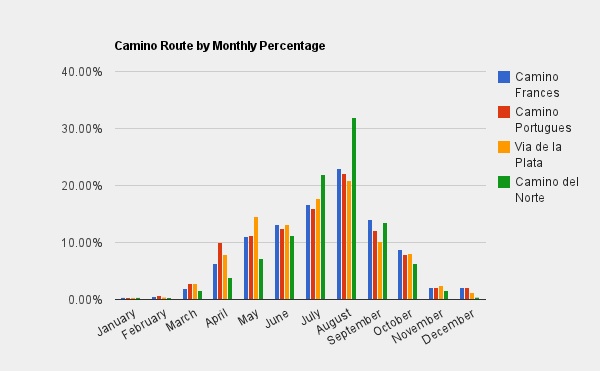
Fig. 4 spells this out in some detail. Over 60% of traffic on the Camino del Norte happens in July, August and September. See too how the Via de la Plata is quieter in the high summer months.

Each of the charts shows that the Camino Frances is by far the largest, but that its growing popularity is matched proportionally by the other camino routes. An encouraging sign is that the capacity developed for the 2010 Holy Year presumably can accommodate a continued influx of pilgrims until the point at which normal growth reaches the 2010 level.

Fig. 4 also shows that it might be best to enjoy the Camino del Norte in a month other than August, that all routes are very quiet in the winter, and that if the heat of summer abates by that time, September and October might be good months on the Via de la Plata.

Fig. 4 - Percentage by month of the top four routes.

A big thanks to the Cathedral of Santiago de Compostela for its great statistical info. It was fun to sort through the raw data and see what it says about the best months to take the various routes and also to see the enormous expansion of the Camino de Santiago over these last years.

2012 Brings Increase in Pilgrims to Santiago

In response to a question on the Camino Forum I help moderate I dug into statistics at the Cathedral of Santiago de Compostela’s website to see if the Spanish economic crisis is affecting the quantity of pilgrims heading to Santiago. Surprise! The numbers are actually up — and pretty dramatically.

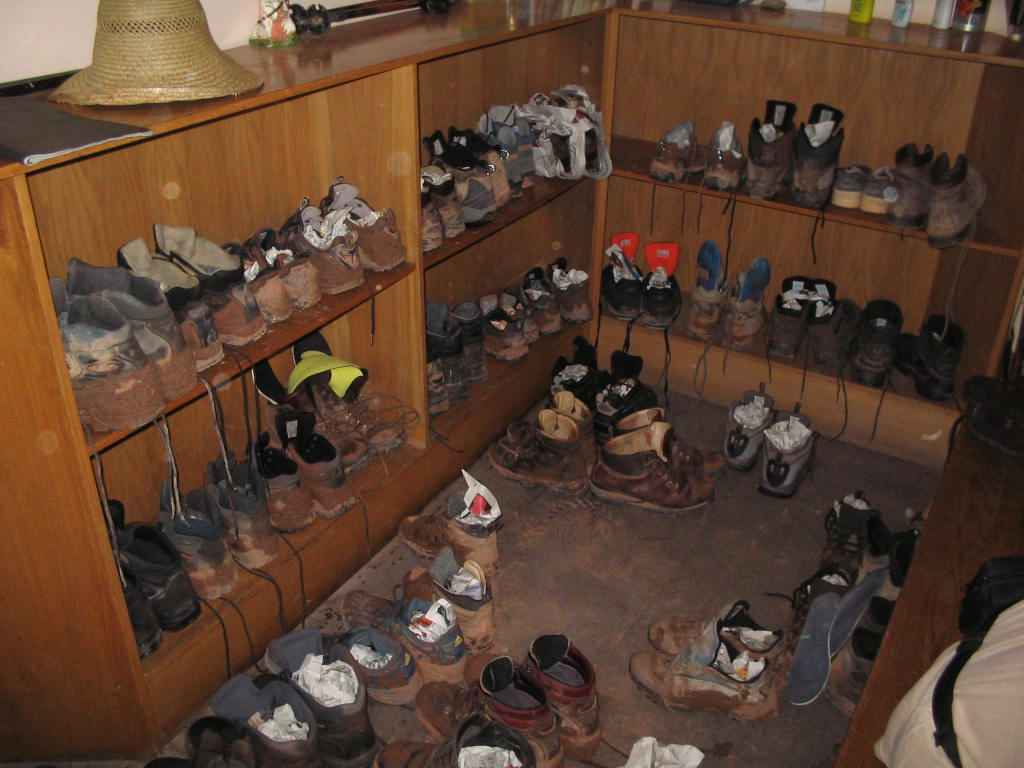
Pilgrim boots at the albergue in Najera

So far this year 5,441 pilgrims have received their compostelas in Santiago, compared to 4,493 in the same months in 2011. This follows the general increase of the last decades in which interest in the Camino de Santiago has grown each year. A 20% increase is a pretty big number.

Still, the numbers are smaller than in the first three months of the Holy Year of 2010, in which 8,691 pilgrims received their compostelas. However, at a 20% annual increase that number will soon be matched. Clearly the Camino de Santiago is on a big upswing as more and more pilgrims find something special in their journeys to the bones of Santiago.