Surprising ways Perugia is more civilized than Seattle

IMG_5140

No, America. The bowl on the left is not an extra sink.

We Americans somehow are taught to believe we’re ahead of the rest of the world, but after spending the last two months in Italy, I’m pretty impressed and occasionally a little bothered by how surprisingly civilized this place is. This is true in my temporary residence in Perugia, sister city to Seattle, my home town.

I don’t want to pretend Italy is always clean and proper. A man stopped Theresa and me the other day, and after discovering we are American, went on a long rant about how Italians throw garbage everywhere. Sure enough, in Rome the other day I chose not to take a picture of two men sitting on park benches surrounded by litter. I didn’t want it sullying the Chamber of Commerce style photos I’ll use in my guidebook.

But still, Italians are surprisingly progressive, and Perugia is a good example of this. For instance,

  • Every day is a bidet day — As I’ve traveled Italy for the last two months I lived with a family and also stayed in a variety of hotels. Without exception each bathroom came equipped with a bidet or bidet-equipped toilet. These refreshing devices are virtually unknown in America, so a little instruction could be necessary for us Yanks. The goal is cleanliness — even, as we say in America, where the sun don’t shine. That’s progress.
  • Garbage is picked up SIX times a week — While progressive Seattle is considering
    IMG_5141

    Tonight is my first blue sack night!

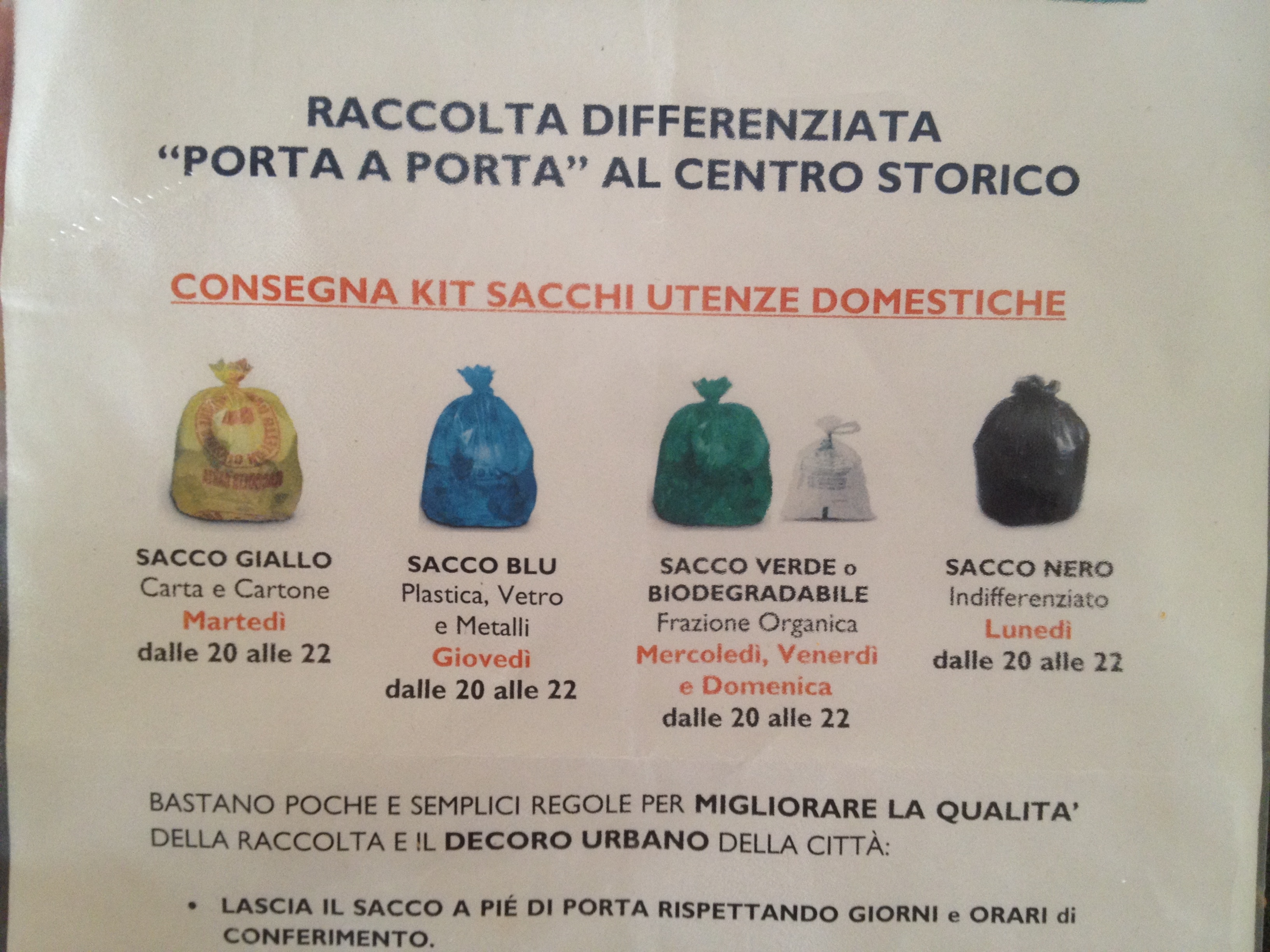
    moving to biweekly garbage pickup, Perugia picks up four types of garbage a total of six times a week. On Monday put your landfill garbage on the doorstep. On Tuesday put out your paper and cardboard. On Wednesday,  your compostable. Thursday put out your plastic, glass and metal. Friday it’s compostables again. On Saturday, take a day off to rest because on Sunday — it’s compostable day once more. I was up late and watched the process last night: a worker comes by in a tiny, white dump truck and picks up the bags. No smelly outside garbage cans at all, at least here in the historic center city.

  • Don’t touch the fruit — Correct etiquette at Italian supermarkets is to use handy, disposable plastic gloves to pick out your fruits and vegetables. Even at fruit stands you point at what you want and the clerk gets it for you. I thought about the need for cleanliness in American supermarkets last spring. I watched as someone in front of me squeezed a half dozen plums with her bare hands before picking her own. I don’t know that she was carrying any germs of any kind, but how do you disinfect a plum before eating it?
  • The streets get swept — Last night two serious-looking men with long, Italian, witch-
    IMG_5143

    This garbage dump truck is about the size of my Mini Cooper.

    style brooms wearing reflective vests walked down the narrow street outside my window and swept little bits of trash into the middle of the road. Right behind them came a mechanical street sweeper that swept and vacuumed up the debris, finishing the cleaning with a gentle rinse. I remember Mayor McGinn of Seattle desperately asking Seattle residents to go out to the corner and pick up fallen leaves because a rainstorm was coming. At least in Perugia, nothing stays around long enough on the street to clog anything.

  • My morning coffee costs €1.50 — Yep, all that great, inexpensive Italian coffee has scared away Starbucks. Who would buy a $3.50 latte when a real, Italian cafe latte is the equivalent of about $2.00? Yes, I drink it standing up in a cafe/bar with no WiFi or cushy chairs that doesn’t open until 8:00 a.m., but tastes just as good — maybe better. And I don’t have to tell the barista what my plans are for the day.
  • Italians take a nap in the afternoon — Americans think this is incredibly lazy, but the hot afternoons explain why Italians button up their stores at 1:00 and don’t return until 4:30 or 5:00 p.m. They are cool at home, with the shutters and windows closed
    IMG_5142

    It’s 11:00 pm in Perugia and the outdoor restaurants are packed.

    on the sunny side of their home or apartment, where the stone walls absorb the heat during the day and radiate it at night. Who’s outside in the heat of the day? As it turns out, it’s the tourists. They sweat their way through the shopping streets, wondering why all the stores are closed. Italian business owners would never think of opening their doors midday for the tourists — forget the business, it’s just too hot.

  • You’re not going to read about gun violence — You knew I’d mention this. Yes, Italy’s gun death rate — in spite of all the Mafia talk — is only 1.28 per 100,000. The USA is 9.42. According to my calculator, which I have no reason to disbelieve, we’re 7.4 times more likely to die by a gun in the US than in Italy. Yesterday the wind slammed the door of my bedroom shut, which sounded to me a lot like a gun going off. I worried that my neighbors would wonder if I’d fired a weapon, but then I realized they’re not living in gun culture here. They probably thought it was just a door.
20140803-102417-37457823.jpg

“Enough carrots,” Bugs says. “Prosciutto today!” Sorry, Porky Pig, but Italians are into ham. Big time.

Well, there are some things that seem little uncivilized, too. Like, I’m not sure why cashiers don’t put my change right into my hand rather than into a little dish by the register. And I wish Italy would ban smoking in outdoor restaurants as well as indoors. Also, I wish there were cold, unsweetened drinks available somewhere — anywhere. And I still don’t get how moms, dads, grandparents, teenagers and babies in strollers can stay out each night until after midnight, wandering the streets in nice clothes with gelato cones in hand. At that time of day in America we’re all watching TV.

But this is how it’s done in a traditional and ancient country that sometimes is a little more civilized.
 

The last chapter is done, now for the first twenty-eight

DSC_2929

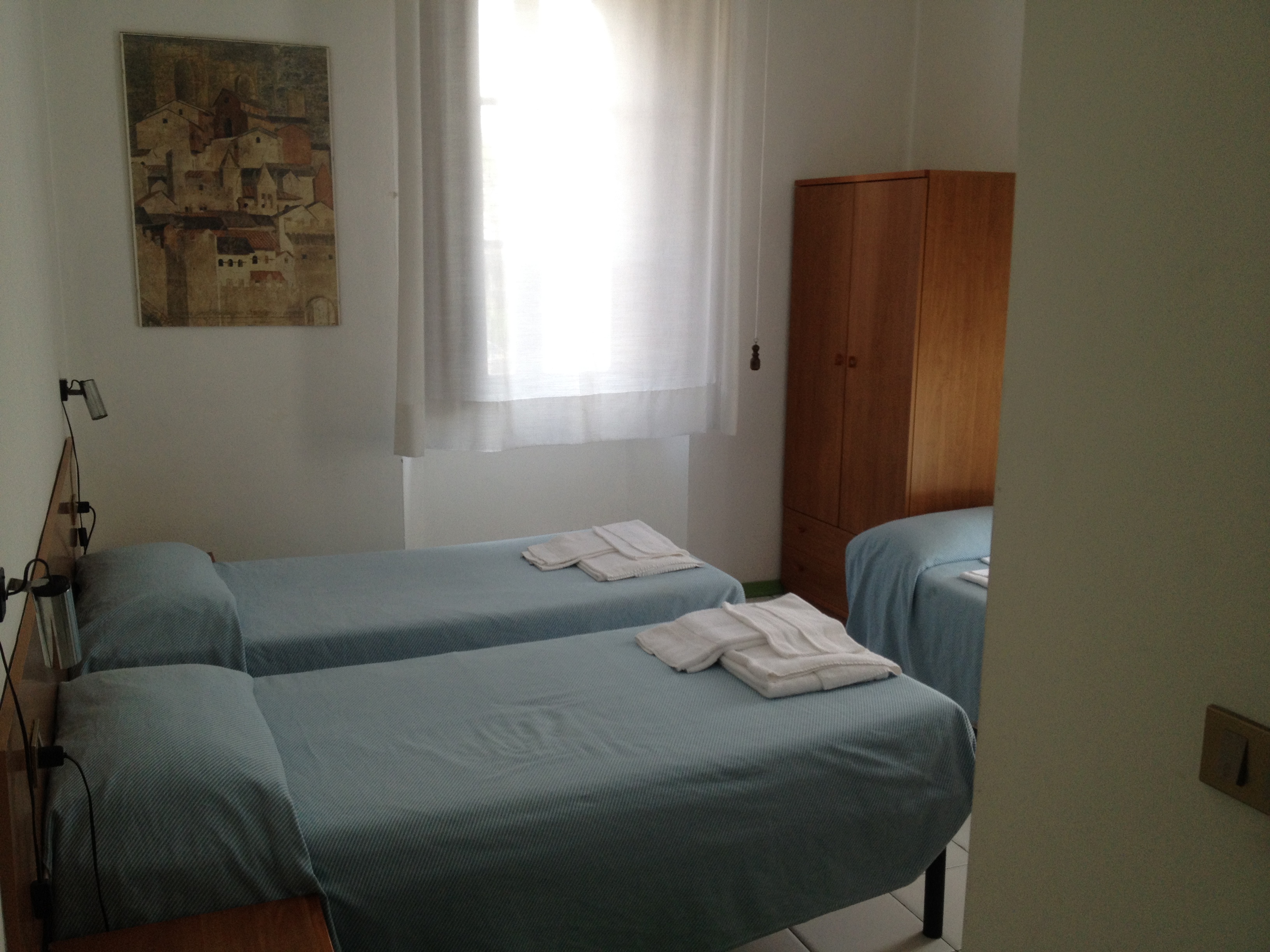
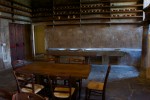
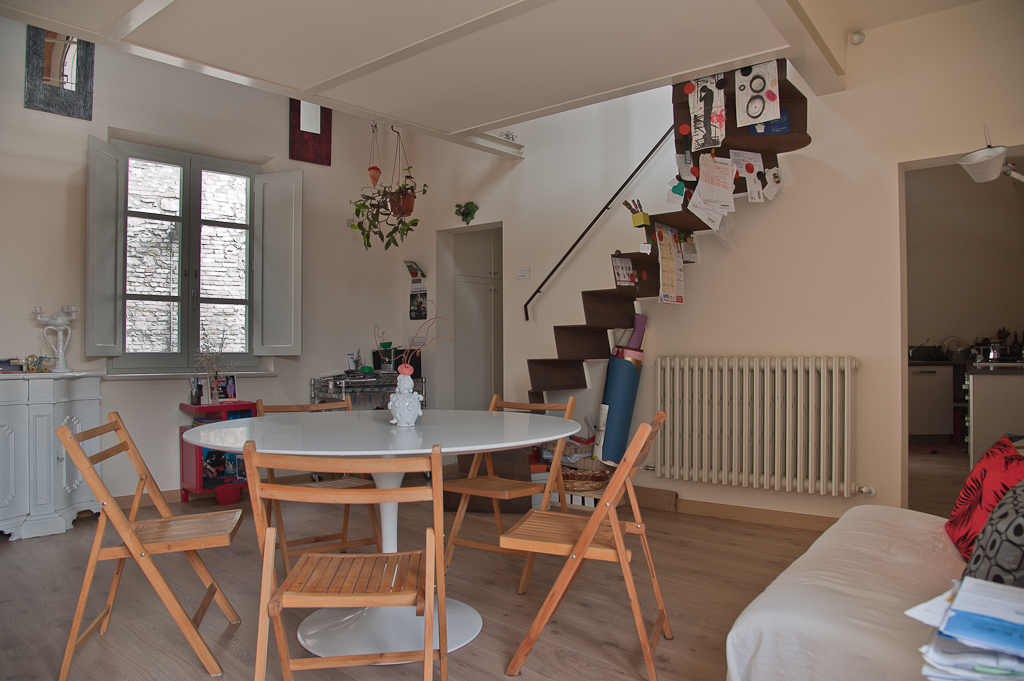
Interior of my little apartment on Via San Giacomo in Perugia. Note writing futon on right.

After a great month of Italian language study followed by another month of walking the Via di Francesco from Florence to Rome I’ve now started writing my pilgrimage guidebook: The Way of St. Francis: From Florence to Assisi to Rome. In fact, today I finished the final chapter. I just need to finish the first twenty-eight and I’ll be done.

Last spring as I planned the Italian research phase of my project I knew I’d stay in Italy for three-ish months. In the first month I would study Italian, in the second month I’d walk the pilgrimage route, and in the third month I’d catch up on anything I’d missed, including walking the route a second time if necessary. When I finished walking the route for the first time last week — with the amazing Theresa Elliott — I also finalized my plan for my last month. I decided to rent an apartment in Perugia, which is very central to all locations on the walk, and from here I can start writing while catching up on any missing pieces.

There are plenty of missing pieces. Although I’ve walked 626km (388 miles) I missed or was rained out on three stages (Stia to Camaldoli, Assisi to Spello, Trevi to Spoleto). I got lost in one stage so I need to repeat that (La Verna to Pieve Santo Stefano), and I messed up on a portion of another stage, so I’ll need to repeat that one, too (Pieve Santo Stefano to Sansepolcro). Also, in talking with a local pilgrimage expert I’ve discovered an alternate track for the first two days (Firenze to Pontassieve and Pontassieve to Consuma). This track solves some problems and may be worth including, so I’ll explore it as well. This adds up to about six more days of walking before I’m truly done with the walking/research phase.

IMG_5129

Smooth heel bottoms. On the sides of the heel you can see that the cushioning has compressed over time.

One problem with the upcoming days of walking is that my beloved Treksta Assault GTX hiking boots finally bit the dust. As I walked the last couple of weeks I felt the bottoms become slippery on downhills, and the boots have hardened over the many miles I’ve used them. As I think back, I realize I walked 700km with them in 2012 on the Camino del Norte and 626km here. They’ve done well over 1300km (800 miles) and I’ll replace them when I’m briefly in Florence this weekend. I hope I can find a pair that’s half as good. These have been excellent boots — few blisters and very comfortable — perfect for the long haul.

So during August, in between walking trips, I’ll be writing. Editing, really. As I’ve walked each stage I’ve dictated the walking directions into a program on my iPhone. Each night after I’ve walked I’ve transcribed my dictation onto my laptop — creating twenty-four separate documents. Just today I compiled all the transcriptions into a single file entitled “Manuscript” and made a startling discovery. I’m already 3,000 words over my 40,000 word limit! This means I’ll have to edit and smooth the text of the central chapters, bringing them down to about 35,000 words to make room for the Introduction and the text boxes in each chapter that describe important sites. My goal is to have the twenty-nine core chapters of the book finished when I step on the plane to Seattle around Labor Day. Then back in Seattle I’ll choose from among my 1,400 photos, compile the elevation profiles, create the maps, and then groom it all into a final submission to the publisher by year’s end.

If you should happen by Via San Giacomo in Perugia you may find me sitting on the futon in the living room of my tiny apartment on this ancient street below the Porta Eburnea, typing into my laptop. If I’m not there I’m likely walking a leftover stage between towns not far away. I’m learning to stay cool in the hot Italian summer, and enjoying this odd and productive moment in my life while I prepare what I hope will be a blessing to pilgrims who someday walk along this way.

DSC04435

This is what it looks like to research a pilgrim guidebook. Backpack…. boots….iPhone in left hand for dictation…. GPS in right hand to record the track. Crossing the aqueduct at Spoleto.

The joys of walking to Rome with Theresa Elliott

DSC04422

Theresa in Spoleto sporting skorts.

I hope my pilgrim friends will forgive me for this, but I have to say it: of all the people I’ve walked with in 3,500 kilometers of pilgrimages my favorite walking partner is my sweetheart, Theresa Elliott. I’m not just saying this because of how I feel about her. No, there are some specific reasons why I get a kick out of walking with this amazing woman.

A big part of it is that it’s fun to watch Theresa be seen by Italians. Over and over again I see women (and, of course, Italian men) stop and stare at Theresa as we walk by. In Monterotondo I watched a woman with an ice cream cone stop mid-lick with her mouth wide open, ice cream melting onto her fingers, and stare at Theresa as we walked by. I saw it so often that, for fun I started counting. “One, two … six …. ninety-eight …. four-hundred….”

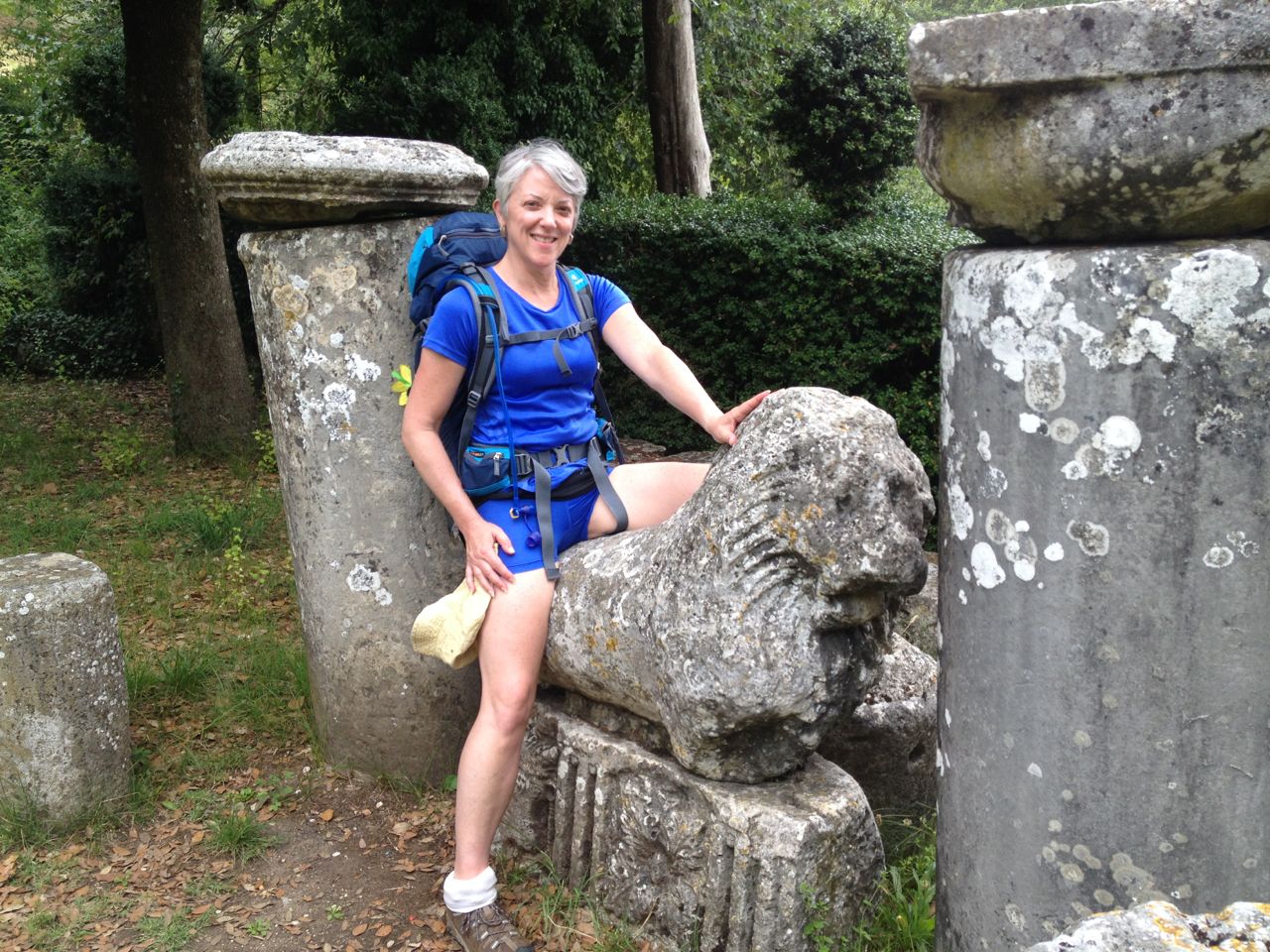
I’m not sure exactly what it is. Maybe it’s the skorts.

IMG_4496

See? Skorts are part shorts, which comes in handy if you’re riding a lion.

For the uninformed, skorts are a combination of shorts and skirt, in this case made of Spandex®. Theresa found two pair at Costco before leaving Seattle and she’s worn them almost every day while walking. Even for pilgrim women a hiking skirt is a little uncommon, but Theresa has proven skorts a great choice for hot weather walking. I’m not certain Italian women find the combination of skorts and pilgrim hiking boots to be leading edge fashion, runway bound, but the look attracts attention.

I know it’s also that Theresa is in great physical shape and her figure brings admiring looks. All those years of yoga, dancing and good self-care have given Theresa a very athletic build. She also has excellent posture and all the things our mothers told us about standing up straight (it’ll make you look 10 years younger and 10 pound lighter) come true with Theresa. She’s just a few years younger than me, but there’s a youthful spring in her step that gives her a winsome energy, which is in distinct contrast to another unusual aspect of Theresa’s appearance.

She has naturally grey hair.

I noticed soon after arriving in Italy in May that the hair of Italian women never turns grey. It’s the most incredible thing. Older women, grandmothers, great-grandmothers, elderly women in walkers, gypsy panhandler grandmothers — all have hair in various shades of blonde, brown or black, surprisingly with no strands of grey or white. I began to be suspicious until it was revealed to me by an actual Italian woman — they dye their hair. All of them do it. Just as soon as any grey appears.

Theresa does not dye her hair. Ever. She has a healthy, thick head of black, grey and white — a color combination that is not for sale at any drug store. When Italian women see this athletic, shapely, grey-haired, skort-clad, booted, American yoga teacher strolling down the lane in red lipstick they are, well, sbalordito, which according to Google Translate means … “flabbergasted.”

Consider, for instance, the three 80-ish year old men near Labro who were standing outside a farmhouse as we walked by, on our way up to the lonely peak of Faggio Bustone on a blustery morning last week. Between the three of these elderly farmers there were not enough teeth for one complete set. As we walked by they stopped mid-sentence and stared at us in bewildered amusement. Then they peppered us with questions. “Where are you from?” “Where are you going?” “Do you know there’s going to be a rainstorm today?” “Are you carrying a tent?” “Where are you staying tonight?” “Are you sure you’re ready for this?” “Do you know how steep the climb is?” And then the question most pressing on their minds: “We understand why a man would do this, but why are you bringing this pretty woman with you?” “Much less this yoga teacher in skorts?

OK, the last question was mine, but the other questions were theirs and they are all versions of the same basic fact: Theresa makes a strong impression on these Italians. And I love that. It happened again tonight after dinner. I watched a woman stop eating and just stare as we walked by. I know that one of her thoughts is, “What a striking woman,” and I know the other thought, as she sizes me up, is: “Hmmm. He must be rich.”

But watching Italians watch her is not the only reason why I’ve enjoyed having Theresa with me these two weeks during my months-long Italian sojourn. What’s even more fun is that I get to see Italy through Theresa’s eyes.

DSC04421

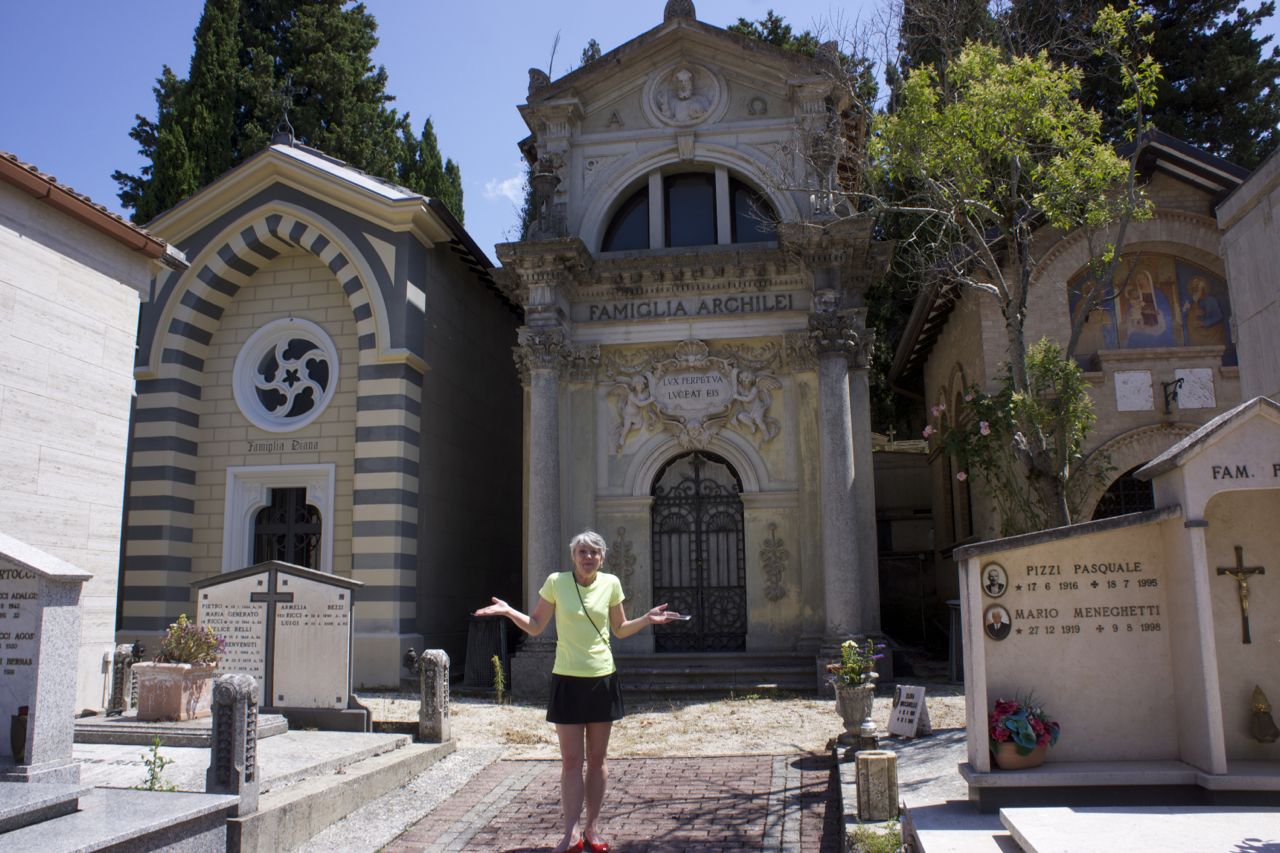
Theresa in skorts at the Spoleto cemetery.

Take for instance her fascination with cemeteries. I’ve passed right by countless cemeteries in my pilgrimages in Spain and Italy. They’re usually on the outskirts of the villages and towns along the way and, to me, seem sad and a little eery. When we arrived at Spoleto and headed to the UNESCO-listed basilica, Theresa was much more interested in the cemetery nearby. She described it to me as a fascination with the little buildings, the lives and stories they held, and the care with which they are maintained. As we walked toward Rome, Theresa most looked forward to finding another cemetery to explore.

It was interesting, too, to see how Theresa dealt with the issues around the pilgrimage itself. Remember, we averaged almost 15 miles of walking each day, sometimes on difficult terrain through brambles or up and down steep hillsides. Theresa’s athleticism helped her overcome every day’s challenges. More than that, she taught me some lessons about listening to your body.

IMG_4863

Pilgrimage is over. At the Spanish Steps in New Dress #2.

Each day of a pilgrimage I assume I’m in for an ordeal, punctuated with beauty and meditation of course. I push my body ahead whether I’m hot, cold, hungry or thirsty and keep a uniform pace all day long, onward toward the goal. Theresa’s pace varied depending on how she felt, and she was comfortable either being in the lead or being behind by 20 meters. She was always appropriately tired after the walk, but once at the hotel Theresa would take a one hour nap, after which — no matter how long we’d walked in the day — she would bounce up and be wanting to wash clothes, shop, or explore. She is so connected to her body. I push and push, collapse in fatigue at night, and drag myself grimly onward the next day. She feeds, soothes, listens, comforts and honors her body and then is quickly ready for the next day’s challenge.

During our walk Theresa overcame a couple of difficult skin rashes on her legs, as well as some sunburn on her shoulders and a few blisters on her feet. She never complained one single time. She never asked for pity or comfort. She is a very strong person and I can’t help but admire her stamina and composure.

She’s also curious. As we walked she gathered a pocketful of mementoes. Some stones, a few broken tiles, a piece of jewelry and a tiny plastic arm from a child’s small doll. I trudged past each of these little treasures, not wanting to weigh myself down with extra ounces that add up to pounds. I know she will keep these shiny little objects and treasure them as part of her long walk to Rome.

And of course it’s fun to be with her because, well, she’s a girl. She’s totally into the art and architecture and archeology we’ve seen along the way, but she can’t pass a dress shop without wondering if that dress will fit. Among the highlights of Rome — the Colosseum, the Vatican, the Forum, the Spanish Steps and Trevi Fountain — the dress shops could not be missed. Sure enough, we found a couple of beautiful dresses that look very Italian, which just means even more people will notice this strong, smart and pretty American woman as she enjoys her time in this Eternal City.

IMG_4279

After a very long first day of hiking, Theresa is still smiling as we arrive at Abbazia San Pietro in Valle.

Here at Assisi, Halfway to Rome

DSC04296

So many sunflowers on the way to Valfabbrica.

Here in Assisi, the halfway point of my walk from Florence to Rome, I’ve stopped, relaxed a bit, and had a few moments to take stock of this camino so far. Since I walked last year from Assisi to Rome I’m back in familiar territory. The last weeks, between Florence and Assisi, have been an exploration and discovery. I set out on June 28 and today is July 12, so it’s been about two weeks of tough and beautiful walking.

So here’s what it looks like by the numbers:

Distance Log

If you study the chart closely, you’ll see that I’ve walked 272.9km over thirteen days. That’s an average of 21 km (13 miles) per day. This is about average for me compared to prior caminos. What is different is the aggregate elevation gained and lost. Camino de Santiago regulars are familiar with the Route Napoleon from St. Jean Pied de Port to Roncesvalles, a very tough uphill/downhill day that crosses the Pyrenees with an elevation gain of 1240 meters. Averaged over the 13 days of this camino the elevation gain is a daily 675 meters — about half a Route Napoleon per day. Two of these days almost match the Route Napoleon for elevation gain, and while the Route Napoleon loses only 469 meters by the end of the day the average daily elevation loss on this walk is nearly equal to the elevation gain.

On the bright side, though, there are some great views from the tops of these mountains around here.

A question I’m often asked about this route is — are there low-cost hostels so you can keep costs down? The answer is a qualified “yes.” There are hostels, almost always located around parish churches or monasteries, but you have to call in advance to book a room. In some cases, you have to have the correct credential or you will be turned away (there are three quasi-competing caminos covering much of this territory). Most of the time I have chosen to share a double room in a hotel which has meant that my nightly cost is about €30-35 plus meals.

DSC04174 copy

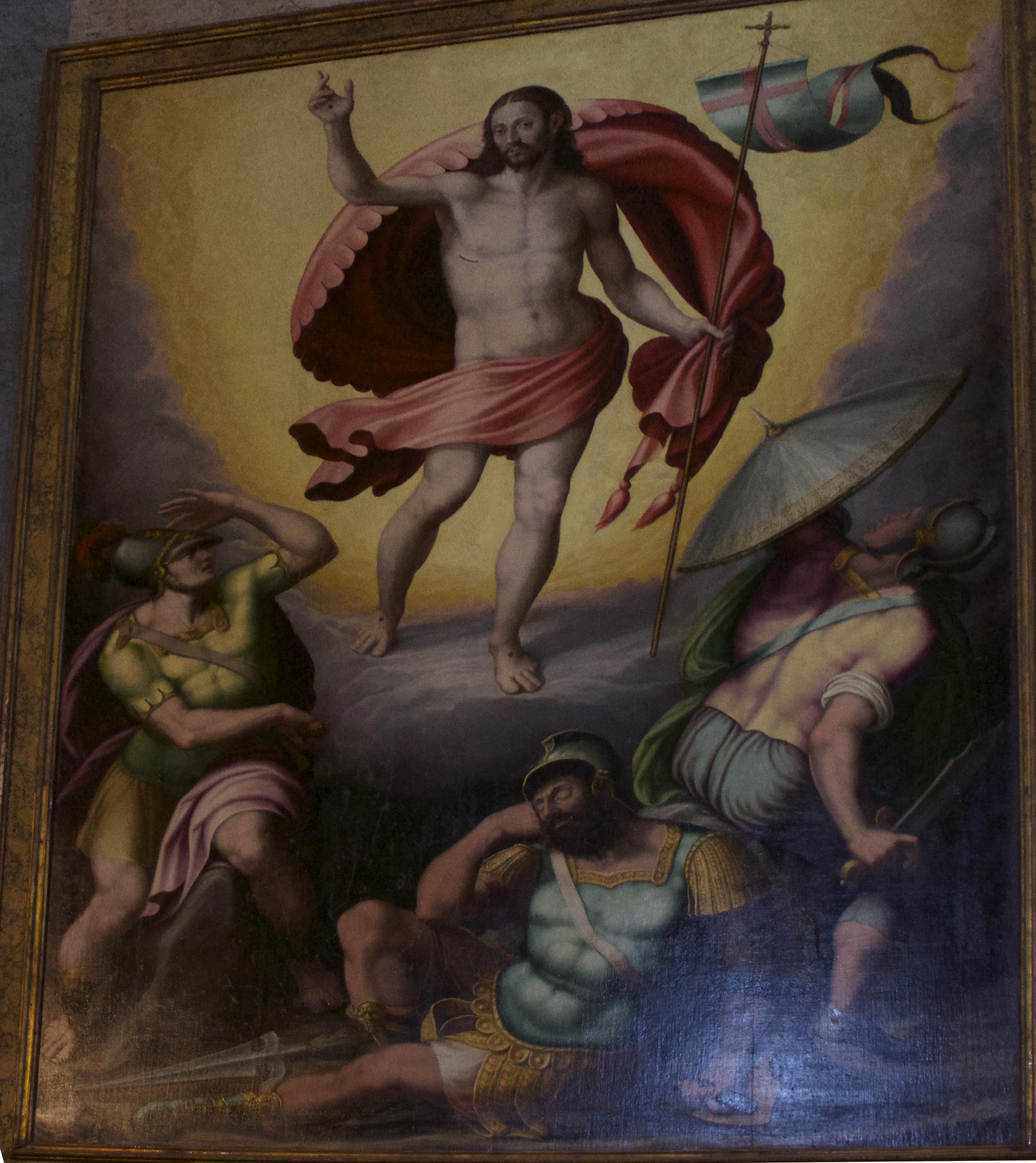
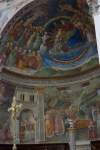
And this amazing 500-year old painting was just hanging there in the empty cathedral.

Italians are famous for their food and you have to examine menus carefully to find inexpensive options. Breakfast is coffee and toast. Lunch is a panino. There’s always a snack in the afternoon. Dinner starts late — 8:00 pm — and can take hours and cost €€€ if you do the whole antipasto, primo, secondo, dolci ritual. People on a budget can turn to the “contorni” page (side dishes) find a mixed salad and then order a pizza or pasta for a main course, usually for around €10 total.

Really the biggest question should be, “Is it worth it?” For me, the answer is unequivocal. Yes. If you’re in fairly good shape, find a part of this walk and do it. If you have a month and can handle it — do it. There are many sections that are very manageable for any average walker, and many of the harder ones can be avoided by taking a bus or train. If you’re not scared of exercise, you will be rewarded if you do the whole thing.

The other day when I was walking around in the cathedral at Gubbio I started to realize how absolutely amazing this walk is. I walked from bay to bay on the left side of the nave and looked up at each individual painting hanging there. Here are masterworks of Virgilio Nucci and others from the 16th century — items any museum in America would be delighted to display. And they are just hanging there, almost ignored in this cathedral set high enough above the city that you really have to want to get there.

The same is true in almost every corner of this territory. Walk into an old church and you won’t be surprised to see a 12th century fresco. This saint or that saint walked over here or over there. Here’s an Etruscan arch from before the Roman era. Here’s an aqueduct from the time of Christ. Or a mosaic. Or a sculpture. Or a tomb. Amazing.

IMG_4115

Funny, I have no photos of myself. But I did take one with the cool new shirt I bought in Vienna.

And I, how am I? Health-wise, I’m fine. Tanned, a little lighter than before, a little sore in the feet and legs. Most of all, I’ve walked alone a lot. I’d hoped to walk for a week with Jacqueline, but her extreme knee pain kept her in buses and hotels. Since she joined me at La Verna she had only two walking days. But she was great company at other times during her eight days total on this trip.

In terms of the book project, it’s going fine. I have dozens of pages of transcribed notes from each day’s walk. I’ll need to go back and redo a couple of stages, but I’ve covered the essentials for thirteen of the fourteen walking days. When I’m done with the remaining two weeks’ of materials I’ll hang out in Perugia for a month and gather my notes, work on the text itself, complete a thorough list of accommodations available each day, and then compile it all. I’ll be back in Seattle sometime just after Labor Day, and then will put the project to bed by the December 31 due date.

The walk has felt very much like work — the hard work of muscles, legs and feet. Sweaty. Thirsty. Hungry work. I’m hoping it will be more playful in the days ahead, when Theresa and her sweet spirit are here to greet me every day and to share the walk.

Sometimes from the middle of a project it’s hard to say, “Wow, this is great.”  I know when it’s all done, though, I’ll look at this summer as a golden memory, a dream, a fantasy. But in the meantime . . . . tomorrow I walk.

Nine days done, twenty-one to go

IMG_4150

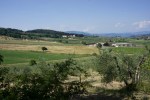
The panoramas are unbelievable. This is taken from Citerna toward Citta di Castello, tomorrow’s destination.

All year I’ve been gearing myself toward thirty critical days, the four weeks plus two days in which I would actually walk the route that is the subject of my upcoming guidebook. It’s hard to believe that I’m nearly one-third of the way through. I’ve learned a lot about a wonderful and quirky GPS device, about a great camera on loan to me, about myself, and about the difficult and beautiful way I’m walking from Florence to Assisi to Rome.

I should say first of all that I’m fine, my health is fine, all my gear is intact, I’m not lost (at the moment) and I’m having a good time. I should also say that in the last few days I have been dealing with very hot temperatures, long days of walking and some poor way marking that has meant I’ve sometimes had to invent my own way to get from one stop to another. And let me say too that there has been some good company along the way. Dear Jacqueline has been with me since La Verna, three days ago, but unfortunately her knee has given out and she’ll be taking the bus or train to Gubbio and then on to Assisi, skipping ahead about five days and then heading back to Vienna. I’ve met other pilgrim friends — three Italians, a Frenchman, an older German couple and three fun mental health professionals from Lübeck, Germany.

But this walk is different than any other walk I’ve done. What makes it most different is that I’m working as I walk. I walk with the GPS in my right hand, with my iPhone in my left hand, and with my camera strapped around my neck. Every step I’m looking for a good photograph, making sure I don’t miss a turn in the way for the GPX way marks I’m creating, and describing it all into a dictation program on my iPhone.

Every day I learn more about the GPS device. I learned yesterday that if I stop the stopwatch function I also stop the track recording. This is bad. In my futile attempt to save battery I just erased the steps I’d walked (though I later found a way to recover them).

As I walk, though, I find that I’m thinking not about myself but am thinking about how best to describe what I’m going through for future pilgrims who will read The Way of St. Francis.   I’m taking the sights of this walk and trying to explain it in words that will go on a page, along with a few maps and photos. How do I condense all this experience into a book small enough that pilgrims will be willing to toss it into their backpack with them? How do I make sure they don’t get lost (like I have 3-4 times in 9 days)? How can I be certain I haven’t missed a turn or a landmark that will be explain where they’re at and where they should go? How also do I represent the amazing sights along the way, like the serene Santuario della Verna, nestled atop a mountain in the Central Apennines?

So many questions, and as I walk ahead and blindly speak into my iPhone I recognize I won’t have the answers until I finally sit down with all the material at the end of my walk and begin to flesh out what can and can’t go into the guidebook. At that point I will probably be hundreds or thousands of miles away from the trails that are the source material for the book, and I will just have my recordings, my photos, a pile of receipts and some random memories of hot, long, beautiful days in Tuscany, Umbria and Lazio.

Oh, and I’m using my Italian every day. I wish I’d listened better to Flora, David and Maria of Comitato Linguistico in Perugia. But even though I wasn’t the best student I’m putting their helpful lessons to work all the time, and my Italian is getting better.

Random reflections in the rain

PandelPellegrinoAround midnight last night I started to become annoyed at the loud talking and laughter coming from the restaurant below my hotel window. I don’t think I wished any evil on the loud diners, but if my thoughts magically caused the midnight thunderstorms and torrential rains I feel only a little guilty. With the loud and sudden downpour the merry making quickly ended, and somehow amid the crashing thunder I fell into a gentle sleep.
I realized this morning as I was greeted by a dripping day that guidebook writing and rain do not mix well. My walking routine requires having my iPhone in one hand for dictation, my GPS in the other hand for directions and distances, and my borrowed camera strapped around my neck for photos. All these electronic gadgets don’t fare too well underwater, so I decided to take the train and bus to my next destination instead, Camaldoli village. Here I could catch up on writing and editing, do some of the map and photo work I’ve skipped, and send my sample chapter to my publisher as promised by June 30.
It was no small decision to skip ahead. This means sometime this summer I’ll have to return to this little town of Stia in the Central Apennines in order to complete this walking stage in better weather. My schedule pulls me ahead, though, since I’m meeting my pilgrim friend, Jacqueline, in three days at Della Verna for a week’s walk to Assisi.
Once in Assisi I come to the high point of my summer — walking for two weeks to Rome with my sweetheart, Theresa. She’s been training in Seattle for the walk and, given that’s she’s already in great shape, I know she’ll be a happy and fun partner.
In the meantime, the rain gives me a chance to do some planning, writing and thinking.
The planning part was very basic. Today my employment as a pastor officially ended and outside of some mixed feelings there is practical work to be done: I need health insurance. Before I left Seattle I’d signed up on the Washington health exchange but never heard anything back (except that they cashed my check). Today I spoke for over an hour on Google Chat over sketchy WiFi with the State of Washington and my insurer. The result? “Call back in a week while we figure out what happened.”
The writing part was also pretty straightforward. I worked on my maps of the first three stages, using PhotoShop to add a redline over the trail I had marked with GPS as I walked. Every time I use that little gizmo I give thanks to the First Churchers who kindly gave it to me as a going away gift. So after today’s efforts I have three draft maps — one for each stage I’ve walked so far.
The thinking part is the most complex of my tasks under these cloudy skies. I’m feeling disconnected from family and friends due to the distance and the length of my sojourn. I’m feeling a little sad to miss events like Seattle’s Pride Parade and First Church’s participation in it. I’m also feeling sad about the loss of a close working relationship with the great First Church staff members who’ve been colleagues and friends over these last years. I’m missing the congregation and the many familiar and loving people who filled my life. On a rainy day when I’m not walking, the distances feel bigger and the time away seems longer.
It reminds me of a feeling from my first camino, back in 2008. I’d thought I was looking forward to some solitude and I remember taking the last train before my walk, seeing pilgrims with backpacks, and resenting them for intruding on “my” solitude. Within a short time — about a day — I was reaching out to pilgrims of all nationalities, hoping for some basic, human contact to break through my newfound loneliness.
As much as I want to think I’m self-contained and self-sufficient I discover again and again on these pilgrimages how much I depend on human interaction. I loved my time in Perugia, mostly because of the new friendships with Italian language students from around the world. I seem to crave both adventure, which takes me away from what is familiar, and intimacy, which comes only with deep roots. I know this is the enduring contradiction of my life and I’m not sure I’ll ever be truly happy until I can both be on the road and in the midst of friends and loved ones.
So until I own my own jetliner and can transport everyone I care about along with me I’ll always be a little unsettled, a little restless. Gail said of me before we split up, “You are brilliant and restless.” The brilliant part, she liked. The restless part she could never accept, much less love.
As for me, I’ve come to accept the restless part. In my work its focus on the future has kept me unsatisfied with an unsustainable or unjust present. So I’ve held political office, hosted a TV show, unseated a mayor, led protest demonstrations and marches, started organizations, fought institutional inertia and publicly challenged unfair rules. I’ve sailed across the Pacific, walked over 3000km in Europe, skippered sailboats in the Mediterranean, led tour groups to Israel, Turkey, Italy and Egypt, and studied five foreign languages. I’ve completed a doctorate and raised two healthy sons. I’ve also had two unhappy marriages, both ending in painful and difficult divorce.
So much to think about, but the rain has ended, night has fallen, dinner is served in the restaurant below my room, and the sun will come out tomorrow. So enough of planning, writing and thinking. Tomorrow it is time to walk again, to take this restless me and make it so tired and happy that it has no choice but to rest. I’m walking now toward Theresa, toward home, and toward whatever rest or promise or hope the future holds.

A round of applause, please, for German pilgrims

IMG_3975

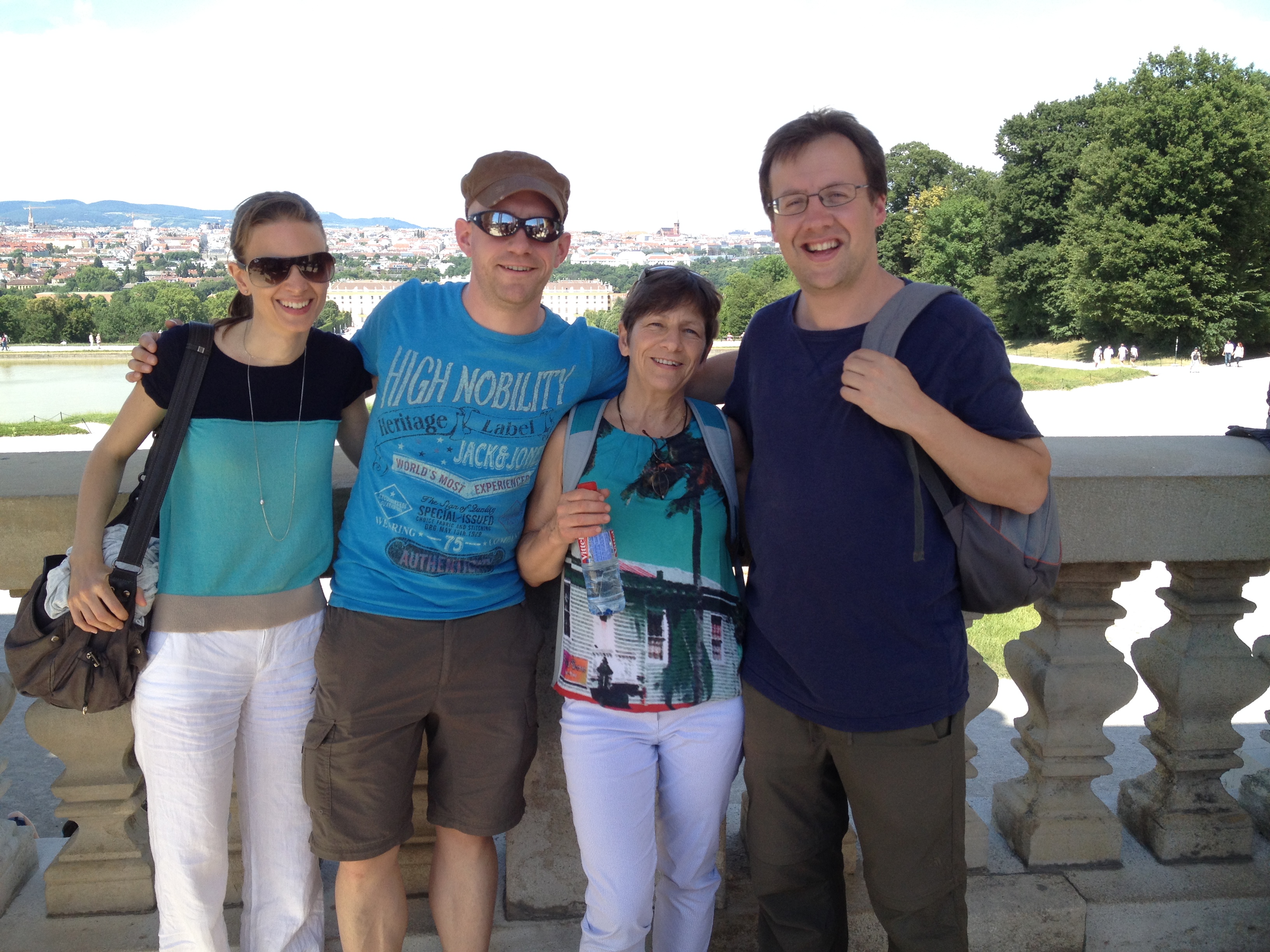
From left: Jacqueline, Sebastian, Monique, Martin (missing Annina)

It’s been several days since I posted and a lot has been going on — all of it good. After leaving Perugia I stayed almost a week in Vienna, visiting pilgrim friends. Among the group from my 2011 camino were Sebastian (a German pilgrim and fireman), Jacqueline, (a German speaker from Austria who was our helpful host), Martin (an Englishman who speaks fluent German), Annina (another Austrian who speaks German) and Monique (a Swiss woman whose primary language is German). Yes, that’s a lot of German, and they were nice enough to speak in English for the one non-German speaker in the crowd. We had a fabulous time, full of memories and friendship and warmth. Our “camino family” meets for a reunion twice a year, but this is the first time I’ve been able to join them. Kudos to Jacqueline for her great job organizing our schedules and flights to get us in the same (beautiful) place for a great time.

After a quick trip to explore Salzburg, I headed to the airport and flew to Florence to begin my month of walking and writing as I make my way to Assisi and on to Rome. After I arrived I spent a relaxed time in preparation, and the next day (Friday, June 27) I headed out to retrace the walk Jacqueline and I took a few weeks ago to Sant’Ellero, the first stage out of Florence. This time I wanted to get a good GPS track of it and also catch up on some photos. The walk went well and I have good text, photos, a map and other materials to send as a sample to my editor. I took the train back to Florence to spend the night there and immediately headed to the Basilica of Santa Croce, which is the starting point of this walk, to see if I could get in, but I missed it by just a few minutes. This is the third time I’ve missed entry to Santa Croce, and sadly it was my last time in Florence. My photos from the exterior will have to do.

The next morning (Saturday, June 28), I toyed with the idea of waiting until 9:30 so I could get into Santa Croce, but instead jumped back on the train at about 8:30, got off at Sant’Ellero and walked from there to the little village of Consuma, near the top of the Passo del Consuma over the mountain ridge from Florence. On this stage I met other pilgrims! A German trio of women is walking as far as Sansepolcro, about a week from here. One of them (Christine) has pretty decent English and she apparently has been designated to speak English with me. We played leapfrog (figuratively) on the way up the mighty climb to Consuma. They stayed last night at the same hotel as me — the Hotel Miramonti, but had dinner on their own. I suggested we get together for dinner the next night (tonight) when we’re all staying at Stia.

IMG_4103

My sunny hotel room in Stia, just above the main street.

I got up early this morning (June 29) and headed out of the hotel at about 7:15 so I’d have more time to rest and write at my next goal, the village of Stia. The 16km day was tiring, mostly because I’m not quite in “pilgrim shape” yet and my leg muscles were tired from the day before. When I arrived in Stia the waitress/front desk person greeted me and told me my passport was on the way. “Passport?” I said. “I have it right here.” It was then that I realized the front desk at the Hotel Miramonti hadn’t returned my passport to me — and I hadn’t asked for it. I’d walked all day without it. “I know more than you,” the kind woman said with a smile. “There are some German pilgrims who are bringing it for you.” As I was finishing lunch Christine arrived with my passport in hand. I didn’t really miss it, but it’s nice to have it back. I know I would’ve missed it later.

So . . . .I’m sitting here in my hotel room on Stia’s main street, procrastinating and blogging instead of writing in my book. I’ll have dinner later with my three new friends. It’s been a lovely day that ended well, thanks to some German pilgrims. (P.S. I’d take a photo of my passport, but in the European style the front desk at the hotel has it).


Some Goodbye Thoughts about Beautiful Perugia

IMG_3871

Last night’s goodbye celebration with this wave of language students (from left: Esther, Anna, Jonna, Ibrahim, Roxanna e io).

It’s time to say goodbye to Perugia. Like standing on the beach with the waves pulling sand away from my feet I’m feeling the current that is about to carry me away. Four weeks ago I arrived in a wave of new students. Over the next weeks I watched as other students came and went in each week’s flowing tide. I’m catching tomorrow’s wave, so it’s time to say goodbye to this place I’ve come to call home. Tomorrow I leave for Rome, then I’m off to Vienna to visit friends, and then I return to Florence to begin my walk over 30 days to Assisi and on to Rome. I’m grateful, but also very sad.

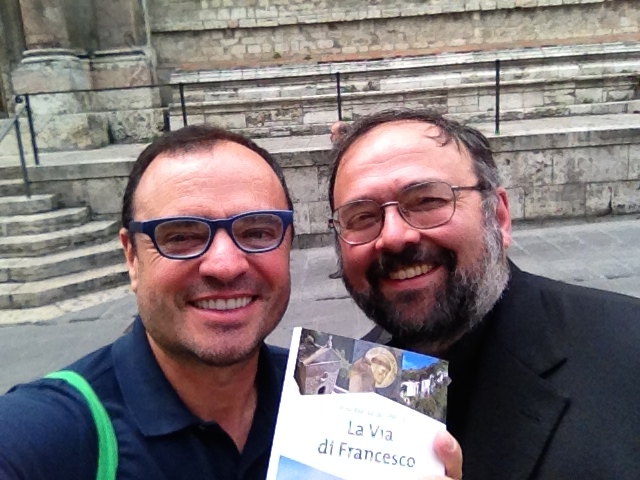
Don Paolo Giulietti, fellow pilgrim and priest

Don Paolo Giulietti, fellow pilgrim and priest

Goodbye to the teachers and staff at Comitato Linguistico (Frederica, Flora, David, Luca, Ugo, Floriana, Giulia), goodbye to the friends I’ve made who live here in Perugia (Gigi, Chiara, Don Paolo), goodbye to my new friends among the waves of students from other countries (Flavia, Thomas, David, Anna, Roxanna, Ibrahim, Jose, Renate, Esther, Jonna, Yagmur, Christopher, Tamila, Patricia), goodbye to my Italian family (Graziella, Luigi and Alessandro).

And goodbye to this beautiful city. Perugia is a special place, a old and gentle city with a lively student population from all over the world, an earth colored town, set on a hill with farmland on one side and green hills on the other. It parties hard when the hot sun goes down, and it cocoons quietly when the weather is cool and wet. Its many hills test the feet and legs, but all exhaustion is smoothed away by its chocolate, its gelati and its wide rivers of Umbrian wine. Perugia taught me how to enjoy Italian food and how to drink like an Italian — from aperitivo to digestivo and beyond. When I get home, Theresa and I will have to do our very best to recreate the Limey served at Dempsey’s on Corso Vanucci.

IMG_3781

We got the colors backward, but this photo with Patricia and Roxanna warmed hearts and raised eyebrows.

I learned to drink like an Italian, but did I learn to speak like an Italian? Four weeks is not nearly enough time to cram a beautiful and complicated language into my 56-year old brain, but I can have simple conversations now and I do understand a fair amount of what I hear. As is usual for me with a new language, I read much better than I speak or write. My four weeks have been worth every penny, and as I calculate the dollars I realize it’s been much cheaper to spend this four weeks here in Perugia than to spend it at hotels and restaurants in a typical vacation. My tuition, room and board for four weeks was under €1,600 (about $2,200). The friendships were free.

Some people — Italians even — asked me why I would study Italian before writing my guidebook. It was out of respect. Respect for this country, respect for this culture, respect for this people. I feel that after a month of language study I’m more than a tourist in Italy. I’m a student of Italy. As I walk the pathways between Florence, Assisi, and Rome I will walk with a greater appreciation and a growing love for this beautiful place and a more practiced eye to help me understand and learn.

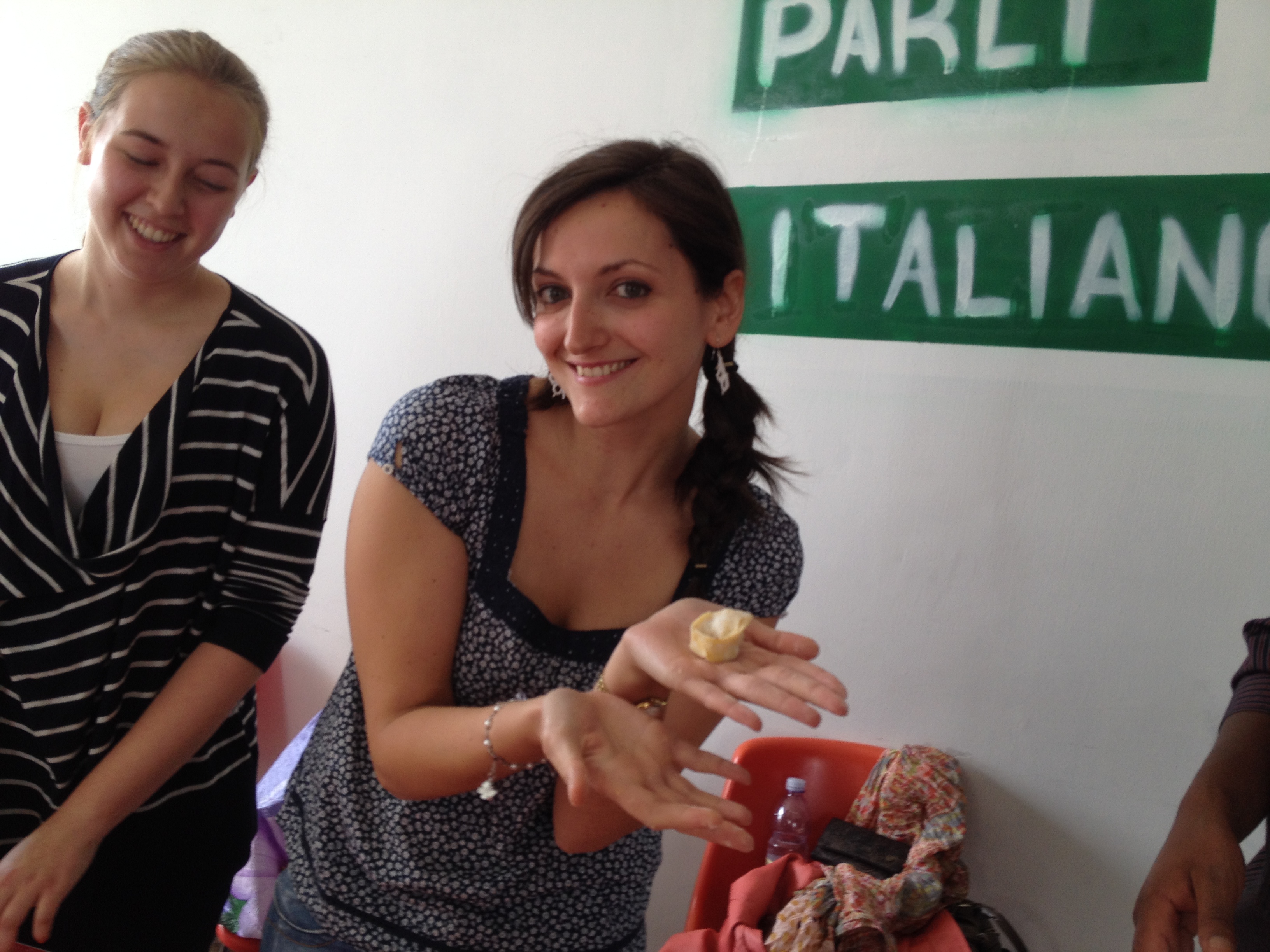
Teacher Flora schools us in correct preparation of tortellini.

Teacher Flora show us what a tortellini should look like.

I found teachers at Comitato Linguistico to be impressively intuitive and extremely helpful in the process of immersing us in the Italian language. When I was puzzled in class, like the strong, happy, young mother she is, Flora would cock her head, look at me with a smile and loudly say, “Sandy! Capisce?” After a few questions and answers I would nod and she would smile and say, “Okaye,” the Italian version of our American word. I would then correct her and say, “Solo in Italiano per favore.” “Va bene,” she’d then say, with another big smile.

I had fun with “OK.” In feigned frustration over dinner one night I took a few minutes to teach people from various countries how to say “OK” in correct, American English. Today, my teacher David came to class with a big smile on his face. He called me over and in pen wrote this word on his palm: “Okè.” He looked at me to see if he had found a way to spell it to help in its correct pronunciation. “Va bene,” I replied, with all the pride of a first-time language teacher.

My teacher David, who mastered the correct pronunciation of a helpful English word.

My teacher David, who mastered the correct pronunciation of a difficult, but helpful English word.

I would love to come back to Perugia one day — to see these amazing people and to enjoy their beautiful city for at least a few weeks more. These people know how to enjoy life. People who come here, if they are open to it, may be taught as much about happiness as they will be taught about Italian. Every piece of chocolate (or Nutella®) seems to be eaten with a particular delight. Every bit of pasta is the best pasta ever. Every glass of wine has the bouquet of rural Italy. Things seem deeper and more connected here. More sensual. Even the people. I was a stranger a few weeks ago, and thanks to the warmth and hospitality of many, I’ve been made to feel at home.

However, this home is like a beach. The tide is coming in tomorrow morning and it will wash me away, the sands shifting under my feet until the current carries me onward. Here, on Monday, another group of students will arrive in the next wave, and then the next, and on. They will find joy and heart and laughter mixed with pasta and pizza and passato prossimo. They will come to learn Italian. They will leave with an appreciation for this place, like all of us this month who found a happy home for a brief time on a beautiful beach in central Italy.

Mambo #5 (+Uggo) at Spoleto

After class today we had a fun excursion to Spoleto, a great town here in Umbria with much to see. I took lots of photos of the town, but I’m saving those for some guidebook someone’s writing. Here are some fun photos that I hope you’ll enjoy. Ciao!

I get by with a little help from my friend

DSC03265

Jacqueline in a covered walkway along the Arno at the start of Saturday’s long walk.

As I sit on my bed with the sound of birds chirping outside the open window and the orange rays of the setting sun glancing off the floor of my room, I take stock of how I’m feeling today and ask the question, do I really get to do this for 30 days in a row?

Following yesterday’s grueling 30 km walk in the searing Italian sunshine I’m tired, my legs are sore from my hips to my heels, the toenail on my left foot is turning blue, I’m suffering from something called golfers’ vasculitis, and I’m missing home and loved ones. But I’m excited that I’ve finally hit the road and I’m starting to feel that pilgrim ecstasy that other pilgrims know. It is the joy of walking that pulls a pilgrim out of bed each day as the trail calls forward to each new day of challenge and progress.

The weekend began on Friday with a 2-hour train trip from Perugia to Florence, where I met Jacqueline of Vienna, a fellow pilgrim from caminos in 2011, 2012 and 2013. Jacqueline has already been a huge help to my guidebook project. She found a German book that describes this track and translated portions of it so I could more easily follow the less-traveled stretch from Florence to Della Verna, where the main trail picks up. In translating it she discovered the primary weakness of this route — there is no easy way to get out of Florence. In fact, the guidebook suggests starting in Florence by getting on the train for 20 minutes and then walking from a place called Sant’Ellero Sull Arno. From Sant’Ellero a person picks up a clearly marked trail to the next town of Consuma.

DSC03282

We stocked up on food at this excellent roticceria, assisted by a proud father and son team.

Well, Jacqueline insisted there must be a way to walk to Sant’Ellero, so she researched it online and decided to fly from Vienna to Florence with the express purpose of joining me for a walk, to prove her theory that the walk can be done without resorting to trains. Of course, we both knew that the primary requirement to end a walking stage is that there be accommodation. We also knew that the best way to see if there is accommodation is to go there and ask.

So…..on Saturday morning, June 7, we set out together from Florence’s Basilica of Santa Croce to walk to Sant’Ellero. A little overshadowed by its neighbor, the Duomo, Santa Croce is the largest Franciscan church in the world, which legend says was started by St. Francis himself. It’s also rumored to have relics of St. Francis — some of his clothes and such. Santa Croce is also home to the tombs of some of the most famous Florentines — Michelangelo, Galileo, Michiavelli, Rossini, and more.

DSC03312

Looking down to Florence in the distance, with the Duomo on the far left.

Jacqueline and I set out after a leisurely breakfast  at 9:00 in the morning. Oops, we missed the coolest part of the day. The weather forecast called for a steaming plateful of Italian heat, and even by mid-morning we had begun to sweat. The GPS track we downloaded from WikiLoc (thanks, Gigi Bettin), sent us along the Arno River, then out of Florence toward Bagno di Ripoli. After about 5 km we were beyond the exurbs of Florence and feeling good. We stocked up for lunch at a great roticceria and, seeing the mountains ahead of us, we began what we knew would be a hard uphill climb.

In fact, the road started to climb very steeply. At a settlement high above the valley called Bigallo we caught our breath at a very fascinating spedale (hostel) for medieval pilgrims who’d chosen to walk to Assisi from Florence and parts prior. This gave us extra confidence that Florence is a great place to begin this trek, after all, we were walking in the footsteps of pilgrims from centuries past.

After lunch we turned left, across from Bigallo, to begin the more remote section of our walk where we’d been told by a bartender in Bagno di Ripoli that we’d find a beautiful path along a Roman road. Sure enough, soon we were on gravel roads, climbing and climbing. Then we came across a stretch of what obviously was Roman pathway, given its ordered and rounded stones. We continued to walk. And walk some more. By olive orchards. Through olive orchards. Through forests of pine. Through forests of oak. Along gravel paths, along Roman roads, and only briefly along asphalt drives. All of the walk under the 90F (33C) Tuscan sun.

Even as very experienced pilgrim walkers we were a little overwhelmed by the distance. Part of it was the sun, another part was that I was stopping every few hundred meters to speak into the dictation program of my iPhone in order to take notes or I was pausing every little bit to take photos. By about 4:00 p.m. we’d already walked 7 hours, and we soon came across a sign that said the next town of any size — Rignano Sull-Arno — was still one and a half hours away. Our final goal of Sant’Ellero was another 3.7 kilometers beyond that. A little despair began to set in.

I started to drag a bit, and Jacqueline trudged on ahead. Finally we came to Rignano. After a tall iced-tea that perked me up a bit I began to ask in my two-week new Italian if there were any hotels in the area. Immediately two men in the bar were on the phone to find us a room for the night at the house of someone who lets rooms. I explained that it wasn’t for tonight we were looking, but for the future, and they left me with a phone number I could call for more info. We also noticed a campground here, as well as a B&B a few kilometers out of town. Progress.

By this time it was 6:00 pm and even Jacqueline was beginning to drag. Still, our goal was Sant’Ellero which also included a train station where we could catch an 8:00 train back into Florence. At a second bar we asked about foot paths from Rignano to Sant’Ellero, but were told the only way to get there was by walking along the highway. We scouted around a bit more before we left Rignano at about 6:30 p.m. for our day’s final walking goal.

All roads lead to Rome, but not all roads were built by Romans like this one.

All roads lead to Rome, but not all roads were built by Romans like this one.

The 3 km walk along the highway was every bit as treacherous as we feared. Cars whizzed by, while we had just the space of the white line and a few inches beyond it as our path. Thankfully, with 1 km left, a red brick sidewalk appeared and we headed off the white line and into Sant’Ellero, noting signs for a B&B 6 km out of town. Here we also found a map mounted on a wall at the train station that clearly spells out the footpath to Consuma, stage two of the grand St. Francis adventure.

Utterly exhausted and a little dehydrated after 11 hours of walking, much of it uphill in the blazing sunshine, we caught the 8:00 p.m. train back into Florence.

Over a dinner of pasta and salad, Jacqueline and I asked ourselves, would pilgrims really want to walk this hard and hot walk, and then pick up and do another hard and hot 25 km (15.5 mile) walk the next day? Especially in heat like this? On the plus side, there are amazing views of Florence and many panoramas of beautiful valleys and farms along the way. A walk along an ancient Roman road is pretty awesome, too. The lack of accommodation is a challenge, though, but a pilgrim can take the train back into Florence like we did — it’s just a €3 transaction and 15 minutes on the hourly train — and then return to Sant’Ellero the next morning by train for Stage 2.

Then we asked ourselves the more personal question: would we have the strength to go on after such a hard day? As I sat there on the terrace of the hotel with Florence active and loud below, I wondered what had brought me here and why I would even consider leaving home and family and church and community to walk a long, hard, grueling walk for 30 days in the hot Italian sun. Would I be in misery for the next month? Would my feet hold out? I laid on my bed after dinner, a beer, and two sips of red wine, knowing I’d sleep well.

When I woke up this morning something strange happened. I found myself asking, where will I walk today? Is it really true I don’t get to continue on the path? Do I really have to wait another three weeks before I pick up at Sant’Ellero and walk to Rome?

My body is tired, but my heart is full. I’m ready to go. I’ve caught the bug again. All those tourists I can hear outside my window in Florence are seeing some amazing sights, but adventure is up the hill in the distance, down it again, across the river and beyond to Assisi and then to Rome. When language school is done, when camino reunion in Vienna is complete, when June 27 finally arrives, I will be ready for the road. And I can hardly wait.

Today I’m thankful for my great camino friend, Jacqueline. She has been a huge help on this project and I can’t begin to say share with her my gratitude for her assistance and inspiration.