How Dinner Conversation is Like Basketball

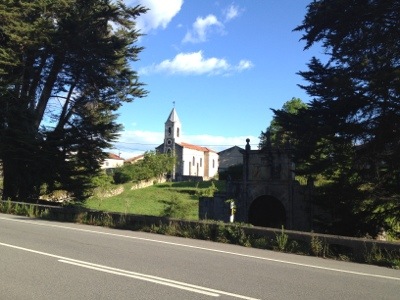
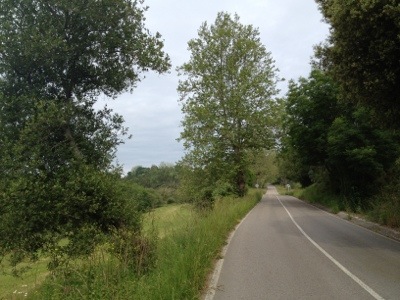
Day Ten: Colombres to Llanes — After breakfast in the deserted breakfast room I gathered my things, paid for my laundry and dinner, and stepped out into the day. I knew the camino route followed the highway, so I walked down the motel driveway and faced oncoming traffic from the narrow shoulder of the road. The lack of scenery along the wide expanse of asphalt allowed room in my thoughts to reflect on last night’s dinner conversation.

The best dinner conversations I’ve enjoyed over the years follow an unspoken protocol. The host or hostess, in addition to making sure everyone has enough to eat and drink, subtly guides the conversation so that everyone at the table is included. The goal is for all to participate and for everyone to have a good time. Others at the table help by being certain not to dominate the conversation and, after they’ve spoken, by asking a leading question of someone else at the table.

A dinner party, then, is a lot like a basketball game. The ball (the conversation) should be in constant movement and everyone should get it regularly. If someone doesn’t pass the ball to others or if two teammates make all the plays, the other players might as well go sit on the bench.

Good basketball teams don’t happen by accident — they take coaching and practice. The same is true of conversation. Get six strangers together and you don’t really know what will happen, particularly if some of them don’t know the game.

Which brings us to last night. Along with the three youngsters (American, Québécois and Dutch) I was joined by an older, married pilgrim couple who described themselves as “from Europe.” As the conversation developed it was clear that the focus of the older man’s attention was the young, female American pilgrim. With a few exceptions the conversation among the six of us became a conversation between the two of them. No one among us, myself included, seemed quite able to shift the focus. I tried several times to draw out the older woman, hoping we could wrest the attention to a different axis, but I couldn’t quite pull the whole table along.

It reminds me of a scene from last year’s camino. I was sitting at dinner in a small albergue, enjoying the conversation with three pretty French women across the table. I poured them a refill on their wine and then heard a voice from the older woman next to me saying, “don’t just pour for the young women. I’d like some wine, too.” I hadn’t realized until that moment that I had been focusing on the pretty, young table mates. That night I needed to remember that dinner conversation is like basketball. At our conversation last night if we’d had more dribbling and passing and more team involvement I think we’d all have had a better time.

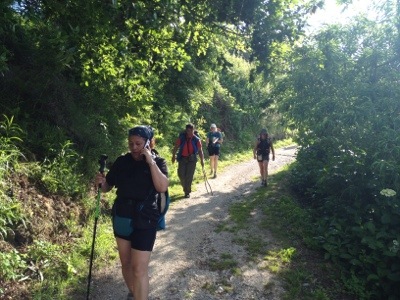
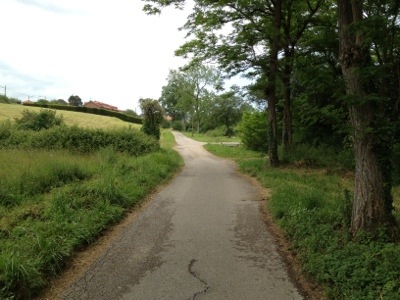
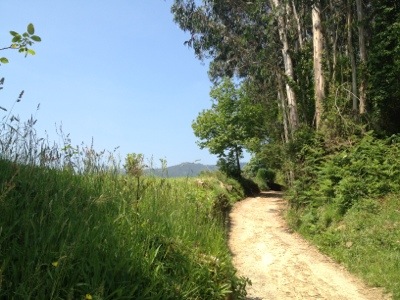
Soon it was time to turn off the main road to a smaller road on the left, which led to a gravel road that followed along and above the highway. After a time this road returned to the highway once again. At Buelna I followed the guidebook’s directions to cross the highway, descend through the town, and find the GR-E9. The “GR” denotes it as one of the “Grand Route” walking/biking trails of Europe and its wide, well-graded gravel trail way became the route for most of the rest of the day.

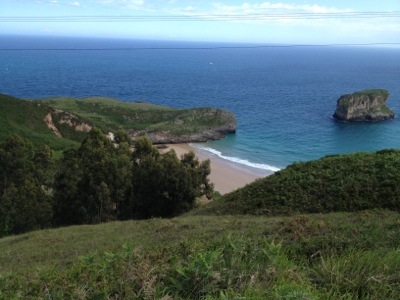
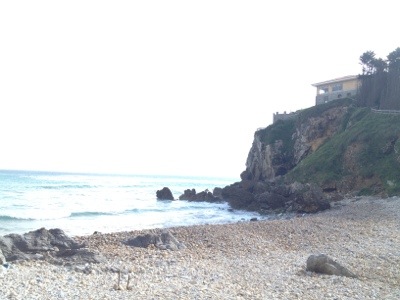
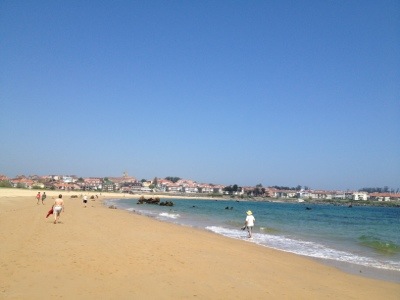
The E-9 followed the coastal cliffs and occasionally offered panoramic views or quiet, isolated beaches. The kilometers melted away accompanied by the sounds of murmuring creeks and crashing ocean waves. I enjoyed seeing the five Spanish women briefly (Begona, Annabelle, Pilar, Nuvia, and Anna), along with a French couple and Czech foursome I’ve seen several times recently.

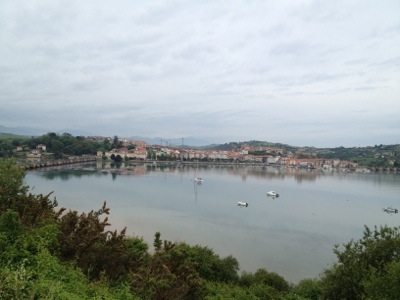
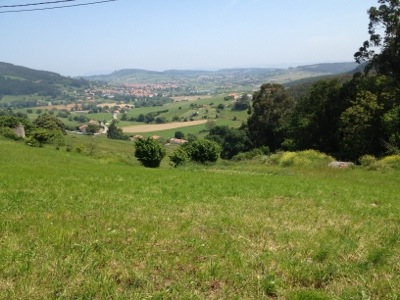
Eventually the trail came to the town of Andrin where I stopped for breakfast #2, enjoying a delicious tortilla espanol. I hadn’t carefully looked at signs to find the way from the restaurant, so I guessed that the road headed west out of town. Wrong. After walking 1 km the wrong way I asked directions and headed back, almost to where I began, and found the trail as it climbed a steep hill. At the top of the hill was a spectacular vista of the ocean, with a full view of Llanes ahead. I followed the signs and was once again on the E-9. The trail led below then above the highway and then took a steep climb to a TV tower above Llanes. For a time it seemed as though this route would bypass Llanes, but eventually it descended and connected with Llanes’ main route. As I came into town I noted the name on Google Maps of a large hotel. When I passed it I liked its quaint and dignified style and couldn’t resist going to the front desk and asking the cost. At this moment I’m enjoying the view from one of the hotel’s elegant and surprisingly inexpensive rooms.

Today I’m missing home and also my pilgrim friends. But I’m also happy to have some quiet and rest in a lovely place after a good day’s walk.

Taking stock of my walk after 10 days:

  • I’ve walked 226 km (141 miles)
  • My blisters are healed
  • I’m feeling well, except for some hip pain from yesterday’s fall
  • I’ve diligently stayed clear of any kind of work, thanks mostly to my coworkers who are handling things completely on their own
  • According to the scale at the Llanes pharmacy I’ve somehow managed to lose six lbs
  • All told, things are going very well. If you’ve read this far into today’s entry, thank you for your kind attention.

    Off to bed now after a big, late lunch. No basketball for me tonight.

    20120607-163910.jpg

    20120607-145717.jpg

    20120607-144842.jpg

    20120607-144832.jpg

    20120607-144819.jpg

    20120607-144803.jpg

    20120607-144729.jpg

    20120607-164530.jpg

    20120607-164543.jpg

    Oops, I Think I Fell Into a “Mad Men” Set

    Day Nine: Comillas to Colombres —I saw the motel in the distance and couldn’t quite reconcile it with its setting. In ancient Spain where everything has a medieval or Baroque patina, here was a motel — yes, a motor hotel — right off the set of Mad Men. I couldn’t imagine what the rooms might be like (maybe springy beds and noisy air conditioners?), but after 32 km of walking I was not about to be picky.

    Today’s walking began early, the three Italians with whom I was sharing a room were awake and packing their bags at 5:30. They politely kept the lights off until 6:00, which was when I’d told them they could awaken me. Together we finished readying our things and somehow I headed out the door a few minutes before them.

    I wound my way down the streets of Comillas to the main highway where yesterday I’d seen the yellow arrow way markers and headed out the red, paved pedestrian walkway that climbed along the highway out of town. After 20 minutes or so the Italians passed me, along with a friendly Spaniel-ish dog who had just adopted them.

    After a bit the pedestrian walkway petered out and we were walking along the road again (insert frowning emoticon here). After a bridge over the Rio Rabia our smaller road veered off to the left and climbed above the main highway, giving vistas of the valley which fell out to our right into a small ocean bay. The road continued up through farms then rejoined the main road after a few kilometers of ups and downs. At the final uphill I passed the five Spanish women from yesterday as they turned off to a rest area to recover from the steep climb. This was to be just the first of many steep climbs today.

    The road then meandered through an immaculate but empty golf course. Near the clubhouse was a tiny, ancient chapel with a tree growing out of its bell tower. Not something you see every day, even among the 200-800 year old churches of Spain.

    From here the road descended, losing all the elevation we’d gained, and dramatic views were visible of San Vicente de la Barquera and its bridges, castles and churches. My Italian friends were just ahead and they continued on while I turned right so I could find breakfast. At a little cafe overlooking the quiet harbor I enjoyed a coffee and croissant as the Spanish women passed by with a wave and then settled into their own breakfast at an adjacent cafe.

    Armed with a few calories I headed back to the camino trail, which immediately climbed steeply through the streets of San Vicente. The road dropped down, then climbed even more steeply through a eucalyptus forest. After a descent followed by a roadside walk that included a deserted and overgrown but somehow picturesque pedestrian tunnel I crossed a bridge and began yet another ascent, this one on a steep, green path through the forest.

    My French guidebook describes the following descent as “a little acrobatic” and sure enough, for the first time in 2300 km of camino walking I actually slipped and fell. My right boot lost traction on a steep gravel slope and slipped ahead about two feet, leaving me in a lunge-like position with my left knee on the ground. Somehow i managed to keep my balance and I wasn’t hurt much, but I wouldn’t be surprised if my hip or back are sore in the morning.

    The path soon joined an asphalt road which ran next to a gravel quarry, its machinery loudly grinding while big diesel trucks noisily drove in and out of its gate.

    I followed the road into Unquera and walked along its pedestrian walkway until it was blocked off then headed onto the sidewalk of its main street to the concrete bridge out of town. I couldn’t believe my eyes when the camino signs pointed to yet another enormous climb, this one easily 300 meters on flagstone pavers at perhaps an 8-10% grade.

    By now it was 2:00 and the sun was at its hottest for the day. Near the top of the climb was a tiny camino chapel (wish I’d taken a photo), then the trail stopped and suddenly I was at the albergue of Colombres, my intended goal for the day. There was no sign to note that the camino had now left Cantabria and was in the Spanish “autonomous state” of Asturias.

    The albergue was full of children with no room left for pilgrims, so with the Italians, who were just ahead of me, I hunted for lodging. After 10 minutes with no hotel in sight they headed left while I headed right and somehow I ended up alone out at the main highway, approaching a motel right out of Mad Men.

    As I came around to its front door, very hot and tired after many climbs and descents in the sun, the first thing I noticed was that the large parking lot was deserted. Not a good sign. I noted patio furniture on the terrace, a good sign, but weeds growing through cracks in the concrete, another bad sign. I passed the shuttered restaurant and cafeteria to find a vast lobby with a desk clerk speaking loudly on the telephone while fluorescent lights flickered and buzzed overhead. She noticed me right away, but continued answering the caller’s highly detailed questions (“What is included in the dinner?” “What time is breakfast?”). This gave me a chance to inspect the vintage furniture, to peruse a 2008 edition of Perro magazine (all about schnauzers), to admire the empty expanse of the vacant sunroom, to realize that I was probably going to be the only guest in the entire 60-70 room hotel tonight and to theorize that the hotel was built in 1959 for a convention of American advertising agency execs and hadn’t changed since then.

    Finally when she was free I learned from the desk clerk that the cost of the single room was only 30€ including breakfast and that one of her friends was happy to do my laundry (for an as yet to be determined price). When I arrived at my room I marveled at the vintage 1950’s fixtures in the bathroom (blue toilet and sink, yellow tile). To my delight I soon learned that showers were just as good fifty years ago as they are today.

    I headed out in the late afternoon to catch a bite at a roadside restaurant (the hotel’s restaurant doesn’t open until 8:00) and was delighted to run into Amelia, Julien and their Danish friend whom I’d met way back at Guemes. They were intrigued at the thought of sleeping in a Mad Men motel and we agreed to meet at 8:00 in the restaurant for a dinner of…..fish sticks and canned vegetables maybe?

    20120606-171515.jpg

    20120606-171543.jpg

    20120606-171559.jpg

    20120606-171627.jpg

    20120606-171646.jpg

    20120606-171656.jpg

    20120606-171703.jpg

    20120606-171710.jpg

    20120606-192034.jpg

    Only 280 Miles of Walking Left

    Day 8: Santillana del Mar to Comillas — The directional signs to leave Santillana this morning were non-existent, leading us to speculate that the town was trying so hard to be authentically medieval that painted yellow arrows, the key to pilgrim directions, were forbidden. How else to explain that two walks up and down the village’s streets this morning did not reveal the way out of town?

    Last night I’d had a nice dinner with John of Calgary, then had headed straight to bed, somehow finding sleep amidst the giggling of my five female Spanish roommates. After their quiet departure at 5:30 am I couldn’t get back to sleep, so I gathered my things and headed out the big, black, steel albergue gate.

    Here I joined two Italianos and a Maltese pilgrim as we walked up and down the street, hoping for a hint of the way out of town. Finally we all headed out the car road, in spite of the yellow “X” (meaning it was not the pilgrim route) and walked along the highway first to Orena, then to Caborredondo. The others chose to stay on the highway to Novales while I found the official pilgrim trail and its very welcome yellow arrows.

    Before Cobreces I returned early to the highway to find breakfast and waved to the Italian/Maltese contingent who somehow I’d beaten to this point. I then missed the pilgrim trail and stayed on the highway most of the way to the pretty town of La Iglesia. From here the camino wound on small roads through the tiny villages of Pando and Concha, then finally climbed a rise and revealed Comillas in the distance.

    I crossed the bridge into town, then walked up to the winding streets at the heart of this medieval town. After a few tries at finding the albergue I finally located it and set my pack on a bed to reserve it so I could head out for some lunch in the shade.

    A sign outside the albergue described an unsettling fact: Santiago de Compostela is still 456 km (280ish miles) away. I’ve managed about 160 km +/- in the last 8 days, though I’m actually two days ahead of schedule. Perhaps it’s the early arrival here, though, that’s made me feel I’m not maintaining a quick enough pace. But Comillas holds some interesting sightseeing treats, so it would be a shame to rush along and miss them.

    I wrote emails at a cafe in the plaza and planned my assault on the main landmarks of this touristic, medieval seaside village. Spanish and German tourists sparsely inhabited the square and there was a relaxed feel to this town that records its beginnings as a Roman mining center over 2000 years ago. I watched from a distance as a few other pilgrims arrived and looked for the albergue, including John of Calgary. I wanted to tell them where it’s at, but shouting across the square or jumping up to run and catch them didn’t seem quite right. Instead I ordered a round of huevos fritos and patatas fritas and decided to make this my final meal of the day.

    After awhile I headed back to the albergue where I may have lost my first argument in Spanish. The hospitalera’s boss came by the albergue at 2:30 and discovered pilgrims inside prior to the 4:00 opening. She was offended and loudly complained although she wasn’t about to throw anyone out. I tried to explain to her that in 2200 km of caminos I found it customary for pilgrims to enter an unlocked albergue and choose their bed. She wasn’t satisfied to hear that but I was pleased to engage in my first, albeit unsuccessful argument en Espanol.

    The hospitalera soon arrived and collected our money as per normal. I chatted briefly with the Spanish women from last night then took a tour of the Palacio Sobrellano, a lavish home built by a Catalan noble on one the town’s many hills. A glass or two of wine with John, then off to bed.

    20120605-130232.jpg

    20120605-130249.jpg

    20120605-130304.jpg

    20120605-130326.jpg

    20120605-130750.jpg

    “Tout Droit” Does Not Mean “Turn Right”

    Day Seven: Mogro to Santillana del Mar — My inner alarm clock woke me at 6:30, in plenty of time to shower, tend my feet, and pack my things. I headed out for breakfast and to buy stamps and a few pharmacy items. Then went back to my room for my pack, checked out of the hotel, and headed to the train station. It was time to become a real pilgrim again, and this four-star hotel was a comfort to be left behind in favor of much more walking and the more pilgrim-like simplicity of albergue life.

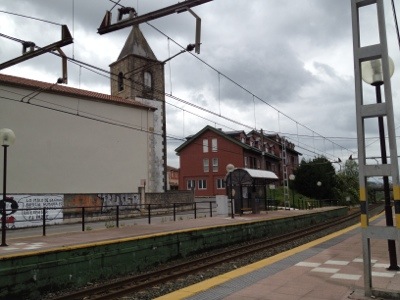
    I’m not sure whether it was the lack of signage at the station or whether my decision to take the train had damaged my camino karma, but somehow I managed to get on the wrong train. My plan had been to catch the train past the town of Boo de Pielago, where I’d ended my walk yesterday, to Mogro, crossing the Pas River bridge the safe and recommended way. But I could only wave to Mogro as the train slowed down at my station. It refused to stop until about 15km later, at Torrelavega. When I arrived there I this time carefully checked the schedule and confirmed the time and location for the correct train to Mogro.

    As I patiently (in air quotes) waited for the right train I was surprised and delighted to catch a glimpse of Lizette of Denmark at the station plaza just 50 meters away. Since I’d already checked through the gate, to say “hi” I would have had to leave the station and buy a new ticket. So I hoped I’d have the chance to see her somewhere later along the way. I’m a little surprised she (and presumably Marianne) are here, since Torrelavega is off the camino. I was sad they’d sad goodbye at Santander because they were nice company. But the camino sometimes brings friends back together at surprising moments, so perhaps I’ll see them ahead along the way.

    I finally arrived in Mogro at nearly 11:00 — much later than planned. A friendly Spanish couple with a dog was just arriving there by foot (did they walk the train bridge?) and asked if I wanted to sit with them, but I was ready to get walking. Rather than visit I headed across the road, finally to begin the day’s walk.

    This region of Cantabria consists of summer homes and rural estates, situated on large plots for views of the verdant countryside. As I walked down toward the factory city of Mar, I met two French bikers, one of whom described his bike journey through the US and Canada some years ago. After visiting briefly with them I walked down a long grade, around the enormous Solvay factory at Mar.

    This part of my walk was not beautiful, but it did give me a chance to become more familiar with the French guidebook I brought along. Last night I used Google Translate on my iPhone to look up a few words. Today I finally realized “continuer tout droit” actually means “keep right on going,” not “continue to the right” or “turn right,” which is “tourner droite.” They never tell you these things in high school French class.

    After Mar the estates became fewer and the small farms more plentiful. Several times I lost sight of yellow arrows and wondered whether I’d missed the way to Santillana del Mar, but each time I caught another arrow and was led first to Camplengo, then to Santillana itself.

    Santillana del Mar is a town frozen in history then thawed out as a lure for tourists. In spite of the tourist shops, hotels and art galleries the town’s cobblestone streets have a genuine charm. I walked its length looking for the albergue, then was directed back to its beginning where I found the tiny albergue down a driveway behind an art museum. I waited with three French people (who were subjected to my attempts to communicate with them in their language), five Spanish women (clearly good friends considering the quantity of giggling) and two quiet Italianos. After a 1/2 hour wait for the albergue’s 4:00 opening I checked in, put my pack on a bed, and headed to the local cafe for some refreshment.

    As I rested in the bar, resigning myself to an evening with no native English speakers, in walked John of Calgary. I directed him to the albergue and enjoyed the prospect of a pleasant dinner with this nice, young man. Tonight will be a simple evening of laundry, showering, eating, and maybe the enjoyment of a glass or two of pilgrim wine.


    Does a Real Pilgrim Take the Train?

    Day 6: Santander to Mogro — Two nights ago at Guemes the hospitalero clearly warned us, “Don’t walk across the railroad bridge between Boo de Pielagos and Mogros.” He knew this was a huge temptation for pilgrims because there are only two alternatives: walk an extra 11 km to and from the nearest foot bridge across the Pas River or for 1.3€ take the train to cross the hundred yard wide channel.

    A walking pilgrimage to Santiago is just that, a walking pilgrimage. For me this has meant that in 2000 km of pilgrimages I have never ridden in a bus or train or taxi to cover the marked pilgrim route. Every km has been walked — sometimes with pain but always with pride that I was never “cheating” by not taking some modern mode of travel. But somehow today felt different. Perhaps it was because of the recommendation of the hospitalero, or perhaps it was because my French guidebook also recommended it, or perhaps it was the quick and cheap Feve train service, or perhaps it was simply because I wanted a second night in the comfy Hotel Bahia in Santander. Whatever the reason, I decided to leave my over-developed pilgrim scruples behind and for the first time take the train for a brief portion of my pilgrimage. Forgive me, Santiago!

    I awoke a little before Sebastian this morning and quietly read and wrote emails until he was awakened by his watch alarm at 7:30. After he showered we slowly headed to the bus station, stopping along the way to complete a very short wedding greeting video he’d promised a friend and then at a cafe for a last croissant together before he left. At the station we both felt very sad as he boarded the bus for Bilbao, the first leg of his trip back to Cologne. The knowledge that he’ll be in Seattle in late August was a partial comfort. Sebastian is a wonderful person and a good friend.

    Back at the hotel after a shower and shave I double-checked train schedules and confirmed my plan for the day. I would return by train from Boo, then tomorrow i would take the train to Mogro on the other side of the river.

    Knowing my walk would only be 14.4 km I left my backpack in the room and headed out the door with only a rain jacket and my French guidebook. I hoped to find a small bottle of water to carry but on Sundays in Spain almost everything is closed. As I headed along the pedestrian mall I managed to find an open newspaper kiosk and was able to buy a small water to carry with me.

    The pedestrian mall opened onto a main arterial, which passed a barracks of the Guardia Civil then emptied into the streets and suburban industrial buildings of Penacastillo. At an intersection below its yellow stucco and stone church the camino turned right and played cat-and-mouse with the train tracks through small farms and trendy subdivisions until arriving first at Santa Cruz de Bezana and finally, Boo de Pielagos.

    When I at first missed the path to the train station I wondered whether habit or Santiago or maybe Freud were telling me to walk the extra 11 km. But now it was already 3:00, my blisters were starting to complain, and the train back to the comforts of Santander was only a few minutes away.

    Tomorrow I will complete the deed when I return by train, not to Boo, but across the river to Mogro. Santiago, I’m on my way — a little less of a purist this time — but I’m on my way.

    20120603-160540.jpg

    20120603-160551.jpg

    20120603-160619.jpg

    20120603-160628.jpg

    Hello Santander, Goodbye Sebastian

    Day 5: Guemes to Santander — Guemes surely has one of the nicest albergues on the Camino del Norte, but the good meal, shower and pleasant conversation last night were not enough to make me sleep well. This morning, after perhaps three hours of sleep, I dragged myself out of bed and promised myself less coffee on the rest of this camino. I need to remember that I am a caffeine wimp and even a noontime cup will keep me restless at night.

    Marianne, Lizette, Sebastian and I had agreed last night to meet for a 7:30 breakfast, then walk together to Santander. The two Danish women had no guidebook and hoped that sticking to us would help them get to the day’s goal more quickly than they had the last few days. We left together after breakfast with the peculiar and somewhat scary sights and smells of a hillside fire about a km away.

    We followed the highway out of Guemes, never quite encountering a town there, only homes nestled loosely together among rolling, green hills. After a time we came to a traffic circle outside Galizano which was our cue to head to the beach for what Padre Ernesto had described last night as a longer, but more scenic walk.

    Padre Ernesto is the bearded and rotund inspiration behind the Guemes albergue’s many ministries. He and his associates work with local prisoners, local women and children, and with programs in Latin America to make a better world. Padre Ernesto is clearly a worker-priest who sees community development and economic justice as his mission field. The albergue is just one, visible part of his many efforts. And he also told us the way to the beach.

    Following his directions before Galizano we came through farms and fields to a narrow path at the top of high cliffs above the ocean. Spectacular views, warm sun, and a stiff breeze made the walk go quickly. After 3-4 km on the cliffs the path came to a parking lot and then a stairway led down to the long, wide beach between the towns of Loredo and Somo. Our route took us nearly the whole length of beach. Across the bay we could clearly see Santander, just a 1/2 hour boat ride away.

    We expected a refreshing walk, but 5 km on sand with the wind at our faces soon made us hungry and tired. We shared a lunch of raciones at a restaurant in Somos, then headed to the boat dock for the ride to Santander.

    While we waited for the boat, a ragged assembly of pilgrims began to gather. Tony and Julie of Sacramento, Daniel of Scotland, Amelia of Berkeley, Michael of Hanover, Martin of Bern, Julien of Quebec, and many others gathered in small groups for conversation then boarded the boat. With a strong wind whipping up waves that splashed water against the bow windows of the boat we continued our happy pilgrim chatter to Santander’s downtown harbor.

    As we disembarked, Lizette and Marianne told us they’d decided to go farther today. So after goodbye hugs, Sebastian and I headed to the bus station to purchase his ticket back to Bilbao, then we briefly searched hotels before settling on the 4-star Hotel Bahia. I’ll wish him a sad goodbye in the morning, then the following morning I’ll continue my walk, hopefully well-rested and ready to attack the next week or so (before Martin arrives) on my own.

    As I write this I’m at a cafe in the square below the Santander Cathedral. Sebastian and I are writing postcards to past camino friends under a cloudy sky. I checked Facebook and discovered with delight that Jacqueline, another dear camino friend from 2011, will walk a nearby camino beginning next week, then will meet me on the steps of the Cathedral of Santiago before Mass on my last day in Spain this year.

    Knowing she’ll be there — even briefly — cushions the blow of Sebastian’s impending departure. His quick humor, jovial smile and kind heart make him great company.

    As much as the Camino is good for solitary thinking, it is the laughter and warmth of pilgrim friendships that keeps bringing me back to Spain. And it is Sebastian’s friendship that has filled the first stages of this camino with joy.


    Getting Closer — to Many New Pilgrim Friends

    Day 4: Laredo to Guemes — Today, as always, the first thought of the day is “what shall I have for breakfast?” The camino variation of that for me is, “Where will I find a chocolate croissant?”

    This was on both of our minds as Sebastian and I said goodbye to our roommates, Tobey and Sean of England, and headed out in the morning air. The question became increasingly urgent as we walked Laredo’s long beach and found that each cafe had only toast.

    Knowing that the town of Santano was a short ferry ride from the end of the beach, we decided to tighten our belts and hope that our croissants would be waiting at a cafe on the other side of the channel.

    So when we came to the ferry landing we were disappointed to learn the first ferry wouldn’t leave until 9:00, a full half hour away. We complained loudly enough that a delightful French couple (Linda and her friend) shared their bread and chocolate with us. Have I ever mentioned how much I love the French?

    The ferry arrived and took us across the 300 m channel and a few blocks from the dock we found chocolate croissants, tortilla, cafe, fresh orange juice and a barkeep willing to make 2 bocadillos to go.

    We walked from the cafe with Malco of Switzerland, heading through town, past a large prison, then to an option: follow the road to Guemes or climb over a tall, wooded hill and walk the beach in Noja, adding 10 km to our walk. The answer was obvious: The Beach!

    We scrambled up the steep hill, were rewarded with views back to Santona, and then stood in amazement as the path turned north and the brown sand beach of Noja was revealed below us. The steep climb down was covered in no time and the next hour was filled with the sound of surf, the feel of the sun, and the cool breath of the wind coming from behind us. Sebastian took off his boots and walked in the surf while Malco and I kept our boots on to protect our tender blisters. We had a long talk about Malco’s plans for his next months of touring on his way to Brazil. At the end of the beach we found a place for lunch on a grassy and shady knoll that looks out over the length of the beach.

    As we left Noja we left behind us the ocean, too, and the relaxing and cool day became a very long and hot walk through small farms in tiny towns. We arrived at Guemes’ albergue at 4:45 with Tony and Julie. The hospitalero’s water and vanilla cookies were very welcome after our hot 32.5 km march.

    After a shower and hand laundry the 20 or so pilgrims adjourned to the albergue’s grassy backyard and spent the cool afternoon in quiet conversation, journalling and reading.

    Along with familiar pilgrims like Tony and Julie we are getting to know Amelia of Berkeley, Lizette and Mareanne of Denmark, Julien of Quebec, Nacho of Barcelona, Florian of Amsterdam, and many other wonderful and diverse pilgrims.

    20120601-184041.jpgThe ferry boat, unloaded at Santona.

    20120601-184138.jpgPath looking back to Snatona and its prison.

    20120601-184152.jpgNoja’s beach. Sunny and beautiful.

    20120601-184221.jpgLong march toward Guemes through hilly countryside.

    20120601-184308.jpgBack of albergue at Guemes. We welcomed the green and the pleasant albergue beds and showers.

    “Pain, Torture or Hell?”

    Day 3 – Castro Urdiales to Laredo At the start of the day, in his unique and lovable way, Sebastian perfectly summarized the options ahead: “Pain, torture or hell?” Three options, and each is brutal.

    We left the albergue at Castro Urdiales (just next to the bullfighting ring) at 7:00 and headed backwards 500 meters on the camino to a bar cafe that advertised early breakfast. After a meal of croissants, jam, orange juice and coffee we headed out to look for yellow arrows that would mark our way for 32 km to the next beachside city — Laredo.

    We debated whether to follow the German guidebook up the hill to the left of the albergue or to follow the Spanish guidebook to walk along the road. Julie and Tony of Sacramento were within shouting distance and told us to follow them. We soon found arrows along the omnipresent N-634 and walked on its shoulder for several km with the ocean cliffs 100 meters below us on the right. Near the tiny town of Cedigo the locals directed us under the freeway bridge and to the right where we could see across the freeway to Julie and Tony who were still walking the former way. Our little road followed the freeway for a few more km until we crossed back under the freeway to a large campground full of tents and camper vans. At the far end of the campground we came to a nice cafe/bar where we enjoyed a conversation with two older Danish women. After they left we had a second breakfast and rested for a hour before the next stage.
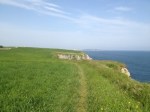
    From here the camino followed the road again, then returned under a tall bridge to the freeway before climbing a small hill through scattered houses and farms where we briefly met Malco of Switzerland, a dredlocked and lanky young man wearing flip flops. At the small village of La Magdelena we encountered a local who informed us in rapid Spanish that we would soon climb a large hill as he pointed out a mountain nearby with a distant TV tower at its top. We had been joined a few minutes earlier by John, a young pilgrim from Calgary, and the three of us began our ascent on a narrow, steep, gravel path. In a few, hot minutes I began to wonder why I had chosen a vacation of walking 700 km over mountainous terrain to get to a town I’d already walked to three times in the recent past. Another thought ached in my mind: could we get there quicker if we’d just stayed on the road?

    When I shared my misgivings with Sebastian he responded with his memorable line: “Pain, torture, or Hell?” It was his way of pointing out that since all the options were tough, what difference does it make which one we take? So why whine about it?

    With that frustratingly rational thought we continued up 10km of steep, wooded hills, sweating more with each step. Finally we arrived at the summit and began our equally difficult descent. In a shady spot where I insisted we stop and rest, Sebastian, John and I shared a nectarine and two oranges. Soon Malco and Daniel, a Scottish musician, stopped to talk.

    By the time we reached the bottom of the hill it was nearly 3:00. In Llanes we found a restaurant and ordered our well earned lunch. Afterward we left John at the Llanes albergue and we walked the remaining 7 km through small farms over hill terrain to Laredo with Daniel. In Laredo we saw the two young Englishmen from last night, Sean and Tobey, and walked with them to the Buen Pastor albergue.

    Though the day was long, steep and hot we were rewarded by many conversations between Sebastian and me, as well as new friendships with several pilgrims from around the world.

    At the end of the day I counted to total cost of today’s ordeal: 2 blisters and a sunburn on my arms and neck.

    20120531-223416.jpgMagnificent vistas after Castro Urdiales, but look out for those mountains reaching down to the water.

    20120531-223439.jpgAnd the road starts to climb, up to a distant TV tower on the mountain beyond.

    20120531-223501.jpgI think this might be Llanes.

    20120531-223516.jpgThe gorgeous beachside town of Loredo where we walked into town with Daniel the Scotsman.

    And We Meet Pilgrims From Around the World

    Day Two: Portugalete to Castro Urdiales — Yesterday in our riverside walk we saw almost no pilgrims. Today we met many, and the albergue here at Castro Urdiales is full of noisy, fun, and friendly pilgrims from around the world.

    Sebastian and I left our pension at 7:00, stopping at a nearby bar/cafe for coffee, croissants and fresh orange juice. We asked directions to Avenida Carlos VII and found it and our first yellow arrows. Carlos VII turned into a paved cycle/pedestrian path, which we followed a full 12km to our first views of the ocean at Las Arenas beach.

    We wound our way a couple km farther to the tiny beach village of Pobena. There we found the albergue’s hospitalero cleaning up. We asked him to stamp our credentials and suggest a restaurant for second breakfast, a custom we happily resurrected from last year’s walk. He pointed us to a nearby bar/cafe, which fulfilled his promise of having great tortillas. While we enjoyed our tortilla we watched as a couple of pilgrims approached. Soon we met Julie and Tony of Sacramento, California, and enjoyed their company for a laughter-filled half hour. We then put bocadillos from the kitchen into our packs for the next stage.

    We walked up a long stairway to the top of the hill and saw magnificent vistas of the bay and ocean. We congratulated ourselves for our cleverness in choosing the Camino del Norte for our walk. After a long and beautiful promenade along a onetime railway bed with constant views of the ocean we went through a small, hand-hewn tunnel to a parking lot and finally to a series of small roads taking us toward the old coastal highway, now called the N-634.

    We walked up two steep km on the narrow shoulder, then down one km to a bus shelter across from the Saltacaballo Restaurant where we enjoyed the shade as we shared our lunch with a red, neighbor dog. Martin, a pilgrim from Switzerland, stopped to introduce himself and visit. From here we continued on the asphalt until a yellow arrow pointed us onto a gravel road.

    This road took us to a path that followed the coastline through hay farms with even more spectacular views of Castro Urdiales followed by a quick descent to the suburbs of this seaside tourist town. With Martin we made our way along the oceanside promenade to Calle Santander for another 2 km through town to the albergue, our refuge for the night. There we met John of England, Petri of Finland, Theo and Theo of Belgium, and our new old friends, Julie and Tony of Sacramento.

    After choosing a bed we headed back to the center city for a tour of the basilica and a cervesa or two. The church was beautiful, but the beers made me sleepy, so we took a quick nap on the beach in the sunshine. Martin found us and offered us to join him for a homemade dinner at the albergue, so we picked up some wine and headed back “home” for laundry, showers, and a delicious dinner.

    Today we felt like pilgrims. We found ourselves in a community of friendly travelers, united by adventure, blisters, and the shared goal of Santiago de Compostela after many days. The life of a pilgrim is much walking and much joy.


    Other Than Getting Lost, a Great Day

    Day 1: Bilbao to Portugalete — After a long trip yesterday it was no surprise that I’d be sleepy, but even so I didn’t expect to sleep until 9:00. That’s 3-4 hours after good pilgrims are already on the road. Sebastian was patiently and quietly waiting in the next bed for me to awake, and once I did it was off to the showers and out the door for our first day of walking.

    The weather was cloudless and warm as we made our way to breakfast, then to the Cathedral of Santiago (Bilbao’s small but elegant medieval cathedral) for our first pilgrim stamps. We found an elderly priest in the sacristy, and the neat, South American nun with him stamped and dated our credentials. Then we headed out the massive cathedral doors for the day’s walking adventure.

    Our plan for the day was simple: walk along the River Nervion to Portugalete, stopping for photos at the famous Guggenheim Museum. This would be a simple 14 km walk, with little need for directions. We would just walk the east bank of the river, then arrive in Portugalete by crossing the unusual and famous transport bridge.

    If we’d looked carefully at a map we would have seen our folly and changed our plan. After walking about 8 km through first pleasant then progressively industrial walkways a man stopped us and asked us in Spanish if we were pilgrims heading to Santiago. We told him “yes” at which point he explained that we had walked nearly to the end of a long peninsula in the river, missing the right bank which was now across a wide canal. There was no bridge ahead to take us to our road. We would need to retrace our steps about 3 km to pick up the correct path. We consulted my phone map and realized he was exactly correct. That meant an extra 6 km added to our day. We tested several roads until, with the help of locals, we found the right way back to the right bank of the river.

    Now it was a straight shot along narrow sidewalks and ultimately no sidewalks to Las Arenas, the town just across the transporter bridge from Portugalete. As we walked, a man in a bike shouted, “Buenos Dias, peregrinos! Buen camino!” Even with no signs all day of pilgrims or yellow arrows or scallop shell markers, at this point we knew we were pilgrims again.

    Sebastian and I agreed that the man who shouted his greetings to us, like the people who gave us directions today, was an angel. All these angels had helped us hapless pilgrims to find our way when there were no markers and no other pilgrims to ask or follow.

    After crossing the transport bridge into Portugalete we stopped for a beer at a sidewalk bar/cafe. The owner was anxious to close for siesta, so he left us outside with our beers and, rather than rushing us to finish, he told us they were free — just leave the glasses. Another of God’s angels.

    Sebastian’s guidebook suggested Pension La Guia, so we settled in there for the night at a price of 20€ each including free laundry by another angel. At 6:00 with no laundry to do it was nap time, with dinner later and time to plan tomorrow’s walk to Castro Urdiales.