Arrival in Bilbao — First Day of Camino #4

Well, the travel yesterday seemed endless. Flight to Iceland 7 hrs, wait in Iceland 1hr, flight to London 3 hrs, wait for the bus 1/2 hour, ride on the bus 2 hrs, wait in the airport 3 hrs, fly to Bilbao 2 hrs. Little sleep, babies crying, , etc., etc. Wait at passport check in Bilbao while the solitary passport agent inspected all EU passports first — perhaps 200 — then decided to check non-EU people when all EU folk were through.

All was well, though, when I saw a beaming Sebastian at the arrivals hall! For newcomers, Sebastian is a fireman from Cologne, Germany with whom I walked last year. We hit it off big, then, and I was delighted in his decision to join me for a week’s walk this year. After a big, manly hug (his words) we taxied into central Bilbao, looked for camino markings, had a slice of pizza, then back to the room to talk until 12:30am.

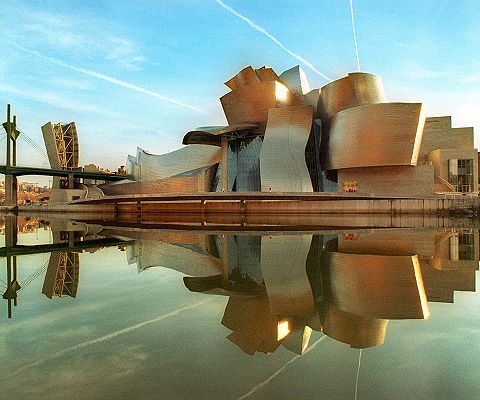
It’s 5:30 am here now. Our plan was to sleep in (yeah right), get breakfast, head to the cathedral for a stamp, pick up the trail, walk to Portogalete at least (13k) and hopefully then onto Pobena (another 13k). Definitely heading to the Guggenheim for a photo, too, to prove we are here.

And so, the fun begins!

One Day to Go — Time to Pack

Here’s what I’m bringing this year (plus my backpack)

Even after three caminos I’m finding myself debating exactly what gear to bring on this year’s walk. I leave tomorrow — just 25 hours from now — so decision time is at hand.

There are a few things I know are handy, but they add extra weight — and weight is the bane of pilgrims and long-distance trekkers. Some items I know I can buy if and when I need them.

Here what I’ve settled on for my Camino del Norte (2012):

  1. Hiking towel — lightweight, dries very quickly. I’ve used this one on pilgrimages for years.
  2. Liquids — these will ultimately go in my toiletry bag, but for airport purposes they’re in a transparent, plastic sack. They include liquid soap, toothpaste, eye drops and sun block lotion
  3. Toiletry bag and toiletries — this has my dry toiletries, and ultimately my liquid ones once I arrive. Toothbrush, nail clipper, dental floss.
  4. Airline tickets, directions, other papers — these stay in an outer compartment in my pack for each access.
  5. Guidebook — also in an outer compartment.
  6. Camelbak water bladder — 2 liter size. Dry until I arrive, then I fill it with trustworthy tap or bottled water
  7. Gloves — Sometimes I only need these once or twice, but when I do, they’re nice to have. Super lightweight.
  8. Toilet paper — goes in an outer compartment in the pack for when nature calls and no indoor plumbing is available.
  9. Rain cover for backpack — into an outer compartment.
  10. Rain jacket — I find it easier to use a Gore-Tex style rain jacket than to have a bulky poncho that is hard to get over my pack and catches the wind.
  11. Warm fleece — I’ll wear this onto the airplane. For cool days and mornings.
  12. Hiking boots — my trusty Treksta Assault GTX boots
  13. Passport and credential — these two important items stay in a waterproof bag in an external pocket for easy access.
  14. Sleeping bag liner — treated with Permethrin. Keeps the random bed bug away.
  15. Camp shoes — super lightweight North Face shoes with comfy, padded soles. For a break from boots after hours.
  16. Blister kit — includes small scissors, needles, thread, band-aids, Compeed, moleskins
  17. Sleeping bag and inflatable pillow in stuff sack — very lightweight, down bag good to 40F and super lightweight inflatable pillow. I also have a tiny LED flashlight attached to the zipper of my sleeping bag in case I need it.
  18. Clothes bag — Having a light “cube” bag allows my clothes to stay together in my pack. Clothes include 3 pair hiking socks, 3 pair sock liners, 2 hiking shorts, 3 technical t-shirts
  19. Airline clothes — my long, lightweight hiking pants, collar shirt, 1 pair undershorts, belt. These items ultimately go into the pack, but the long pants (along with my fleece) help me stay warm in cool airplanes and airports.
  20. Tech bag — charger, plug adaptor, charging cord for phone, charging cord for camera, extra camera battery, telephone, waterproof bag for telephone.
  21. Mylar foil emergency blanket — won’t ever hike without this. A survival blanket that I can use if weather requires or in case of injury where help might not arrive for hours.
  22. Sleeping pad — this is a luxury item. I take it out for when I’m enjoying my afternoon siesta. Also there for the odd time in which I might need to sleep outdoors — it happened once.
  23. Not shown: writing pad and pen, magazines for on the plane (thrown away when done), credit card, debit card (for ATMs), baseball cap, sun hat.

Total weight: 16.2 pounds. Well within the 20 lbs (or 10% of bodyweight) recommended. Ooops, almost forgot my scallop shell.

OK. I think I’m ready!

Blogging the Camino del Norte by iPhone

The screen is tiny. The keyboard is even tinier. Plus, I need my glasses in order to type. So why am I planning to blog my upcoming camino on my iPhone?
The answer is that it’s easier than the alternatives. Coin op computers in Spain usually don’t allow for uploading photos. I don’t want the weight of an iPad. And I want my blog to be as contemporaneous with my walking as possible.
Who knows, maybe Siri can help me find the best tapas each evening?

20120523-111656.jpg

Ten days out, chomping at the bit

The Guggenheim in Bilbao, with titanium exterior (a style copied from First Church Seattle?????)

Hardly an hour goes by when I don’t think about my impending camino. I’ve taken a gamble and ordered new boots, which hopefully will arrive this weekend for their first break-in walk. If they don’t work, I’m back to my old boots which have at least another camino left in them. I’m also getting ready for the start of tomorrow’s big sale at REI, where I’m planning to buy some new technical t-shirts and hiking shorts. I’ll check my Camelbak bladder to make sure it’s fit for duty, and I’ll lay out my gear in the bedroom and probably back and re-pack my backpack over and over in the next few days.

The best part of this year’s camino will be meeting friends from last year. My German firefighter buddy, Sebastian, will join me for the first few days outbound from Bilbao. Then at the end, my buddy Martin, who teaches English in Logroño, will join me for up to two weeks. Both guys are super companions, each a lot of fun in their own way.

As I make plans for the walk it’s clear just how different the Camino del Norte is than the much more popular Camino Frances. The first stop out of Bilbao generally is the town of Portugalete. Problem there is that the only albergue is open only in July and August since it’s an adult school. So, Sebastian and I will make a long day and do two stages in one, heading to the albergue at Pobeña. This gives us a 32 km day, but we can shave off some miles by walking the industrial route along the river in Bilbao to Portugalete. Sebastian’s a good walker and the added advantage of this plan is that we’ll walk along the seashore part of the way to Pobeña.

Whoa — The Camino del Norte is Sounding Hard

Una's boots on the Camino del Norte

I knew the Camino del Norte would be difficult, but in her blog my Internet Forum friend, Una, describes shares a cautionary tale that gives me pause.

I wonder who thinks that a pilgrimage walk is a great way to get away from home and enjoy a few weeks walking in Spain. Well, I don´t blame you. But the only words I can think of to call this post and message is Muddy. Forest mud, river mud, sandy mud, wet mud, red mud, yellow mud, mud that sucks the very soul from your body and makes you wonder why you thought a Camino in April in Northern Spain is a good idea.

So it has been raining. We walked to San Sebastian and stayed in a Youth Hostel there. We took a high track through a muddy forest into Orio. The path was quite beautiful and the views over the sea were amazing. I thought I might get a swim but the waves on this coast are for surfers. In Deba we stayed in a little room beside the beach, the facilities were very basic, and the Walrus, the Carpenter and the little puppy were sleeping there too, all men who snored! I will have nick names for most of the peregrinos by the time I finish in Santiago. I walk with an Irish woman, a Spanish woman from Valencia and a young Portugese fireman who is deeply religous. We four are now in Gernika in a room with a French couple in a very dear youth hostel.

Today the guide book said take the road if possible as there might be mud but the yellow arrows kept leading us into the river, mud, forest and we couldn´t seem to stay on the road. It was very scenic and it was not raining this morning, but is now.

Last night we slept in Ziorta Monastery, what a treat, a Japanese man was the only other person there, we were given a good supper of soup and bread, attended Vespers and got our first pilgrims blessing. We did get Mass in Deba on Saturday night. Mass in the Basque language is hard for the Spanish to understand, let alone the Portugese or Irish but we enjoyed the Misa as it was our first. Unlike the Camino Frances there is not the same opportunity to attend local mass at night as the alberques are on the outskirts of towns.

Just four weeks and three days away from my own Camino del Norte. I’ll certainly be watching Una’s blog to see how the trail goes. Meantime, today’s weather report in Bilbao, where I’ll be starting, shows almost exactly the same temps and conditions as Seattle: 60 degrees and cloudy/rainy.

Camino Pilgrims Come from Many Nations

Fig. 1 - All nationalities who received compostelas -- the Spaniards are by far the greatest numbers.

Here’s the last of my installments on the Cathedral of Santiago’s pilgrim statistics. As you will recall, the Cathedral publishes online stats about pilgrims who’ve received their compostelas during the prior month. The statistics includes some revealing details. The chart in Fig. 1 shows the percentage of Spanish pilgrims each year since 2005. In most years Spaniards comprise more than 45% of all pilgrims. In the Holy Year of 2010 this number increased to over 60%, while pushing down the percentage of non-Spaniards who walked that year. The next highest group is “Other” (not listed on the legend) which comprises a variety of the less-than 10 ten nationalities. The largest single nationality below that is Germans.

Fig. 2 - Non-Spanish nationalities. "Other" is the largest percentage, with Germans the largest single non-Spanish nationality.

Fig. 2 spells out the non-Spanish numbers a little better. “Other” is still the largest group, meaning these nationalities include too many individual countries to make the top groupings, but countries when combined equal a large percentage. The largest groupings of these nationalities are from Japan, Korea, Australia, Mexico, Poland, and Belgium.

The largest single non-Spanish nationality represented on the camino is German. In fact, the top four non-Spanish nationalities are pretty clear in the stats — Germany, Italy, France and Portugal, in that order. Well below these nationalities are a third tier: USA, UK, Canada, Brazil, Ireland, and Holland. So the profile of the “average” pilgrim is pretty much a Western European, with folk from other continents a much smaller percentage of the total.

Not shown is another interesting stat: Spanish pilgrims flood the camino in July and August, when they comprise roughly 2/3 of all pilgrims. The percentages of non-Spanish pilgrims, particularly German, nearly double in the shoulder months of May/June and September/October.

Pilgrim Starting Point Stats

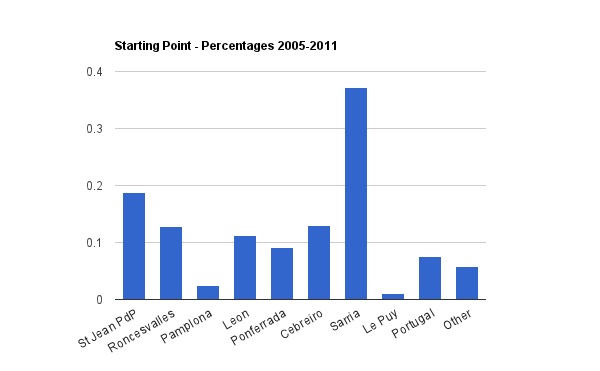
I’ve had a great time poring through the Cathedral of Santiago de Compostela’s statistical pages and have come up with some interesting lessons. Fig. 1 shows the large percentages of pilgrims who start at Sarria, the minimum (100 km) distance required to earn a compostela in Santiago.

Fig. 1 - Many starting points for the Camino, but biggest by far is Sarria.

The fact that fully 37% of pilgrims begin in the last 100 km confirms that the Camino Frances gets more crowded the closer a pilgrim gets to Santiago.  It’s also surprising how spread out the starting places are, and how many people begin in places like Leon, Ponferrada and O Cebreiro.

Interestingly, Sarria is the most frequent starting point by far for pilgrims who finish in all but four months — May, June, October and November. This suggests that local, short-walk pilgrims flood the Camino Frances during the high summer months, while long-walk pilgrims make up larger numbers in the shoulder months of spring and autumn.

Fig. 2 - Sarria is by far the largest starting point for pilgrims in all but four months.

A caution with these stats from the Cathedral at Santiago — they reveal only the eight largest starting points each month. The result is that some important starting points like Astorga, for instance, sometimes show significant numbers but sometimes aren’t recorded at all since they don’t make the top eight consistently. Astorga and other, smaller starting points are included in “other” in each chart.

I’ll look in future postings for country of origin among pilgrims to see how or if that has changed over the years.

Learning from the Cathedral of Santiago’s Statistical Pages

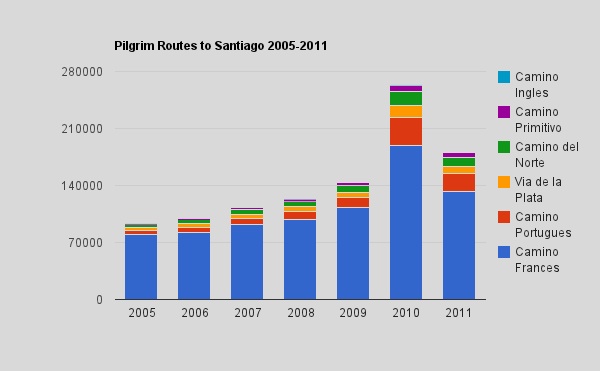
Fig. 1 -- Numbers of pilgrims by route on the Camino de Santiago

Over the last couple of days — partly out of a desire to rest some from a busy Easter season — I’ve been poring over statistics offered by the Cathedral of Santiago about numbers of pilgrims. It’s a fascinating bunch of raw data and I’ve learned a lot about when people go and which routes have grown most.

As you can see in Fig. 1 pilgrimages on the camino have steadily increased during this time, with a big bulge coming in the 2010 Holy Year. There’s no reason not to think that this steady increase will continue for the foreseeable future until the next Holy Year, during 2021, sets another new record.

It’s interesting, too, to see which pilgrim routes are growing the most. As you can see, the second most-popular route is the Camino Portugues, followed by the Camino del Norte, which was about half as popular as the Camino Portugues in 2011.
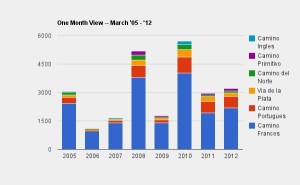
Fig. 2 - March totals 2005-2012

From November through May the Via de la Plata has more pilgrims than the Camino del Norte, but in June through October the Camino del Norte doubles the Silver Way in pilgrimages. This makes sense since the southern route is much hotter in the summer, while the northern route is too cool for comfort in the winter and spring. It’s interesting, too to see the effect of Easter. In the years 2005 and 2008 Easter was in March, hence the large increase of pilgrims in March of those two years in Fig. 2. Otherwise March shows the same steady increase as other months have since 2005. Note, too, how the Via de la Plata is much more popular than the Camino del Norte during this springtime month.

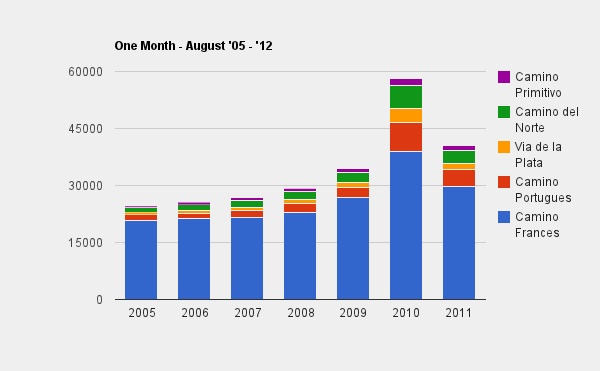
Fig. 3 - Month of August 2005-2012

Another interesting chart is for the month of August. Note in Fig. 3 how the Camino del Norte exceeds the Via de la Plata in size, nearly doubling it during this summer month.

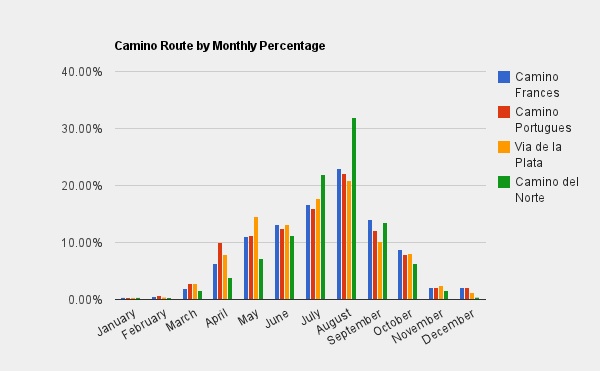
Fig. 4 spells this out in some detail. Over 60% of traffic on the Camino del Norte happens in July, August and September. See too how the Via de la Plata is quieter in the high summer months.

Each of the charts shows that the Camino Frances is by far the largest, but that its growing popularity is matched proportionally by the other camino routes. An encouraging sign is that the capacity developed for the 2010 Holy Year presumably can accommodate a continued influx of pilgrims until the point at which normal growth reaches the 2010 level.

Fig. 4 also shows that it might be best to enjoy the Camino del Norte in a month other than August, that all routes are very quiet in the winter, and that if the heat of summer abates by that time, September and October might be good months on the Via de la Plata.

Fig. 4 - Percentage by month of the top four routes.

A big thanks to the Cathedral of Santiago de Compostela for its great statistical info. It was fun to sort through the raw data and see what it says about the best months to take the various routes and also to see the enormous expansion of the Camino de Santiago over these last years.

2012 Brings Increase in Pilgrims to Santiago

In response to a question on the Camino Forum I help moderate I dug into statistics at the Cathedral of Santiago de Compostela’s website to see if the Spanish economic crisis is affecting the quantity of pilgrims heading to Santiago. Surprise! The numbers are actually up — and pretty dramatically.

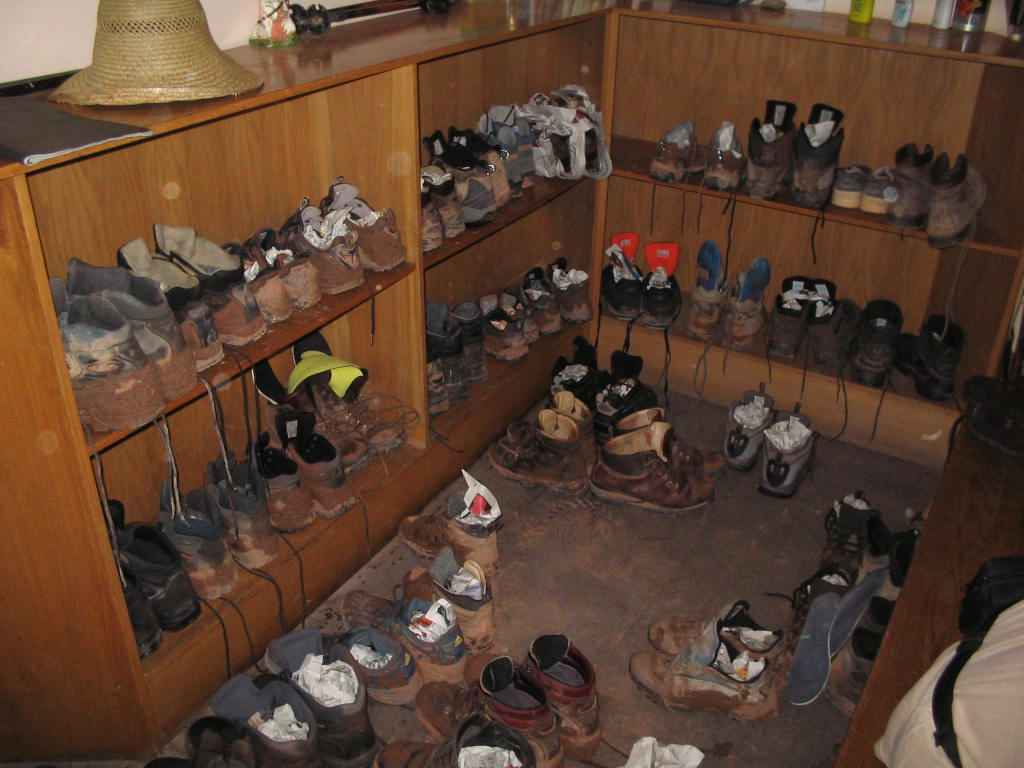
Pilgrim boots at the albergue in Najera

So far this year 5,441 pilgrims have received their compostelas in Santiago, compared to 4,493 in the same months in 2011. This follows the general increase of the last decades in which interest in the Camino de Santiago has grown each year. A 20% increase is a pretty big number.

Still, the numbers are smaller than in the first three months of the Holy Year of 2010, in which 8,691 pilgrims received their compostelas. However, at a 20% annual increase that number will soon be matched. Clearly the Camino de Santiago is on a big upswing as more and more pilgrims find something special in their journeys to the bones of Santiago.

A True Pleasure to Meet Msr. Gérard du Camino

Msr. Gerard du Camino's pilgrim center near Paris.

In a previous post I lamented how difficult it is to find a good guidebook to my upcoming Camino del Norte, along Spain’s northern coast. A kind fellow pilgrim named Ron Joy recommended the French camino guidebooks of one Gérard du Camino. My French is better than my Spanish, so I thought I’d give it a try. I found Msr. Camino’s website and ordered his guidebook of the Camino del Norte.

What a treat to receive a personal email a few hours later from Monsieur Gérard Rousse, a.k.a. Gérard du Camino, sending his greetings, announcing the mailing of the guide I ordered, and inviting me and all pilgrims to come to the pilgrim center he has created at Montrouge (near Paris) to talk about the camino. He gave the address of his pilgrim center, its hours, and asked that I call before I drop in.

Assuming a good experience with his guidebook I think next time I’m in Paris I’ll take him up on his offer. Thanks, Monsieur Camino, for your prompt reply and for your hospitality. What a nice example of pilgrim hospitality.