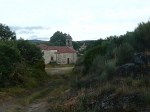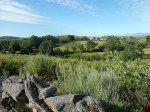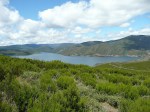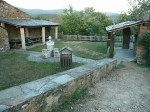
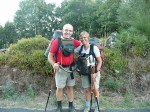
July 19, 2010 Xunqueira de Ambia to Ourense

In My Dinner with Andre last night we had a tender discussion about angels and saints. He told me about his family and divorce and the 1000s of kilometers he’s walked on caminos. Afterwards it was off to the albergue for a good sleep.

As usual in albergue living people start to stir and head out at the ridiculous hour of 05:00. Dawn didn’t come until 07:00, so clearly their reason is to get a jump on albergue beds in the next town. That makes me so sad that beds become a competition. I prefer to begin my walk sometime soon after dawn and trust to the camino to provide a bed at day’s end.

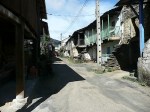
At 06:30 I gave up trying to sleep and was next to last out of the albergue. Today’s walk to Ourense, largest town in my camino, had three main stages — a) tiny bedroom villages, b) industrial zones, c) dense urban areas leading to the old city.

I walked through the tiny bedroom villages with Kjell and Oddbjorge of Norway. Kjell’s English is quite good and he told me the story of how his 1998 camino changed his life. After the camino he came home, simplified his lifestyle, and retired so he’d have more time to volunteer at church. Then he complained bitterly about the Norwegian government forcing the Norwegian Lutheran church to accept homosexual clergy.

Kjell and Oddbjorg walked slowly, so I walked mostly alone through the industrial zone. Here I nearly flipped my first bird (yes, nearly) when a driver missed me by inches from behind as he passed a truck on a narrow road. I jumped as his car whizzed by just inches away.

As I started into the urban section I caught up with the kissy Spaniards and their friend, who was hobbling now with an injury. I tried to help them find the albergue, but I wasn’t that committed given I had my heart set on a cheap hotel somewhere in the center city.

In the urban areas the yellow arrows always seem to disappear, so I had to ask directions several times to get to the Plaza Mayor. I finally found it then was about to sit down for the day’s first beer when I was stopped by a camera crew. A man in a rainbow tank top asked me if I’d be interviewed. I told him I didn’t speak Spanish that well, so he did the first part of the interview in English. He asked me how I liked Ourense (me lo gusta) and where I was from. I told him and also volunteered that I’d just walked 22kms and was very tired and was looking for a hotel. He asked me how many stars, one, two, or three? I told him 2-3 and, off camera now, he sent me to a hotel about a block off the Plaza Mayor.

I checked in, went across the street for a great enselada mixta, then sat to type my daily note to Gail on my iPhone and strategize about laundry (do it now) and dinner (do it after the blazing sun goes down). Ourense has a reputation as the hottest town in Galicia, and today’s temps — likely 95 to 100F — were confirmation.

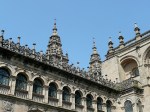
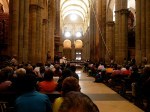
I spent some time at the cathedral — a beautiful church. And I debated with myself about a change in my plan to stay at the hotel I’d reserved given my quicker pace. I could pretty easily get to Santiago on the 23rd at my current rate, but my hotel reservation isn’t until the 25th. I decided to ask Gail’s help online to try to find an available Santiago hotel for the 23/24 then head to Finisterre on 25/26. I left the decision open, though, as I knew a lot could change and I had laundry to do.
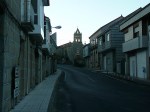
July 18, 2010 Vilar do Barrio to Xunqueria de Ambia

Yesterday I had Wi-Fi so was really glad to be able to Gail my updates. Today, no such luck. I wrote my iPhone emails to Gail at the albergue in the little farm town of Xunquiera de Ambia. There were not many services there, but at least there were some bars and restaurants and the huge church in this cute little town.

Before dinner last night in Vilar do Barrio I stocked up on fruit, water, and cheese for the next day’s walk. On the recommendation of Manuel, son of the owner at the casa rural where I stayed, I had eaten dinner at a tiny restaurant without even a sign outside. The owner/cook/waitress was a 70ish year old woman who made a very nice enselada mixta and a big bowl of caldo galego, my first time trying this Galician classic soup. It’s made simply of potatoes, greens from a peculiar Galician plant, and various spices. Simple but tasty. She was disappointed I didn’t eat the entire bowl, but I was just too full. For that plus bread and wine she wanted to charge me 8€, but I insisted on 10.

After waking from a good sleep I packed and headed out the door for a short day’s walk. I had debated pressing on to Ourense, but given it is Sunday I decided a shorter day and potential church mass would be best.

The day alternated between sunny farm roads and shady pathways, punctuated by sleepy towns. Sheep in the meadows talked loudly to each other while their shepherd looked on. Cows, dogs and cats walked the roads, the dogs and cats, unlike the cows, being nice enough to use private toilets. Cow droppings are one of the charms of Galicia that it takes the most time to adjust to.

Just after I set out I was passed by a group of seven Spanish boys of 15-20ish with small backpacks. After a bit I passed them while they stopped to talk, rest, and smoke. After a time they passed me again, and I caught up again during their break. We all arrived at the Xunqueira albergue at the same time, 11:00 — they the hare and I the ancient sea turtle.

Although the albergue was not supposed to open until 12:30 the hospitalera of this modern and attractive albergue allowed me to leave my backpack and head to the 12th c. church for mass.

The church is a gem of Romanesque architecture, dark but simple and beautiful. Filling the walls are several ornately carved reredos, including two with mi hermano Santiago. There’s also a balcony organ that, according to the secretary who gave me my sello, is 300 years old.

I enjoyed the service, but also had one of those church moments that will certainly make it into a sermon. I sat down in a pew, thirty minutes early for the mass, one of six people among the 40-odd pews. A thirty- something woman came in and, among all the available seats chose to sit in my pew, about three feet to my left. In a few minutes another much older woman came in and sat to my right, then another woman joined our merry group between me and the woman on my left. I counted perhaps 20 people in church now, with 20% of us in one pew and ten minutes left until the service was to begin. Clearly I had sat in “their” pew, but rather than get up and move to another pew I decided to become one of “them.” We worshiped, shared the sacrament, and mumbled our ancient prayers together (in two languages). I smelled their perfume, my first in a week. I halfway expected (and hoped for) a lunch invitation, but suspect they had caught a whiff of Eau de Pelerin (no shower yet after 14 km in the hot sun) and left in dismay.

Met Andre, a québécois gentleman, on the return from church. He’s walked all the French camino routes over the years and once all the way to Santiago. Like most long distance pilgrims on the VDLP he’s now slowing down to time his arrival for July 24 in Santiago.

Shower followed by update writing. Laundry later. Cervesa at the nearest restaurant next. Hot day outside. Windows in the albergue closed to keep out the hot air. A kissy young couple from Seville who’d been at Lubian and who witnessed my defeat at Campobecerros, are taking their siestas on (blessedly) two bunks on the other side of the room. At 14:45 I left to explore the town, find dinner, and prep for tomorrow’s walk into Ourense. Dinner was a joyous affair with Andre and many other pilgrims in a restaurant a few hundred yards below the albergue.

July 17, 2010 As Eiras to Vilar do Barrio

Last night in the distance I’d heard the barking of wild dogs as I fell asleep and then dreamt about confrontations with hungry canines as I lay on my picnic table. Rather than being eaten by wild dogs I’d slept soundly through the evening and woke up first at 4:45, then snoozed until 6:30. It seemed incredibly cold and I dressed in extra layers, then headed down the hill at 07:00 toward Lasa, the place I’d hoped to reach last night. The 6.5 km were all on pavement and I made it there by a little after 09:00.

Lots of teenaged pilgrims with tiny backpacks were leaving town at this cushy hour. I realized then it was Saturday, one week before Santiago Day and I was seeing the first of the fiesta crowds. I’d see these teens and their supply van a few times over the next days.

After a cafe con leche I began looking for bottled water and food for the day’s journey. A lesson from the Via de la Plata: stock up the night before because when you wake up everything will be closed. Sure enough the tienda was closed (no water or actual food), but a panaderia was open. They gave me tap water and sold me two chocolate covered, cream filled croissants. These would be my provisions for the 423 meter/8 km climb that awaited me — the climb the guidebook says is hardest of the Via de la Plata.

I walked through two tiny towns, covering 6.7 kms of fairly flat ground, then began the ascent at Tamicelas. Of course neither town had stores of any kind.

Immediately I felt the effects of yesterday’s 41 kms. Every step was a slog, with my feet tired and sore and the morning mist having been replaced by a blazing sun. The climb was relentless and sweaty and the morning’s croissant was a brick in my stomach. I arrived at the town of Albergueria, famous on the Via de la Plat for its pilgrim bar and my best hope for a real lunch today, only to find it closed. A nice man assured me in Galego that the owner would be back in a half hour. An hour and a half later still no owner. Fortunately, though, the grocery truck (tienda on wheels) arrived, allowing me a lunch of nectarines and cheese. One of the bar’s customs is to hang a scallop shell from the ceiling with the name of each pilgrim who stops there. I was also hoping for a sello for my credentiale with the bar’s name. No luck. Armed with carbs and protein but no memorial shell or sello I set off at 14:30 for the day’s final walk — 7.3 kms downhill to Vilar do Barrio.

The wait at the bar had given me a chance to rest my feet and even catch a short snooze on the bench across the street from the bar. This rest allowed me to push through this challenging phase without a pause, and I arrived at Vilar do Barrio at 17:00. My first stop was the albergue, which I was told was full because of the arrival of a busload of young pilgrims with small backpacks. The kind hospitalera set me up in a casa rural for 40E that offered all the comforts of home (except for Gail, our dog, and our cat). Manuel, son of the owner, did my laundry smelly and wet laundry (no charge). I wrote on my iPhone to Gail as I waited for a bar of soap and a shower. No answer from Manuel or his mom yet on a bar of soap, but I did get a restaurant suggestion and I’ll head there at the traditional Spanish dinner hour of 21:00.

My big walk yesterday put me 1.5 days ahead of plan. I’ll spend the extra 1/2 day tomorrow by walking only the 13.5 kms to Xunqueira de Ambia. I look forward to seeing the 12th century monastery there. With my extra day I will probably take a rest day at Ourense, but may instead get to Santiago a day early.

Here are distances so far:

  • July 14 – Puebla de Sanabria to Lubian. 29.5 kms
  • July 15 – Lubian to Vilavella. 12 kms.
  • July 16 – Vilavella to As Eiras. 41.1 kms.
  • July 17 – As Eiras to Vilar do Barrio. 25.1 kms

Total distance 107.7 kms (27kms per day)

July 16, 2010 Vilavella to A Gudiña to As Eiras

This very challenging and frustrating day began with a nice breakfast at the Vilavella Hotel. Along with ordering a few croissants I had the waitress make a bocadillo to go. She made an enormous one of turkey, cheese and tomatoes. This would come in very handy later.

I left the hotel at 07:30, walked downhill through town and caught the camino at the base of the village. The next 14 kms were a delight as I passed farm after farm, nestled between creeks, with ancient stone walls separating them and huge, light brown cows watching my every move until I passed by. After 14 km the path veered out of the verdant area and joined the highway.

In about a km the town of A Gudina came into view. Since it was only 11:00 I was torn as to whether I’d continue on or stay in A Gudina as planned. I sat on the sidewalk and considered my options as I ate half my bocadillo. The next village with services would be Campobecerros, 23 kms away. It would take me 5-6 hours to walk and I’d be gambling that the town’s one hotel would have a room available. Still, it was only 11:00. Finally I decided to go for it, and I entered the town to get extra food and water. By noon I was on the road with fruit, more water, and two nice looking chocolate croissants.

After leaving A Gudina the camino joined a secondary road following a high ridge at 1000 meters +/- elevation. It would follow this road for about the next 12 kms, crossing tiny hamlets one by one. The gravel road then cut across a ridge and soon began a quick descent on loose shale to Campobecerros where I arrived at 18:00.

Exhausted, I stopped for a beer at a tiny bar, then found the hotel. I asked for a room and was told to sit and wait for a few minutes. Twenty minutes later, still no room. I asked what was going on and was told they had no rooms. By this time – 18:45 – I was getting concerned. I knew it was 14 km to the next town with services, Laza. That would take over 3 hours to walk, and I knew it would be too dark to walk by 22:00. I asked if they could call a taxi to take me to Laza, and they agreed. No answer from the taxi driver. Just wait a few more minutes they said. Got hold of the driver. He’ll be here in maybe 20 minutes. By now it was 19:15 and, frustrated, I decided to hit the road and use what little outdoor camping gear I had with me if I couldn’t get to Laza before nightfall. I wasn’t sure why it had been so difficult to communicate with the staff at the restaurant, but I chalked it up to the Spanish/Galego language difference.

I made it 8 km downhill before my body just could not go farther. At the town of As Eiras, 44.6 kms and 14 hrs after I began, I found a camino rest area with three covered picnic tables. I slept the night on the westernmost table with the sun’s last glow on the horizon and a crescent moon in the southwestern sky, typing a note to Gail on my iPhone in my sleeping bag atop my sleeping pad at 22:36 in the evening. Beautiful pine forest was around me here, with the tiny village seemingly deserted, at least from the vantage point of this tiny picnic area on the outskirts of town. Next village, Laza, is 6 km away. Too far that night for this tired body.

July 14-15, 2010 Puebla de Sanabria to Vilavella

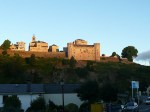
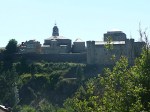
July 14: My first day’s walk started well, had some rough patches, but ended well. I set out from the hotel, with the red dawn casting a pinkish glow on the castle above the city. After walking past the castle I search for yellow arrows and immediately was lost. I theorized that  I’d need to head down the river vally in a northwesterly direction, so I set out on roads that seemed to follow that general route. By the time I reached the main highway — the A-52 and its companion, the N-525 that would shadow this camino most all the way to Santiago — I found yellow arrows again and walked ahead with more confidence. I walked the first day through quiet farms and fields with the goal of reaching Lubián. This meant climbing the mountain to Padornelo.

The walk up toward the pass at Padornelo was one of those frustrating camino moments where a pilgrim wishes he’d used a map. The marked trail enters traverses a canyon of perhaps 2-3 km in length, but the highway and freeway bridges above cut right across the canyon, saving the long walk down and around the canyon. If I’d known enough to get on the N-525 road I could’ve walked the high bridge, gone through the tunnel after it and in 1/4 of the time made it to Padornelo on the other side of the tunnel. But all pilgrims complain about walking, even though that’s how we’ve chosen to travel. Anyway, I trudged around the canyon, climbing to an elevation above the bridges and tunnels, then came down the other side with the “town” of Padornelo there to reward me.

In reality, Padornelo is a large gas station and a hotel/restaurant. My thought had been to stay here for the night, but when I saw that it was likely empty of pilgrims and set right by a highway I instead decided to have a beer at the restaurant and keep on walking. My feet, not yet used to the abuse yet, weren’t happy about that plan. I took off my shoes, hung my socks on the chair, and put my feet up on the chair until the bartender looked askance at me. That was a good cue to move on, which I did, walking down the mountain, losing about 1000 ft in elevation over the next 6-7 kilometers.

After a couple of hours the trail turned into a narrow, one track affair and I was convinced I was still a long way from Lubián when quite suddenly I came upon an albergue right at the entry to a tiny village. There was no hospitalero in attendance, but the albergue’s 16 beds left only one vacancy — my bed for the night. I set our my things and headed out for some refreshment. Climbing into the main section of town, along the road, I came to a bar and who should I find there but my friend, Artur! Somehow my long day of walking had allowed me to catch up to him. After a shower we had a relaxing meal and continued our ongoing conversation about medieval history, theology, geopolitics, and the military.

That evening I tucked myself into my bunk, enjoying vistas out to the forest just beyond the stone walls of the albergue. I was glad to be a pilgrim again.

July 15: The following day I slept in while other pilgrims packed and headed out the door. I had mentioned to Artur my plan to walk a short day and stop at the destination spa/resort at Villavela. I enjoy modern architecture and I’d found the online photos of this hotel to be rather intriguing. That meant a short day of walking for me, and Artur held back because he wanted company along the way, though his plan was to walk farther.

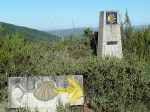
We left Lubián, walking downhill toward the day’s lowest elevation, and then uphill toward the peak of another camino mountain, this one 300 meters above the valley floor. At the top, which marked the border into Galicia, we could look toward the west and see for perhaps 20 miles. We stood together next to one of the white, concrete markers with blue scallop shell that would accompany us, marking our mileage the rest of the way into Santiago.

We arrived at Vilavella after only about 12 km of walking. There we found Dick and Annika, who made a big deal out of the “ritziness” of the hotel, not knowing I was planning to stay there for the night. I had an enormous bocadillo (sandwich) with Artur, then wished him well on his way, after which I settled into my unusual, two-story room. This was certainly one of the most modern hotels in which I’d ever stayed. The fact that it was in a tiny farming community that smelled like cattle gave it an unusual charm. I bought some red swim trunks so I could enjoy the pool and I spent the rest of the day relaxing and enjoying my fine surroundings.

Here’s the note I wrote that night to my wife, Gail:

As I write this, I’ve walked nearly 50 km now in 2 days without any advance training and my legs are killing me. People say the 3rd day is worst…. The weather is perfect so far and I have a sunburn on the back of my neck since I´m walking mostly mornings going in a generally westerly direction.

This camino is practically deserted in comparison to the Camino Frances. And most of the pilgrims seem to be Italians. They understand Spanish very well, though. Wish my Spanish was better, though after another 2 quarters of college Spanish this year it’s definitely improving. If someone speaks slowly I can understand a fair amount. Now that we´re in Galicia all the printed material is in Gallego, but it´s pretty close to Spanish and for the most part understandable.

July 13, 2010 Puebla de Sanabria

I met Arturo today. He called my hotel at noon (I grumpily answered the phone from my deep, jet-lagged sleep) and we met for lunch at 14:00. Arturo is actually Artur and it turns out he’s not from Seville, but from Estonia where he’s a Lt Colonel in their army. He’s a scholar of medieval history and tells great jokes. As we were eating, a pilgrim couple (Dick and Annika) stopped at the table and visited. They’re from Netherlands and are on their 5th camino, each starting from their home.

Arturo gave me the scoop on this camino — he’d started in Meride and in Extramadura it’s not well marked and there are few pilgrims to follow. He’s been lost multiple times.  Also he and Dick and Annika each had confrontations with big, scary dogs. Arturo carries a big stick to ward them off after being pushed down by one a couple of weeks back.

Artur was on his way to the next town and had amicably timed his arrival in Puebla for when I would be there. I planned, though, to spend another night at the modern and comfortable Parador, resting from the long trip. So he headed down the road at about 16:00. I hoped I’d meet up with him over the next few days.

Anyway. . .  I planned to set off in the morning, most likely with Padornelo as my final destination, but possibly as far as Lubian. I planned to use my best doggy diplomacy on los perros, use my best Español on el itinerario (my iPhone camino app in Spanish that served as my only guidebook) and try to be super observant of las flechas amarillas (yellow arrows) so as not to get lost. After a tour of the historic sites of Puebla and its castle I headed back to the hotel to have my final rest before my first day’s walk.

And so, the adventure begins.

July 12, 2010 Heading Out for a Camino in the Holy Year

After 2008, even after completing my dream of walking the Camino de Santiago, I couldn’t let go of it and move on to something else. Why? The camino had hold of me. Its extremes — physical challenge and spiritual reward, camaraderie and solitude, beauty and deprivation, familiar and foreign — made an irresistible combination. I also knew that an unusual and important day was coming for the camino — the Holy Year.

In the Catholic calendar each July 25 is a day to honor Santiago (St. James, in English), one of the primary disciples of Jesus. In a year when July 25 lands on a Sunday the entire year becomes a Holy Year, and that Sunday becomes a very special celebration. I’d learned in 2008 that this infrequent event would happen in 2010, and then not again until 2021. If I could arrange to be in Santiago at that time I’d experience the grandest of grand celebrations in honor of St. James.

The challenge would be that other pilgrims would have the same idea and would crowd the pathways and albergues of the camino. In preparation for this the governments in northern Spain had been building pilgrim infrastructure to accommodate the crowds. The increased pilgrim traffic during the previous years — up to 100,000 in 2008 from mere hundreds in the 1980’s — was expected to more than double in 2010. But the last thing I wanted was to fight my way through crowds on the way to Santiago’s Holy Day.

My solutions was to walk an alternate camino to Santiago, the Via de la Plata. This route begins in Sevilla and continues 1000 kilometers to Santiago. In July the southern stretches are notoriously hot and dry, discouraging most pilgrims from attempting this route during the Holy Month of the Holy Year. But since I had only 2 weeks’ time to make this year’s pilgrimage I began to plan for a distance of only about the last 250 kilometers, and I chose the largest town at this distance — Puebla de Sanabria — as my starting point. An advantage of the Sanabres region as my beginning was that it was noted as a very beautiful area. I anticipated lots of solitude and a relatively cool walk for July. The disadvantages were that it is mountainous, with steep climbs and descents, and it is remote, making access difficult and time-consuming. Fortunately I found a flight to Madrid and a red-eye bus to Puebla de Sanabria that would work to get me to the beginning of my journey. I also posted on my favorite camino Internet Forum that I’d be walking this route and I learned a pilgrim by the nom-de-plume of Arturo would be in this area at exactly the same time. Hopefully we’d meet and I would enjoy some companionship in what might be a fairly lonely walk.

I set out from Seattle, arrived in Madrid some hours later, and then found my way to the bus station where I waited five hours for my bus to Puebla. I had managed to get a front seat, so I enjoyed the views until nightfall, then for hours watched the white and yellow highway stripes flash as they passed under the bus. At sometime after midnight — about 12 hours after I had arrived in Madrid — the bus let me off at the Puebla de Sanabria stop located about 2 km outside town.

I asked directions at the bar/cafe where the bus had let me off and was pointed to the town’s lights up the dark road and across the river. I asked for a taxi. No luck at this hour. So I set out on the shoulder of the dark highway, hoping I was going the right direction. After about 1.5 km I came to a crossroads with a sign for my hotel — the Parador de Puebla de Sanabria. I followed the sign up the hill and came finally to my rest for the night. I buzzed at the locked door for an attendant and before long was let in the hotel where I settled in for a much-needed rest. Though it was after 01:30 here in Spain I was still on US West Coast time, which put my internal clock at about 10:30 in the morning. Still, the trip had been a long one and I fell asleep quickly.

August 28, 2008 Finisterre

The two hour bus ride to Finisterre was a delightfully different way to travel across Spain. We sat in the front row of a double-decker bus with an enormous windshield before us that allowed us to see everything within 180 degrees. We arrived at Finisterre, walked the tiny downtown, and then caught a taxi to the hoteljust a few yards shy of the lighthouse itself. We made a reservation for dinner at the hotel’s tiny restaurant and settled in for a delicious meal as the fog rolled in across the water. That night our sleep was interrupted by the sound of the fog horn blowing just a few yards away, and in the middle of the night we awakened to a thunderstorm that moved from one side of the cape to the other with constant forks of lightning flashing all around us. It was a very dramatic welcome to the end of the Earth and a fitting end to an amazing journey.

Postscript: I was very blessed with excellent health throughout my 800 km (500 mile) camino in May, June and August. I was more than satisfied with the journey itself. In fact, it had captured my imagination in ways I would never have guessed. And the fact that I returned, over and over again in the subsequent years, demonstrated the allure that this ancient journey has even for a modern pilgrim like me.

I had begun the pilgrimage expecting it to be a walk of solitude and introspection. I’d quickly learned that I had a deep hunger for community. The highlight of this and subsequent journeys was actually the pilgrim relationships I made and the new friends I discovered. In the coming years I would return to college to improve my Spanish, I would plan more caminos along other routes to Santiago, I would sponsor my son, Luke, on a camino of his own, and I would advise hundreds of other pilgrims on a UK Internet Forum.

At its heart, the Camino de Santiago is slow travel. Instead of driving through a region to see its sights, the pilgrimage walk allows one slowly to absorb a region, step by step. Today I cannot drink a glass of La Riojan wine without tasting the camino again. The fragrant nectar, made from grapes of this northern region of Spain, evokes all the feelings and many of the smells of the walk. Somehow the physical exertion provides an opening for Spirit, almost like a treasure hunt in which the next turn or the next cafe table or the next church holds surprising and delightful rewards. Even albergue life, with its uncomfortable bunks and symphony of snores has an attraction. They, like other parts of this amazing walk, hold the joy of camaraderie, of shared ordeal, of celebration and quiet conversation, of the search for the Divine in the separation from the routine and immersion in the extraordinary.

August 27, 2008 Santiago Rest Day

The previous night Gail and I had eaten at a small restaurant near the hotel then headed back to the hotel for an early night in our comfy room. The next morning we enjoyed a Hotel Altair breakfast (croissants, ample fruit, great coffee, exotic jams and jellies) and then went to get Gail’s completion certificate, the compostela. After a little exploring and time taken to greet other pilgrims we’d recognized from our walk, we headed to the cathedral for the noon pilgrim mass. The place was jammed, even though we’d arrived early. At the end of the mass, seeing that the famous botafumeiro (a large censor, lit with fragrant incense and swung on a long rope from transept to transept) was not to be used in the service we went back to the hotel. We heard from people afterward that the botafumeiro had indeed been used, but just at the end of the service. The funnest part was left until the end.

Through the day we enjoyed shopping along the narrow streets of the old city and meeting pilgrim friends over cervesas or red wine. We took the short walk to the bus station and arranged a ride to Finisterre the next day and I arranged a hotel at the tip of Capo Haro, just at the end of the famous cape that earns the nearby town it’s Latin name, “End of the World.”

As Gail took a well-deserved nap that afternoon I returned to the cathedral for some quiet time on my own. I walked down into the crypt to view the small sarcophagus where tradition says Saint James’ (Santiago’s) bones are kept. I prayer to God a prayer of thanksgiving, then headed back up to the nave to think and prayer and remember. I decided to pray for every single pilgrim I’d met during the walk and to give God thanks for the memories of our meetings. So I prayed for them all, and as I prayed tears of relief and joy and loss streamed from my eyes. The camino had reminded me of my love of discovery — discovery of foreign lands and discovery of the joys of friendship. In this church I came to realize that God is indeed present on a pilgrimage — present each step of the way, present in the laughter and embrace of pilgrim friends, and present in the traditions of an ancient Christian community that calls us to live beyond ourselves, stepping from our comfortable lives into God’s joyful embrace.

August 26, 2008 O Pedrouzo to Santiago de Compostela

As I loaded up my gear in O Pedrouzo I realized this would be my last day of walking the Camino de Santiago. The feeling was bittersweet — I was happy to know that I would accomplish the goal I’d set for myself months ago, but I was sad that the end of something I had enjoyed immensely was at hand.

The weather was perfect. In fact it had been sunny without rain every day we’d been in Spain this August. We set out after a hotel breakfast anxious to put the miles behind us and get to the cathedral in Santiago and say hello to the Apostle James, after which the whole pilgrimage is named.

A few miles from O Pedrouzo are the outer fences of the Santiago airport, where the camino runs from the middle of one side, around the end, and then to the middle of the other side. This means about an hour of walking past the airport, sometimes with jets landing or taking off right overhead. At the end of the runway, near the road, is a stone marker that is the first welcome to Santiago. This is still some miles from the cathedral as we would discover.

We continued on to the tiny village of Lavacolla, just below the airport, where medieval pilgrims had washed themselves in a creek as preparation for their entry to Santiago. We bought a soda at the sole bar and looked beyond us to a tall hill, perhaps our last before the city itself.

The last hill seemed like a mountain range. We walked past a never-ending TV station property, through a subdivision of homes, and finally to the monument at Monte de Gozo — the Hill of Joy. From here is the first sight of the twin towers of the Santiago cathedral and, dominating the hill, is a modern sculpture that honors the visit of Pope John Paul II ten years earlier.

We found our way to the enormous albergue below, then lost the camino from there, guessing that it must go to the bottom of the hill where the main road crosses a bridge into town. Sure enough, we picked up the trail again just before the bridge and noted with joy the sign indicating our arrival into the city limits of Santiago.

At this point it seemed like we had already walked 30 km, not the 12 km we’d actually covered. This modern section of Santiago seemed just like any other sprawlingly suburban city approach. We walked past car dealerships, offices and strip malls, then came to the end of the street we were on, forcing us to make a left or right turn in order to continue. The path wasn’t clear, so we stopped once again for a cold drink and discussed our options, watching as we did to see where other pilgrims were heading. I could barely sit still out of excitement to complete the walk, and finally we began the last climb, up the hill and along the blocks of 6-7 story apartment buildings to what clearly was a gate into the old city. We walked through the gate, up the last hill past many tourist shops, down through a tunnel, turned left and came to the vast Plaza Obradoiro that sits below the cathedral’s grand west facade.

We were here. For me, after 800 km and three months I’d made it to Santiago. For Gail it was 188 km of pain and struggle, perhaps over more difficult obstacles.

It was afternoon now, and we had missed the noon pilgrim mass so there was no point in rushing to get to the cathedral. Instead we headed to our hotel, The Altaïr, and immediately fell in love with its combination of old world warmth and modern sophistication. Gail settled in for a well-deserved rest and I headed out for my pilgrim certificate and to explore this town that I’d been aiming for all these months.