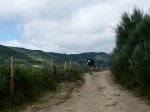
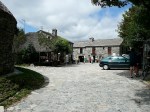
August 25, 2008 Arzua to O Pedrouzo

At breakfast Gail and I walked downstairs to the hotel dining room and again met an older German couple with no English. This gave Gail a chance to practice her high school/college German. Her accent is great and it was a good intellectual challenge for Gail to be pulled back into her German vocabulary and grammar and a great opportunity for me to remember how smart my wife is.
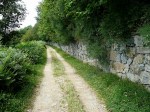
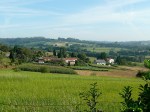
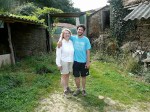
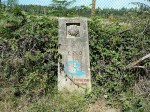
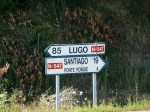
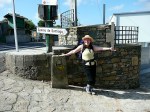
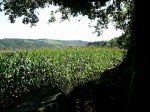
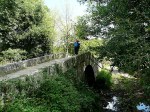
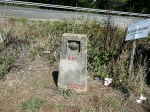
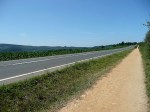
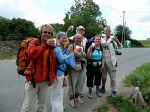
We left Arzua with the plan to cut our remaining distance to Santiago into two days’ journey. Through the day we played leapfrog (not literally) with Carol (Pinky) and Jake, and as the day’s walk through woods and near farms came to a close we discovered we were together in a hotel just off the camino and adjacent to the car road to Santiago. We settled into the hotel and ordered drinks to share with Jake and Carol in the hotel’s back garden, then had a relaxing dinner together in the hotel restaurant.

Tomorrow we would take our final steps to Santiago de Compostela, the fulfillment of much dreaming over many months.

August 24, 2008 Melide to Arzua

Today’s walk would take us only 14 km to the town of Arzua, which would give plenty of time to relax and rest. Our guidebook mentioned an ancient church at Donas de Vilar and a medieval castle at Pambre that was off the camino near Palas de Rei, so we decided for reward ourselves with a taxi ride and church/castle tour if we could get to Arzua at a decent hour.

The thought of only a 3 hour walk gave Gail great hope, so we made it to Arzua by lunchtime and found a room at a hotel right on the camino in the heart of town. We left our things, found a taxi, and enjoyed a long ride to Castillo Pambre, a very scenic and deserted castle between woods and farms off the camino. Unfortunately there was no way to go inside the castle, so we walked down into a horse pasture to get the full effect of the building’s architecture and shared the space with a huge white stallion. We then headed to Vilar de Donas, and after finding the keeper of the key, studied every aspect of this nearly 1000 year old church.

Today was a nice day of gentle walking and car touring. This quiet and interesting day gave us both the sense that we were now starting to have fun, even as the end of our walk drew near.

August 23, 2008 Eirexe to Melide

Even to make it to Santiago on a relaxed schedule would require us to walk 22 km today, so I hoped that Gail’s foot pain would be better today and we could make it to Melide.

We set out with no sign of Christian, but we saw Carol and Jake on and off through the day. Jake, at 20ish years old, was a camino jackrabbit. He was in great shape and able to walk back and forth between us and his mom as though each step was effortless. Carol had a slower pace and we often saw the two catching another cup of coffee (or an ice cream bar) along the path.

We walked downhill through the town of Palas de Rei, stopping only to look for an ATM and lunch. We nabbed a few additional stamps for our credentials at churches along the way, including one at which the priest ran out of his building, waved and shouted at us to come in and see his amazing church, then asked for a 5€ donation for the privilege. The stop was worth it mostly to admire the chutzpah of this entrepreneurial servant of God.

As the day wore on Gail began to reach the limits of her endurance. We finally arrived at Melide, where we’d arranged a rendezvous with Jake and Carol, but we couldn’t locate the hotel they’d mentioned and Gail was desperate to get off her feet. I left her in the main plaza and ran off to find any hotel, securing a great room in the Pousada Chiquitin. Something about this hotel’s combination of location, simplicity and chic modern made me really like it. I ran back to get Gail and settled her into the room while I went across the street to the albergue to do our laundry.

While Gail rested I enjoyed stepping back into albergue life, if only for an hour or so. Even though I was staying at a nearby hotel I was welcomed into the albergue by the kind hospitalera and allowed to use the coin-op washer and dryer. The washer ate my coins and then stopped partway through its cycle, which led the hospitalera and me to get put our arms around it and shake it back to its senses. Sure enough it began to work again and my laundry proceeded to get cleaned.

While I waited for the cycle to complete I went to the albergue kitchen and enjoyed some of the usual enjoyable pilgrim company. As always, pilgrims from all over the world were in attendance and I had a long conversation with a young female Australian veterinarian who was walking the camino from St. Jean Pied de Port. When the laundry was done I walked over to Gail with our clean clothes. She was asleep, so I headed out for a haircut and after she woke up we had dinner in the hotel’s restaurant before calling it a day.

August 22, 2008 Portomarín to Eirexe

Pressing on through her pain, Gail was now becoming a hero. While she walked and while she rested she thought through her own medical diagnosis of what was happening (she’s boarded as an internist as well as an anesthesiologist). Each step felt as though there was a rock between the bottom of her foot and her boot. The pain became excruciating and it was only later that she decided it was probably an less common form of plantar fasciitis in which the forward section of the plantar fascia is inflamed. Once again I offered a taxi for Gail. Once again she was insulted and refused. Bless her heart — she was going to brave out the entire walk!

On the other hand, I was in great shape and thoroughly enjoying each moment of this walk. It was an enormous gift, after all, the completion of a plan I’d had for years, one that had suffered a setback in June with my mother’s illness, but one that was day by day coming closer to fulfillment. We were just a few days outside Santiago now and I longed to visit this city on which I’d long set my sights.

The one thing the that was also clear, though, was that my secondary goal of walking to Finisterre would probably not happen. I’d arranged our flights for what I thought would be an adequate time to include a 3-day walk to Finisterre after Santiago, but I hadn’t taken into account what our actual pace would be. And recognizing the pain with which Gail was walking I felt a walk today to Ligonde/Eirexe would be about our limit. This would stretch our Santiago arrival date out far enough that we would miss the three days necessary to walk all the way to the coast. I was sad, but I also began to recognize that I might walk the camino again sometime in the future, in which case I would add Finisterre on at the end.

We left Portomarin sometime well after Christian, Carol and Jake. With a modest goal of 17 km I reasoned that we could sleep in and give Gail some time to rest. So we set off through the small farms and quiet towns in this stretch. Arriving in the late afternoon at Eirexe, a tiny settlement with only a cafe/bar and a restaurant with a small hotel above, I arranged a room in the hotel. We enjoyed a very quiet night in this fairly remote area, surrounded by the green of the nearby pastures and no road larger than the camino as it ambled along between the two buildings.

August 21, 2008 Sarria to Portomarín

By this time the effects of the walking were taking a toll on Gail and I was puzzled about why she wasn’t feeling stronger the farther we walked. Gail was complaining of extreme pain in her foot and she was walking very slowly with a barely noticeable limp. I offered to call a taxi and meet her at the next day’s goal, Portomarin, but Gail was insistent she would walk it — and a little insulted that I’d consider calling her a cab. We both recognized, too, that, if Gail didn’t walk the last 100 km from this point on, she would not qualify for the compostela, the completion certificate at the arrival to Santiago.

So we set off from Sarria, stopping regularly at sites along the way to take photos. Over the next km we saw a Dutch man whom we’d met climbing to O Cebreiro, and we spent a lot of time with Christian, an Austrian man who wanted to practice his English and who was delightful company. We also met an Austrian woman who spoke only German and her daughter who spoke English well. Also we met two young Swedish men who wanted to celebrate the birthday of one, so they’d bought two boxes of wine and were carrying them to share with pilgrims along the way.

I usually walked with Christian, pausing each time Gail was out of sight behind us and then allowing her to catch up. At one point just before Portomarin Christian and I were deep in conversation and missed a yellow arrow. Gail called to us from behind and let us know we’d missed the turn.

We walked down into the valley where the town of Portomarin had originally been — it had been moved in the 20th century when a dam had been built, creating a reservoir over the town’s ancient site. We crossed the new highway bridge high above the lake and climbed up into the new town on the hillside above, noting the Romanesque church that had been moved stone-by-stone from below to the new town. Gail sat on a bench in the square while I hunted with Christian for a hotel room. When we got to the room Gail collapsed on the bed. I told her to stay put and I would bring her dinner. I found a restaurant, explained in Spanish that I wanted a dinner to go, brought it to her, then returned to the restaurant for a meal with Christian, Jake and Carol who’d by now met each other. When I returned to our room Gail had fallen asleep with the dinner half finished beside her. I lay down next to her, hoping her camino would become more joyful in the days ahead, but thankful that we could be here together to experience these days of walking the Camino de Santiago.

August 20, 2008 Triacastela to Sarria

If I’d been smart I would’ve chosen the shortest route possible to the next town, Sarria. Instead I remembered Stefan of South Africa’s words about how I must go to the monastery at Samos because it’s one of the great experiences of the camino. This adds about 6 km to the day’s total distance and Gail’s was exhausted and discouraged after three tough days of walking. This day would not be a hard uphill or downhill, but it would be long.

As we left Triacastela for Samos I noticed someone had written in French on the back of a road sign, “Don’t forget to smile!” I pointed the graffiti out to Gail and translated it for her. She was not amused. This was no vacation for her — just a long walk in a foreign country trying to keep her husband happy. I was sad that Gail hadn’t started to enjoy herself yet, but I knew, I just knew, that as her body caught her up to the physical challenge she would find the great spiritual rewards of the walk.

The walk from Triacastela begins along the roadway, with timbered parks and a creek off to the left side. Soon it veers into the forest for the long, shady walk to Samos. After a few hours we saw the large monastery in the valley below. I was thrilled to see this important building, rebuilt from its original medieval structure after a fire. It was clear that the monastery was the primary institution of the little village of Samos and I had images of the idyllic life of a monk, copying manuscripts in the morning and working in the fields in the afternoon.

Gail and I came down the long, narrow, curving road into town, stopping at a produce store to pick up delicious fruit. We came into town, had lunch at a roadside cafe (where unfortunately a detour had caused large trucks to constantly roar past us), then headed a few blocks toward the monastery itself. We discovered the monastery door was unlocked and its gift shop was open, but unfortunately the monastery itself was closed until its guided tour hours, much later in the evening. Intrigued, but disappointed we left Samos for the day’s goal of Sarria.

The quickest way to Sarria is by the road, so we walked out of Samos along the highway, rejoining the main camino some miles out of town. The long walk left us both tired and grumpy and as we walked into town we looked immediately for a hotel that could put us up for the night. A hotel of 12-15 stories in height appeared before us and we arranged a room for the evening, the two of us dropping in exhaustion on the hard single beds.

After showers I convinced Gail to walk out of the hotel with me to find a place to eat and to look for other pilgrims to enjoy. She gingerly walked on her pain-filled feet over the nearby pedestrian bridge across the river and as we hunted for a table among the many sidewalk cafes there we saw the familiar faces of Carol and Jake, the Americans we’d met back at Villafranca. This cheered us both up and we enjoyed a fun evening of camino stories and conversation over Menu del Peregrino and ample red wine. I was glad to see our friends — both to enjoy their company and to show Gail the joys of pilgrim companionship. Our meeting was definitely a bright spot in a day that had been a long slog for my beloved wife.

August 19, 2008 O Cebreiro to Triacastela

Since we’d made the climb to O Cebreiro I was pretty certain the most difficult part of our camino together was now behind us. I was wrong for two reasons.

First, the walk after O Cebreiro continues down, then up again to Alto de Poio. The last km or so is just as steep as anything we’d experienced the day before. We were rewarded by a bar/cafe at the top where we grabbed a cafe con leche and a croissant, then we headed to the pilgrim statue at the summit and enjoyed the beautiful views under bright blue skies.

Second, the walk down to Triacastela is a hardcore descent. The endless pounding of foothold to foothold was merciless and now Gail faced a new challenge using a completely different set of muscles. Our 21 km goal to Triacastela was a light day for a pilgrim accustomed to walking, and I assured Gail this walk would get a lot easier after the first week. This cheered her up and, after several hours we arrived at the outskirts of Triacastela. Gail waited at a bar/cafe as I searched out a hotel.

It took me some time to find a place for us and while I was gone Gail delighted both in the rest and in the sights of the pilgrim river flowing before her. She recounted odd stories about a pair of girls pulling a trailer with an umbrella and a small dog on it. She told me later about a man walking backwards in a kilt. And she described a pleasant conversation she’d had with an Austria named Christian.

I brought her back to the hotel I’d found, which came equipped with a washer and dryer in the basement. Gail rested as I did our laundry and then we found a quiet restaurant for dinner after which we put ourselves to bed, Gail hoping the walk would become more fun and I hoping Gail would have patience with me, the one who’d dragged her halfway across the world for a painful and difficult hike.

August 18, 2008 Vega de Valcarce to O Cebreiro

As I thought about it through the night I realized Gail had been a true hero the day before. Without much training she’d conquered a very difficult climb. She wasn’t here out of any desire of her own. She was here to keep me company and help me fulfill my own goal, to complete the Camino de Santiago. She’d taken two weeks of precious vacation from her work as a physician and had dedicated it to my goal. It was a great sacrifice and I was very grateful for this gift she’d given me.

As she awoke it was clear she was having Pilgrim Second Day Syndrome — the annoying realization on the morning of a pilgrim’s second day that they’d face another and another challenge just like the one they’d already surmounted. There’s a certain hopelessness about Second Day Syndrome, and although the day was bright and beautiful Gail’s cheerlessness was completely understandable. Today we would finish our long climb up to O Cebreiro, gaining at least as much elevation as we had the day before.

At about La Faba the camino becomes quite steep and it was about here that Gail’s pack was becoming a real encumbrance. I stopped her, unbuckled her pack, took mine off, then strapped the two together and lifted them both onto my back. The combined weight was only about 40 lbs — we were both light packers — and the lighter weight made a big difference for Gail, allowing her to gamely trudge up the mountain. Several times we stopped and watched as other pilgrims looked at the double packs, mentally counting the weight I was carrying. I’m sure they didn’t realize backpackers in our local Cascades carry 50-60 pounds on a regular basis and the 40 pounds on my back wasn’t a big deal since we had all day to make our goal and my legs had already been strengthened by nearly 400 camino miles earlier in the summer.

As we neared O Cebreiro the clouds rolled in and the air became quite cool. I learned that even in August O Cebreiro can be chilly. We found a room at a tiny inn, found a warm dinner and a credential stamp at the chapel, and covered ourselves with blankets, trying to stay warm in the cold room. Out the windows, though, we saw the amazing views from this beautiful and historic village and were thankful we were able to conquer the biggest hill of our camino together.

August 17, 2008 Villafranca del Bierzo to Vega de Valcarce

With my mother’s illness behind us I had somehow managed to talk Gail into joining me in Spain for the final 188 km (115 miles). She’d been able to train only briefly, walking back and forth each day the 3 miles to and from the hospital where she works. From her hiking days years ago she had well-worn boots, so at least footwear would not be a problem.

As we made our way to Spain — to Madrid by air, to León and Ponferrada by train, to Villafranca del Bierzo by bus — I realized this last stretch would be much different than the former. Gail had already let me know she was not interested in experiencing albergue life, regardless of the cost savings. That was fine by me. I realized, too, that I was bringing my own camino family this time and wouldn’t feel as much need to reach out to any English speaking stranger I happened to find in a cafe/bar or albergue. Best of all, I’d have a partner with whom I could share the memories for many years after.

I’d made reservations at the Parador in Villafranca del Bierzo, where we arrived on Aug 16.  We headed out to dinner at the same restaurant where I’d read Gail’s email two months earlier and, coming back, we heard the sound of American English behind us. We stopped to introduce ourselves and met Carol and her son, Jake, from Virginia. They had started in León in celebration of Carol’s 60th birthday. Jake, a Northwestern University drama student, had already walked the camino years before. We didn’t realize at the time that Carol and Jake would become our new camino family.

The next morning we had a plentiful Parador breakfast, then stepped out of the hotel to begin our walk. We walked toward the plaza and came to the yellow arrow on the asphalt where I’d abandoned the camino two months earlier. I was thrilled and excited to return and thankful to have Gail with me.

Somehow we couldn’t find the right arrows to cross the river, so we walked across on the auto bridge, then walked until we picked up the arrows again. The way was obvious since the Bierzo river valley dramatically cuts through the ridges that encircle the town. Just as we left town we had a fateful choice to make — take the way along the road or take the Camino Duro, the tough road that climbs to the ridge above town and follows it much of the way toward O Cebreiro. At the turnoff for the Camino Duro the signs shouted out in Spanish, “Danger! Don’t go this way unless you’re very athletic. It is very hard!”

We stood together and talked about which way we’d walk. I was concerned that, without adequate time for training Gail would have a difficult time on the ridge route. “If I weren’t here,” she said, “which path would you walk?” I admitted I would walk the Camino Duro, so together we headed up the steep path toward the ridge.

The combination of a heavy pack and the steep, vertical climb immediately took its toll on Gail. We paused over on our way up, but she persisted. We were rewarded by spectacular views back toward Villafranca and extraordinary views up the valley toward O Cebreiro.

Once at the top the ridge road levels out and becomes much easier. At that point the views take over and the walk is pure bliss. We continued on for some miles in the bright sunshine until coming to a stand of walnut trees. At this point we realized the path headed back down a steep, gravel road to the valley floor below. We picked our way down to the town of Vega de Valcarce and located an albergue/hotel as our stop for the evening. As should be, Gail was exhausted. We found dinner and caught a good night’s sleep in our simple hotel room, halfway up the last big climb of the Camino Frances.

June 17, 2008 Molinaseca to Villafranca del Bierzo

A crisp and chilly, but sunny morning greeted me the next day and I rolled out of bed early, hoping to cover many miles today and perhaps find my pilgrim family at Villafranca del Bierzo, 30 km in the distance.

After a couple of hours I arrived at Ponferrada, with its famous Templar castle and — an ATM! With cash in hand and a croissant from the bakery adjacent to the castle I headed on past the wineries, to Cacabelos. Growing tired with the passing hours after many days of walking long distances to find my pilgrim friends, I stumbled into Villafranca and paid for a bed in the Ave Fenix Albergue, one of the more storied hostels on the camino (partly because it has burned down three times). I walked toward the plaza and there, having a late lunch, were Trevor, Danni and Tim! After a week I’d finally found them. We shared hugs and then, over beers, many stories of our pilgrim adventures.

Late that afternoon I checked my email from home and was surprised to read this message from Gail:

Hi Sweetie,

I hope you are catching up with your comrades!

I have some important news to pass on from your mother.  After her [recent car] accident, she took some time to resume activity, and has noticed her exercise tolerance was down.  She also was experiencing some pain in her chest that she thought was the bruise on her sternum.  However, after a student suggested she be checked out, she was referred for a treadmill test today, and it sounds like the treadmill test indicates that she probably has coronary artery disease.  The doctor gave her the option of getting another type of stress test (presumably a “stress thallium” …), or being referred to a cardiologist for heart catheterization.  (The doc consulted a cardiologist after her stress test).  I spent some time tonight talking with her about the pros and cons, and right now she is thinking she probably will want to go straight to the cardiologist and have a cath, with angioplasty or stent if needed.  This sounds like a reasonable decision to me.  If
she is referred, I think she will end up having the cath sometime this week or early next.

She is otherwise doing fine:  no chest pain unless she exercises, and she has medication and strict instructions if things get worse.  She is feeling completely well, and I suggested she treat herself to comfort food tonight, and practice relaxation!  She sounds like she is in a very good mood.  We should know a lot more tomorrow, and I’ll keep you posted.  Once I know when she will be scheduled, I’ll take the time off from work and be with her that day (she gave me permission!).

I’m sorry to write with what must be nerve-wracking news…”

Needless to say, I was thunderstruck. I went back out to the plaza and shared the news with my pilgrim family, asking their advice about whether I should head back to the U.S. or stay with the camino. I realized that over the next days I would be in another remote stretch of the walk as I crossed another mountain pass. I knew that ground transportation to an airport would be difficult for at least the next four days, and that Internet access would be equally uncertain. I also knew I’d spent nearly a week trying to catch up to my friends and that if I left the camino now I’d likely never see them again.

I went back to the albergue and decided I needed some time to catch a good rest and plan for my next steps. I’d seen signs for a Parador Hotel, so I grabbed my things from Ave Fenix and checked in to the modern and spacious Villafranca del Bierzo Parador.

That night I decided to proceed with my camino. After all, Gail was there for my mom, and Gail is a physician. In the morning I walked to the plaza again and began looking for yellow arrows to begin making my way up the mountain toward O Cebreiro. I came to a yellow arrow with a branch showing the option of going left or right. As I looked down at the arrow I realized I couldn’t walk onward on the camino with my mom sick. I just couldn’t do it. I asked at a bar/cafe when the next bus back to Ponferrada was and I said goodbye to the camino, perhaps forever. Though they’d already left for the day, I wished goodbye to my friends and began the long journey back home, my goal to complete the camino unmet.

Postscript to the day: The bus from Villafranca left me at the bus station in Ponferrada, and I took a taxi to the train station. Who should be there but the delightful French/Bulgarian crew I’d met at Hospital de Orbigo. And, surprise of surprises, who should be standing there with my lost poles but my Bulgarian friend. She’d found them at the cafe where I’d left them and had adopted them as her own. I assured her they were mine, but were now a gift to her, both from the camino and from me.

I took the train from there to Madrid, then caught a flight back to Seattle. My mother’s surgery was delayed until late in July. The surgery — a stent installment — was successful and she recuperated just fine. During July it was clear to Gail that I was longing to return to Spain and finish my camino. So with all the persuasion I could muster I convinced her to join me in August so we could pick up together where I’d left off. She agreed and we made plans to return to Villafranca del Bierzo in a few week to finish Camino 2008.