Unknown's avatar

About Sandy Brown

Pilgrim trek writer and guide from Seattle USA living in Lucca, Italy. See more at www.sandybrownbooks.com

Australian pilgrim Bill Bennett describes his walk on the Via di Francesco as “Sublime and Profound”

(Editors note: At our request, Bill Bennett, an Australian filmmaker and pilgrimage lover, has written his reflections on the Via di Francesco. We shared an advance copy of The Way of St Francis: From Florence to Assisi and Rome with Bill so he could check the itinerary and get back to us with comments and suggestions. Bill can be reached through his website and blog.

unnamed-1
Arrival in Assisi

Earlier this year my wife and I and a group of five others walked a section of the Via di Francesco, from Santuario della Verna to Assisi.

That we were able to do it so capably, without once getting lost, was testament to Sandy Brown and his wonderful book, which I believe will become as essential to this walk as John Brierley’s guide is to the Camino Frances.

Sandy also very kindly provided us with GPX coordinates which, once coupled to an app on our iPhones, meant we knew exactly where we were at any given moment.

Sandy, thank you for making this pilgrimage so easy for us!

We were all experienced pilgrims. We’d all previously walked the Camino Frances, and other Caminos too – but without doubt we would count the Via di Francesco as the most sublime, profound, and spiritual of any walk we’ve ever done. Why?

unnamed-6Starting off in the monastery at della Verna certainly was a deeply moving experience. This is the place where St. Francis experienced his stigmata, and it’s a crucial part of his story.

We stayed in the monastery the night before we began our pilgrimage. It was a wonderful introduction to the life of the saint. We participated in the traditional procession to the Chapel, which has happened each day at 3pm for centuries. It takes you from a small church through a covered corridor, the walls painted with frescos depicting the life of St. Francis.

The following morning we set off, following instructions in Sandy’s book, and his GPX coordinates. For the next ten days we meandered our way south, through some of the most glorious country I’ve ever seen. I have to say of all the walks I’ve done, the Via di Francesco is by far the most scenic. At times you have to just stop and take in the wonder of what you’re seeing.

The walk also takes you through some wonderful Tuscan and Umbrian towns – and the food is incredible. Not expensive, but it’s the best Italian food I’ve ever had, and I’ve travelled extensively in Italy.
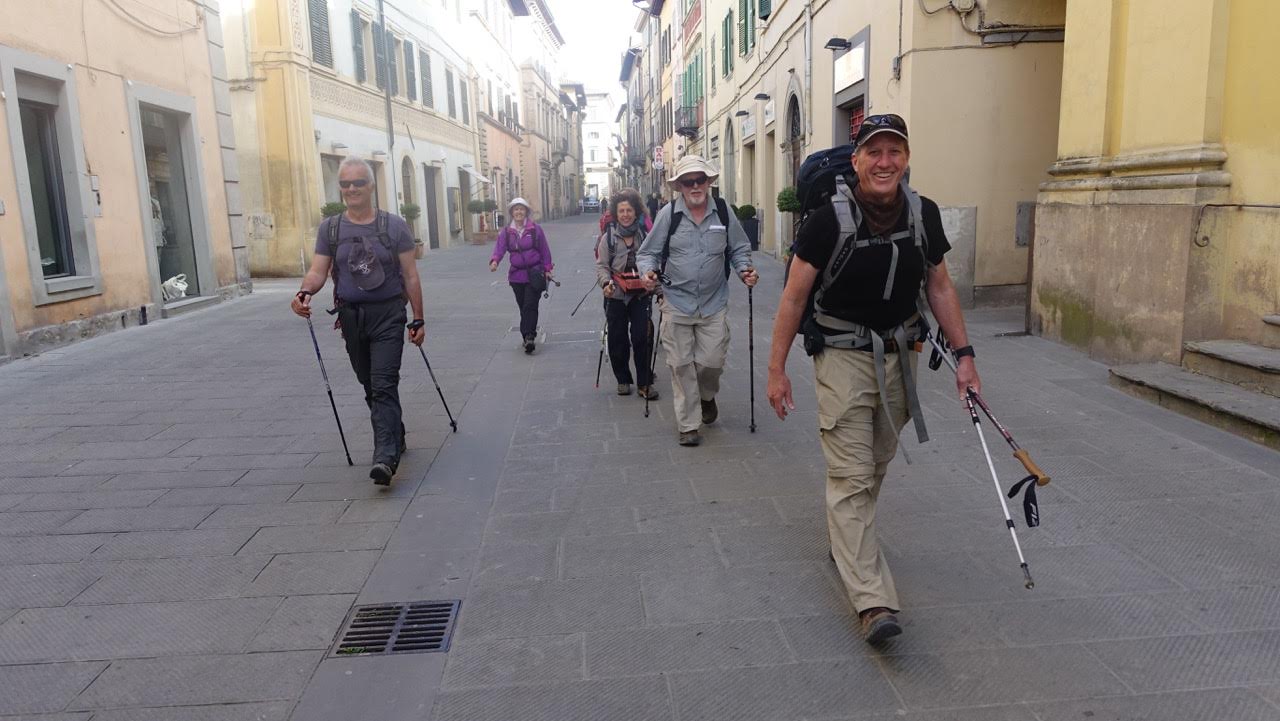
unnamed-2Because we were a fairly large group we chose to stay in hotels – and so that dictated our stage lengths each day. With a fewer number we could have stayed in agriturismos, which are cheaper and get you closer to the local people. If I were to do the walk again, and I’m thinking of it because it was just so wonderful, I would definitely stay in these rural B&Bs.

Reaching Assisi, and spending time in that sacred city, was the highlight of the walk. If you are seeking a spiritual experience, there is nothing more profound than going to St. Francis’s tomb at the Basilica. If you’re simply wanting to hang out in one of Italy’s most beautiful historic cities, then Assisi has everything you could want.

Some months later now, the power of this pilgrimage stays with me. I have recurring memories of moments of exquisite beauty, and of a transcendent spirituality that is palpable on this walk.

unnamed-3I would not have attempted this without Sandy Brown. I mean that. Knowing that the route had been meticulously tracked, and there was a guide book which I could constantly refer to, gave me enormous comfort. I found that the information in Sandy’s book was accurate often down to the metre! He even described barking dogs on one section, and as I walked along it, sure enough there were barking dogs!

The Via di Francesco will never supplant the Camino Frances, however I believe it’s more beautiful, it’s just as profound as a spiritual journey, and it gives you the life and story of St. Francis, which will stay with you for the rest of your life – and beyond!

Bill Bennett

unnamed-4

Donna Jones’ Report on her 2015 Way of St Francis

Donna Jones walked the Way of St Francis (Stia to Rome) mid-March to mid-April 2015 and has these notes to share with future pilgrims –Sandy

2015-03-18 09.47.52

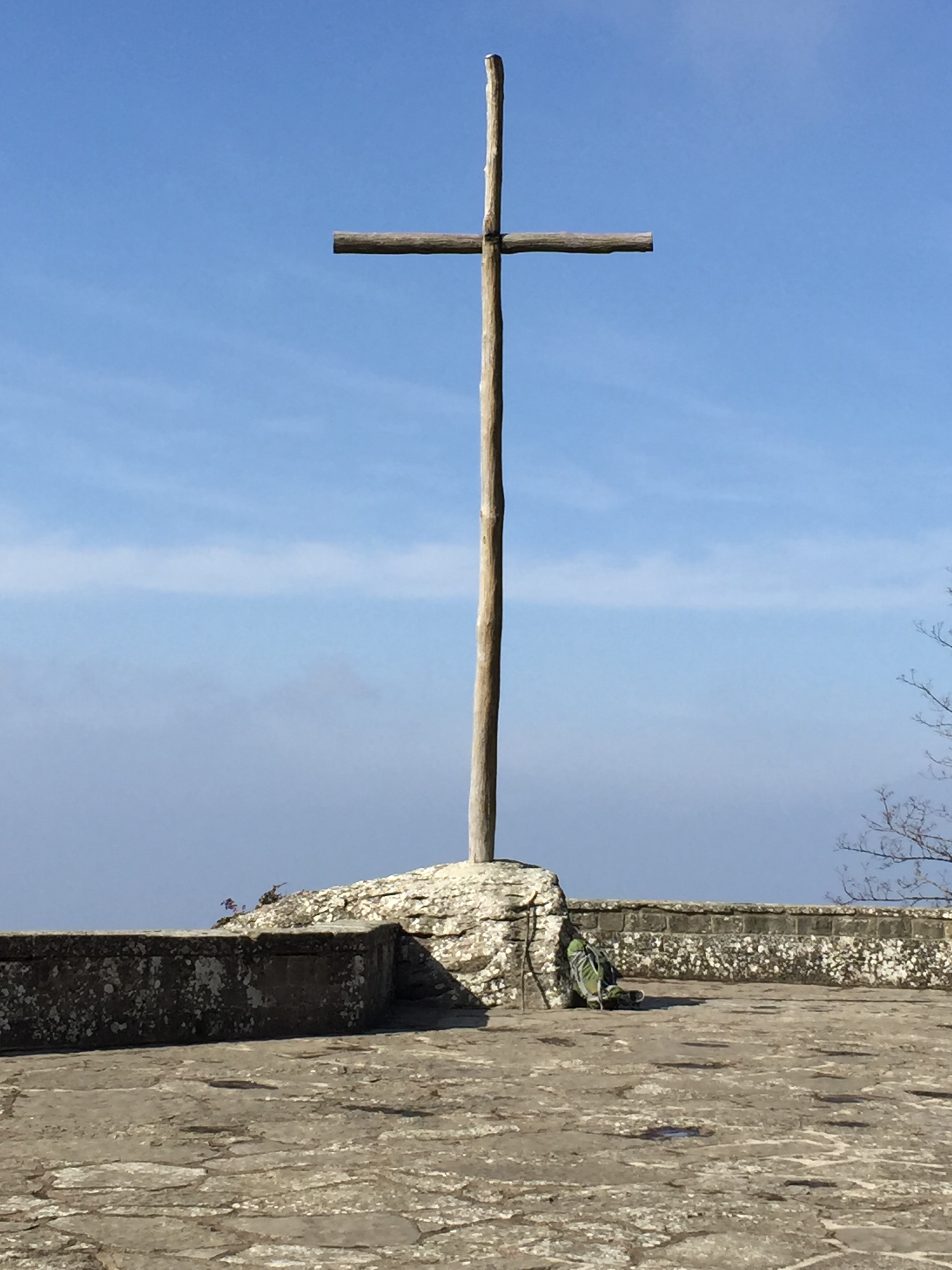
Overlook at Santuario della Verna

I have recently returned from nearly 4 weeks walking the Via di San Francesco. This was my first camino so I will not be able to compare it to the more well known Camino de Santiago. But perhaps a fresh eye on such a beautiful walk will be helpful to others considering or planning it.

First I want to thank Sandy for his willingness to share his experiences and insights with all of us considering this path. And mostly for making us aware that it is possible. Equally important, I could not have done this walk without the kindness, knowledge and support of Salvatore Accardi. Salvatore through his business (Il Mestiere di Viaggiare) helped me identify the best routes and stopping places in this off season for my needs and identified lodging – not so easy when so few places were open. One of the best parts of his support were the GPS tracks he provided which kept me safely on the path despite sometimes, confusing, missing or erroneous signage. I used the app Motion-X GPS on my iphone to keep track.

I mostly followed the stages laid out by Sandy, with some small differences. When I could break a stage into two I took that option, as I wanted to be sure I could do it. I am 59 years old, in reasonable shape but not an athlete and my main form of exercise has jut been walking but not with a pack so I was unsure of what I would be able to do.

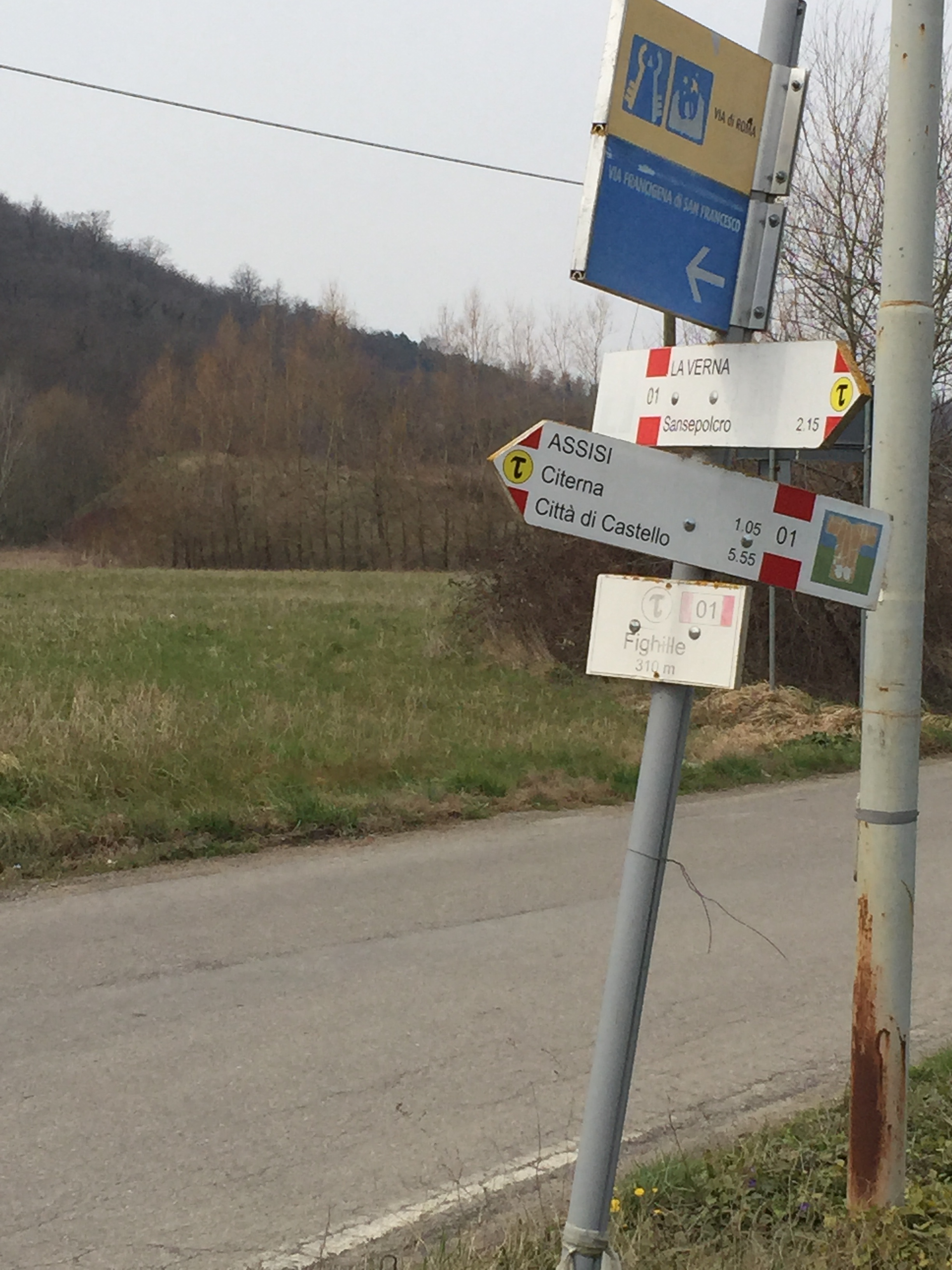
Various way marks

Various way marks

For various timing reasons, I did not begin in Florence so missed the first 3 stages of the walk but met a Canadian on the trail who had walked it and enjoyed it. My walk started in the small town of Stia. I walked from mid-March to mid-April and that had important impacts on my walk. Firstly, there was essentially no one else on the trail. I met the Canadian mentioned above who was walking from Florence to Assisi, an Italian who was walking from Sansepolcro to Assisi, a German couple who were walking a somewhat different route from Assisi to Rome and 3 Austrian women who were walking for a week from Assisi to Rieti. That was it for the entire 4 weeks save for my son and husband who joined me for parts of different sections. Being ahead of the season meant quiet times on the trail but also quiet times in some small places that might not have lodging open yet. Because I worked with the wonderful Salvatore, I had lodging somewhere every night despite some hostels and inns not yet open. The other big factor for this time of year is the weather. There were 2 days of walking with snowdrifts in the mountains, beautiful, not too cold but sometimes tricky footing. Mostly however there was water. Though I only had 3-4 days of rain, the rain and the melting snows meant that rivers and creeks were full and some of the stream crossings were not possible, however – there was always a way and that never slowed us for long. The best part of this time of year was that the temperature for walking was wonderful, never too hot or too cold.

Viewpoint at Montecasale

Viewpoint at Montecasale

Admittedly I am a novice and not young but it did not seem is an easy walk but it was wonderful, beautiful, and soul lifting. Most of the paths were wide gravel or reasonable forest paths or very quiet asphalt. Each day I made it to my planned stop in under 7 hours so was safely in daylight even without the summer hours. So many kind people, amazing little towns, beautiful scenery, delicious food, incredible history, and the opportunities to see these little places you would never come to otherwise, walking up to the sites with so much history, to spend time with St. Francis in the rocks and forest and to just be out walking in this beautiful country. So though there were narrow and steep paths with mud or difficult rocky gravel, some busy roads or less than ideal paths to avoid the busy road and markings that were not standard nor always present it was fully worth it.   Good descriptions, good maps and GPS tracks if possible make it very doable though. I never got lost not felt discouraged, only tired at the end of the day, which was just right.

Here are my stages and a little bit about each one and some comments that differ from Sandy’s experience walking in the summer.

  • Stia to Camoldoli – there had been a windstorm a week or so before the trip so there were trees down all through the forest so paths and creeks were sometimes blocked – though we could always climb over or under. At the top as we approached the hermitage – we encountered snow. The hermitage is beautiful and don’t miss the striking Philospher’s Gate. Stayed at Oasi Divini Maestro outside the village of Camoldoli.
  • Camaldoli to Badia Prataglia was a short stage but the snow on the trail and rain made it challenging, although beautiful.

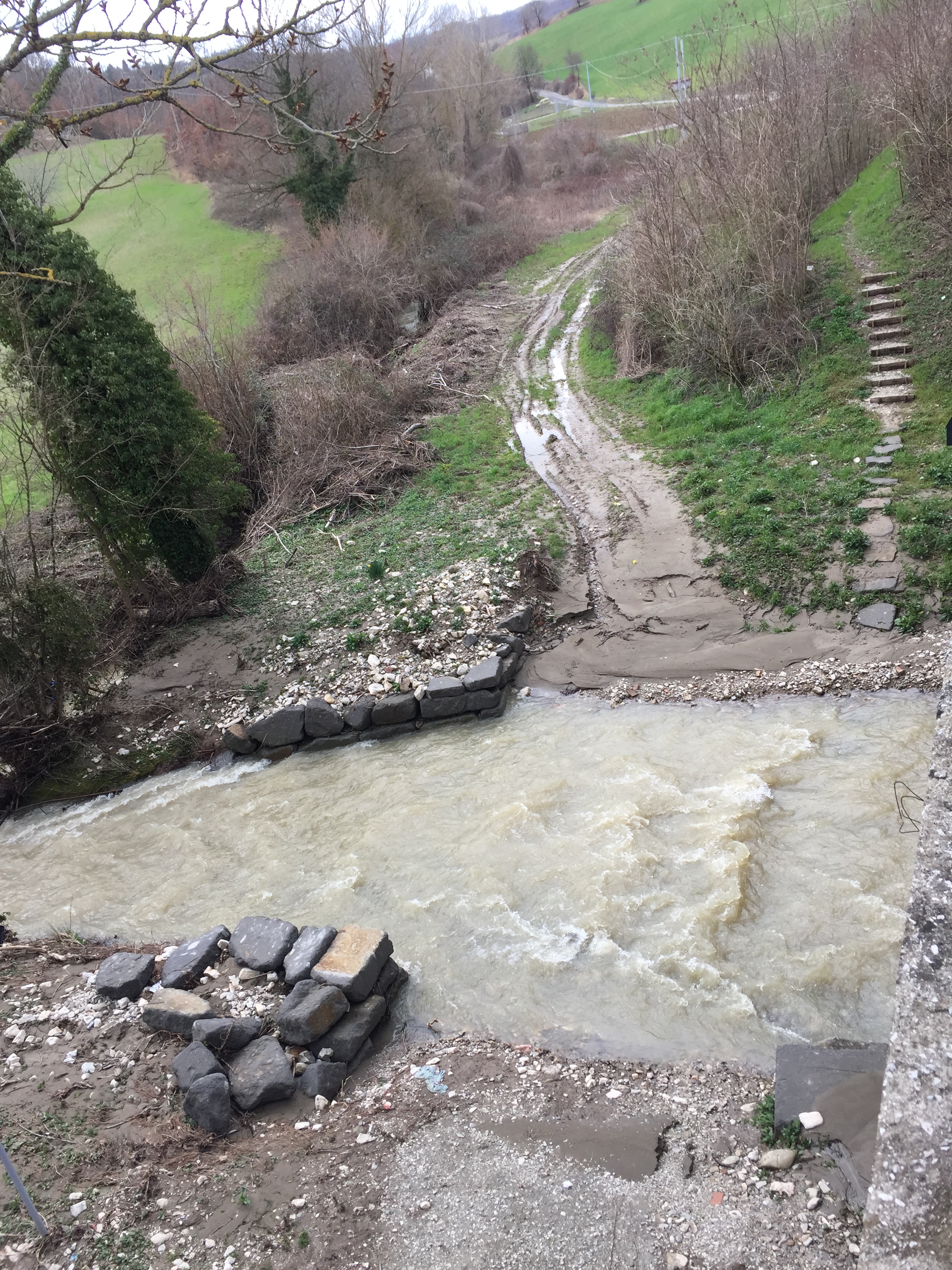
    Impassable stream near Gubbio

    Impassable stream near Gubbio

  • Badia Prataglia to La Verna –The stream to ford in Rimbocchi on CAI 53 was completely impassible so we needed to walk up the road a bit to another marked CAI trail 54 to cross a bridge over the rushing water. This was a nice rocky path that climbed slowly for most of the trip then steeply to join up with the trail 53 near La Verna. Staying at La Foresteria is a beautiful experience and recommended.
  • La Verna to Pieve Santo Stefano – Due to all the trees that had been blown down in the storm – some paths were blocked so we did not take the route through the forest and walked mostly on quiet graveled roads down hill through forest then small towns – lovely.

During the above stages, I was accompanied by Salvatore and I was very grateful for his help on the blocked paths, the impassible rivers and the unknown trail markings. I was ready to head out on my own now.

  • Pieve Santo Stefano to Sansepolcro – Not so pleasant approaching town when passing the sand plant and walking on the edge of the busy road – but this is relatively short and quickly you are off the road and under the highway and into the lovely city of Sanselpolcro. Took my first rest day here so I took the chance to go up to Montecasale– beautiful, peaceful and worth the time to see. I took a taxi up and walked back to town.
  • Sansepolcro to Citerna to Agroturismo La Burgne – lovely and mostly flat until the climb to the Citerna and then down and back up to the Agroturismo. Lovely place with very gracious hosts.
  • La Burgne to Citta di Castello
  • Citta di Castello to Passo Candeggio –The path was badly marked near the beginning – I was saved by my GPS tracks but others wandered for a couple of hours before getting back on the track. The lodging at Passo Candeggio was closed unexpectedly and my Italian was not good enough to understand the phone message. Salvatore saved me here.
  • Passo Candeggio to Petralunga – easy and lovely – up on the ridge mostly
  • Pietralunga to Gubbio – Did this in rain all day – took the full 7 hours but worth it to arrive in that beautiful city
  • 2015-03-27 15.58.41

    Approaching Assisi

    Gubbio to Biscina – came across another stream that could not be crossed so ended up retracing our steps and finding another path on our map that connected eventually to the road to Tenuta La Biscina. Grateful for good maps and GPS.

  • Biscina to Assisi – more rain and some difficult creek crossings but the walk up to Assisi is worth it all
  • Assisi to Spello to Foligno – took the “hard” route out of Assisi which I think is essential. We traveled on to Foligno so that my son who had joined in Citta di Castello could catch the early train.
  • Foligno to Lenano – this takes you up out of the valley – beautiful views – small villages and castles on hill tops
  • Lenano to Spoleto – I always ended up on the “harder” path but was still very doable
  • Spoleto to Macenano – amazing day up to the monastery then through the hillsides – very beautiful
  • Macenano to Piediluco – the waterfall was on lunchbreak when I came through
  • Piediluco to Poggio Bustone – as difficult as advertised but amazing views, the beech tree and wonderful sanctuary/convent at the end
  • Poggio Bustone to Rieti – don’t miss climbing to the top of Cantalice
  • Rieti to Poggio San Lorenzo – 100 km left to Rome!
  • Poggio San Lorenzo – Ponticelli – Chiesa San Vittoria was remarkable.   Stayed at the Agroturismo La Ripa about 3km out of town – wonderful though another climb to get there
  • La Foresta, outside Rieti

    La Foresta, outside Rieti

    Ponticelli to Montelibretti – mostly wonderful fruit orchards and views of hill towns

  • Montelibretti to Monterotondo – beautiful right up until the end. The path is sketchy until you get to the lovely bike/walking path so just need to trust it.
  • Monterotondo to Montesacro – wonderful views of the sheep right up until the urban area arrives
  • Montesacro to San Pietro – better than hoped with lovely last bit long the Tiber

I have many more notes about all of this but really don’t know how much folks need to hear. I am happy to respond to any questions.

Exciting new developments as The Way of St Francis guidebook gets closer and closer

St Francis draft cover.jpg

Draft cover for the St. Francis guidebook

Late last night I pinged Lois, head editor at Cicerone Press, to see if the cover had been designed for The Way of St. Francis: From Florence to Assisi and Rome. My hope was that, given the time difference from Cumbria to Seattle, I’d wake up to good news. Sure enough. When I woke up this morning there was a lovely image awaiting me in my Inbox. I just had to sit and stare for a few moments as feelings of joy, satisfaction and excitement swept over me.

Over the last weeks I’ve been working with Cicerone’s designated editor, Georgia Laval, to get the manuscript ready for publication. Georgia is a young woman, graduate of editing and proofreading school, who has a keen eye for typos, grammatical mistakes, inconsistencies, ambiguities and other obstacles that writers unwittingly put in the way of publishers as we write our manuscripts. Georgia read the text through then sat down with it, meticulously comparing the text with maps and profiles so she could ensure the routes are as clear as possible for the book’s end users. She had lots of suggestions and sent them first in an “edit queries” document, followed by a full “draft” edited text. As I reviewed her edits I also sat down with the maps and marked items on them that we both felt should be called out in each daily stage.

Sample map, this one from Stage 8.

Sample map, this one from Stage 8.

An example of the work is the map to the left. The red line is my GPX track from walking this stage in August (or, actually, from riding a rental bike that day). The track was superimposed onto the map by Cicerone, then I marked in black the beginning and end of the stage while marking in red various highlights from the text. This particular route happens to be a combination of the Via di Francesco and the Cammino di Assisi and solves a dilemma of how to get from Pieve Santo Stefano to Sansepolcro in just one day. The map will be divided into two sections and then will be presented on two different pages in the book. Cicerone’s job is to make it all look pretty and professional in the finished product.

So, my work with Georgia has been to connect the maps (which I’d never seen before) with the text and profiles for each stage. Georgia also confirmed each of the lodging listings — a huge task — to make certain we’re not leading anyone astray. She did it all without complaining and, in fact, thanked me for a smooth and fun process when we finished a day or two ago.

GigiAnd

Photo by Chiara Dall’Aglio of pilgrim pioneer, Gigi Bettin, with a Franciscan official at the dedication of the new pilgrim office in Assisi.

Speaking of lodging on the route, our listings are something of a moving target. For instance, this week in Assisi there was a very special celebration — an inauguration of several improvements that will make life easier and better for St. Francis pilgrims. First, Assisi’s first pilgrim hostel has been christened — the Spedale dei Santi Francesco e Giacomo. It will be a hostel in the style of the Camino de Santiago and is located at the historic cemetery to the north of Assisi proper (about 600m from the Basilica of San Francesco). Second, a new pilgrim office, the Statio Peregrinorum, is now in place in the convent area of the Basilica. Here pilgrims can receive their testimoniums at the completion of their walks. Third, a daily 6pm mass celebrates completed pilgrimages. It’s held in the lower Basilica. Each improvement builds infrastructure and pulls this pilgrimage ahead in the future, making it more and more attractive for prospective pilgrims.

So, even as the book is being edited I’m watching carefully for developments along the way. As much as possible these will be included in the book before it goes to press. I’m expecting the next step of editing in a couple of weeks, followed by review of the galleys and then the long spell of waiting until the book is printed and ready for sale. I’ve enjoyed this project each step of the way and can’t hardly wait to watch The Way of St. Francis be put to use by pilgrims ready to walk the paths familiar to the humble man of Assisi.

After the manuscript is written, but before the book magically appears

Cicerone author

Cicerone is now listing The Reverend Sandy Brown as one of its authors.

According to traditional Catholic cosmology, Purgatory is that grey region between Heaven and Hell where souls continue to be tested before they are sent to their eternal reward or punishment. “Limbo,” it’s sometimes called, and I’ve felt lately it has a lot of similarity to that period of time between when a manuscript is written and when the finished book is published and goes on sale. And that’s precisely where I find myself right now.

After completing Way of St. Francis: From Florence to Assisi and Rome back in early January, I sent off the manuscript and immediately heard back from the publisher: they had put the book into their workflow. That meant that a freelance editor had been assigned and I’d be hearing back in a couple of months with edits to the text. While the editing process takes place a few decisions need to be made by the publisher and me.

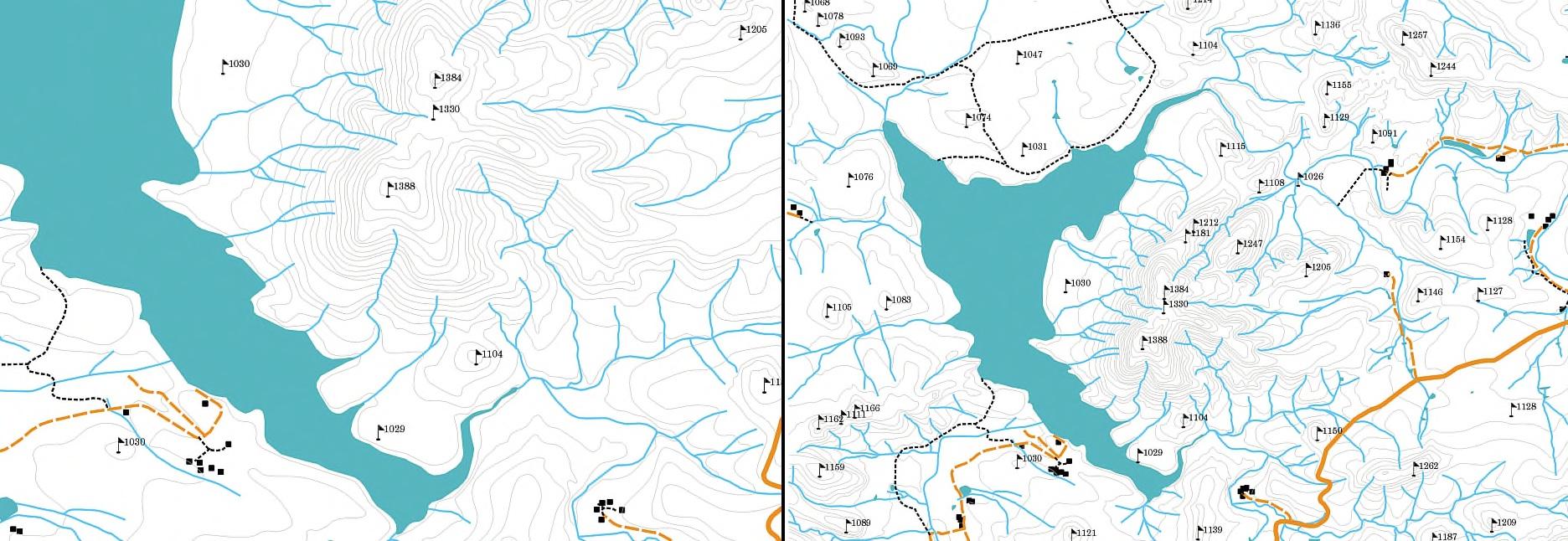
map_scale_compare

This image compares maps at 1:25000 (left) and 1:50000 (right)

The biggest decision is: in what scale will the maps appear? Our choices are 1:25,000 and 1:50,000. Both have their virtues. A tighter resolution of 1:25000 allows a very detailed view of the route — though it more than doubles the number of map pages. A zoomed out map at 1:50000 takes fewer pages and gives a better overview of the region, but lacks the detail walkers might need. According to the publisher, the book would be 288 pages with maps at 1:25000. Obviously, walkers want a helpful book, but they also don’t want to carry a lot of weight. Jonathan, publisher at Cicerone, promised to send along a couple of map samples using my GPX tracks so we could decide together what scale would be best for the book and whether the 1:25000 option is worth the extra pages. At the point the maps will be produced in draft form and I’ll begin the work of editing them to coordinate with the text.

So in the meantime, word has leaked out that the book is in production and I’ve been fielding inquiries from here in the US and also from as far away as Australia. Prospective pilgrims are interested in the route and are anxious to receive the book as soon as possible. They have questions about accommodations, way marks, best routes, and more. I heard from the Via di Francesco folk at the Umbria Tourism office in Italy that they’re also anxious for the book because they’re answering many inquiries from English speakers who want more information about walking to Rome.

That means that before and after my long days of campaigning for city council I’m in conversation with many of these people, providing what resources I can prior to publication of the book.

Some people’s plans are quite interesting. For instance, Bill Bennett from Australia is planning a culinary-focused April/May walk from Santuario della Verna to Assisi that looks fun and delicious. I’ve shared an unedited manuscript with him, along with my GPX tracks, so he can proof the text. A woman contacted me who’d like to walk from Florence to Rome, hoping to find solitude and peace after the death of her son. Another contacted me for a September walk, and we’re hoping the book will be finished on time so she can simply take it along.

SherisTalk

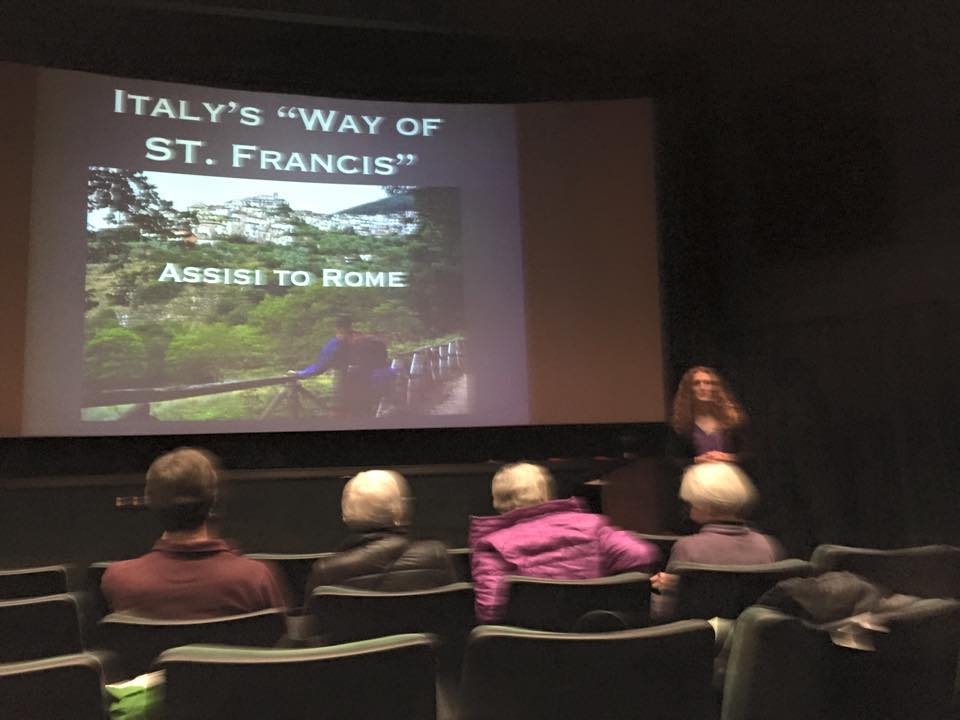
Fuzzy photo of Sheri Goodwin’s good talk on the “Way of St. Francis: Assisi to Rome”

Most surprising to me was meeting a local woman, Sheri Goodwin, who is giving talks about her walk from Assisi to Rome last year. Through her business, Transformational Journeys, Sheri trains women to walk on long treks. I was delighted to receive word that she was speaking on the Via di Francesco at a Rick Steves Europe event in Edmonds last month. Theresa and I attended and loved Sheri’s informative program and slides, which featured many locations dear to us from last year’s walk. We’ve agreed to team up for future talks at Rick Steves and other locations around the area once the book is published.

There’s that phrase again, “once the book is published.” I hate to wish for time to pass quickly, but I’d love to move from the frustrating “not yet” into the joyful “already.” I’m starting to dream and scheme about heading to Italy after the election with a couple of boxes of books for a couple of weeks. It’d fun to see familiar sites and beloved friends again and introduce this book as a resource for others to use and enjoy in trekking on the Way of St. Francis.

But this purgatory requires patience. Let’s see, September 1 is exactly six months away. That’s about 180 days more of waiting and counting to go.

“The Way of St. Francis” is now in production phase

Submitting

The package containing my manuscript gets mailed to Cicerone Press

When I returned from Italy in September my top priority was reacquainting myself with the amazing Theresa Elliott, but after that my top priorities were beginning my run for Seattle City Council and finishing work on my guidebook, The Way of St. Francis: From Florence to Assisi to Rome. The reunion with Theresa was fabulous. The start of my campaign was smooth (as evidenced by this, this and this). And work on the book was….slow.

I returned from Italy with the basic text of the book’s 29 chapters complete. In September and October I contemplated my approach to the book’s Introduction, and then in November I returned to writing and editing.

It soon became clear that my biggest challenge would be the 40,000 word limit. In fact, by mid-December I was already at 57,000 words. I’d already had conversations about expanding the word limit with Cicerone Press, and they were none too keen on the idea. Long experience taught them that, the longer the book, the less likely people would want to carry it with them in their packs.

So, much of December was a process of culling the book down to its word boundary. A key issue became an extra chapter I’d written that covered the Seven Pilgrim Churches of Rome. The walk had been an eyeopener for me, and I knew people would enjoy a walking guide to these important, historic churches. The last thing I wanted to do was cut this 2500 word chapter.

By the end of the process I’d culled out about 8,000 words and then negotiated a new limit of 50,000 words with Cicerone. Hooray! After some final edits I sent the manuscript in. Here how it worked out by the numbers:

  • 29 chapters
  • 140 photos
  • 29 elevation profiles
  • 6 proposed section maps, plus 29 chapter maps to be supplied by Cicerone

The next step is a thorough edit by a Cicerone editor, followed by editing of the photos and maps. This process takes about six months, with printing encompassing another two-three months. In September the finished book will appear, just in time for people to start planning their 2016 walks.

One of the funnest tasks? Choosing a cover photo. Here’s what Theresa and I chose — actually a photo by Jacqueline Zeindlinger from our 2013 Via di Francesco. If Cicerone approves, this will be the cover pic folks see each time they pick up the book. Thanks to everyone who’s helped make this book a reality.

000

Jacqueline’s photo of me, Sebastian and Andreas walking in fields near Vallericco


The many Francesco routes between Florence, Assisi and Rome

Way of St Francis Walks The many modern routes of St. Frances in and around Umbria in Italy.

I’m back to the writing routine for The Way of St. Frances: From Florence to Assisi to Rome and wanted to share some of the helpful info I’ve learned that might not make it into the book. One example is the graphic above of the many walks of St. Frances in and around Assisi.

As I’ve said before, my completed book will be the first one that actually guides pilgrims on every step between Florence, Assisi and Rome. The almost-complete guidebooks are Franziskusweg, a German book (in yellow above), along with the German language Outdoor Guide by the Dutchman Kees Roodenburg (not shown). Both of these guidebooks have pilgrims taking a train for the first day out of Florence and then taking public transport the last day or two into Rome. This is too bad, since there are good walking routes at both ends.

Another popular English (plus Italian and German) guidebook is by Angela Seracchioli (in purple above). Her thick and well-researched book covers the distances between La Verna and Poggio Bustone. The Via di Francesco (dark blue) of the Umbrian Tourism Department also starts at La Verna then continues on to Rieti, where the Via di Roma (light blue) picks up for the last 100 or so kilometers.

The Cammino di Assisi (in green) is a popular route among Italians that begins with non-Frances sites at Dovadola and then finishes at Assisi. There are several smaller routes as well, like the Holy Valley routes near Rieti and the Sentiero Francescano della Pace between Assisi and Gubbio.

The challenge I faced was to find a single route that actually has pilgrims walking on foot each step of the way between Florence, Assisi and Rome. This required some scouting and help from locals who know these routes well. The resulting route is marked above in red and, modeled after the Camino de Santiago in Spain, is doable in 30 days.

GPX Tracks for the Via di Francesco – Florence to Assisi to Rome.

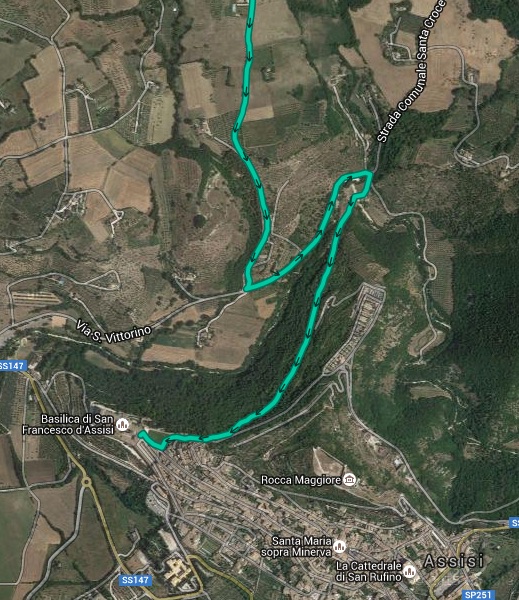
GPXTrackAssisi

It’s now possible to download GPX tracks that cover the exact route of The Way of St. Francis book. Here’s how to do it:

You will need to purchase the book and create a Cicerone Library to collect the GPX files.

  • Go to the the books website at Cicerone.co.uk
  • Go to the link toward the bottom of the page marked “Downloads.” Click.
  • When you click on GPX downloads the site will send you to a “Sign-in or Register” page
  • Once you’ve signed in or registered you’ll be returned to the GPX download page.
  • Now you’re able to download the tracks.

Congratulations!

Looking back at the Via di San Francesco

IMG_5211

My constant companion — note the reading on the odometer, which records my total kilometers walking since May 20.

Yesterday I walked the last stage of the Via di San Francesco and I’m definitely feeling bittersweet as I hang up my hiking boots for the summer. I’m glad the primary research for my guidebook, The Way of St. Francis, is now complete, but I know I’ll miss Italia. I leave for Seattle in two weeks, saying goodbye to this warm and rich country I’ve come to love.

As I walked each day I held in my right hand the little device on the left — a Garmin Oregon 650 GPS, given me as a farewell gift by the kind folk at First United Methodist Church of Seattle. It tabulated each days’ journey into the total for the whole trip — 845.2km (525 miles). Thanks to the Garmin I was able to record my tracks, so now I have GPX files to share with other pilgrims to help them find their way.

In my left hand was my other companion — my iPhone 4s — which I used for dictation of walking notes. I ended up with 41 separate audio files for something around 16 hours of notes, which I transcribed each evening after I walked. These all were distilled into twenty-nine chapters of walking descriptions for 32,100 words.

IMG_5209

Each writing stage, checked off when written.

Clothing-wise: I brought my favorite pair of hiking boots with me which unfortunately will not make the trip back home. They already had about 400 miles on them and were growing bald with age (like their owner). After I bought it in Vienna I wore my fluorescent yellow running shirt almost every day, along with the North Face hiking shorts I brought with me — the best shorts I’ve ever had (cool, stretchy, quick-dry). I almost never used my rain jacket or black, quilted North Face jacket — just too warm here.

Thanks to the loan of a great Sony camera by Robin Werner I’ve recorded the experience in 2,156 RAW-format photographs. It’s taken all the storage available on my laptop, but some of the pics are pretty good and will form the visual core of the upcoming book.

One of the best parts was walking with two people I enjoy. I walked from Santuario della Verna with Jacqueline Zeindlinger of Austria, part of our 2011 camino family and a big help in various aspects of this project. Then on July 15 I was joined by Theresa Elliot and we had two weeks of fun as we walked from Spoleto to Rome. I’ll never forget Theresa, dangling between the iron bars at the cupola atop St. Peter’s Basilica.

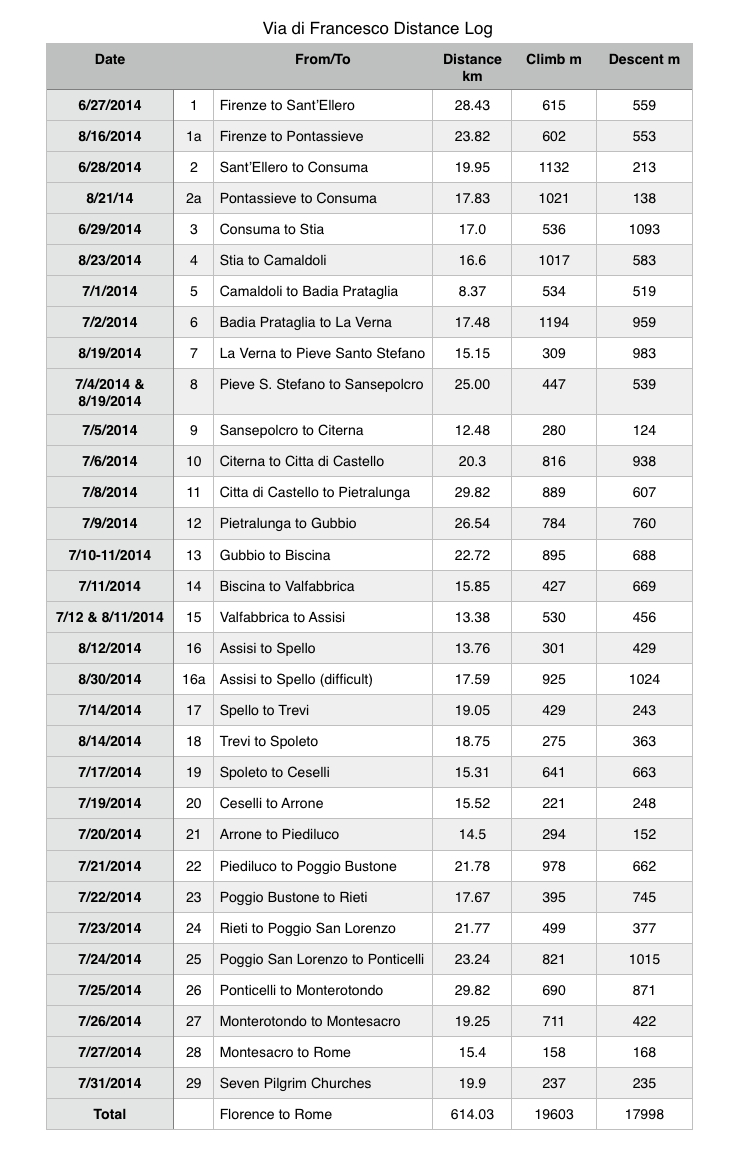
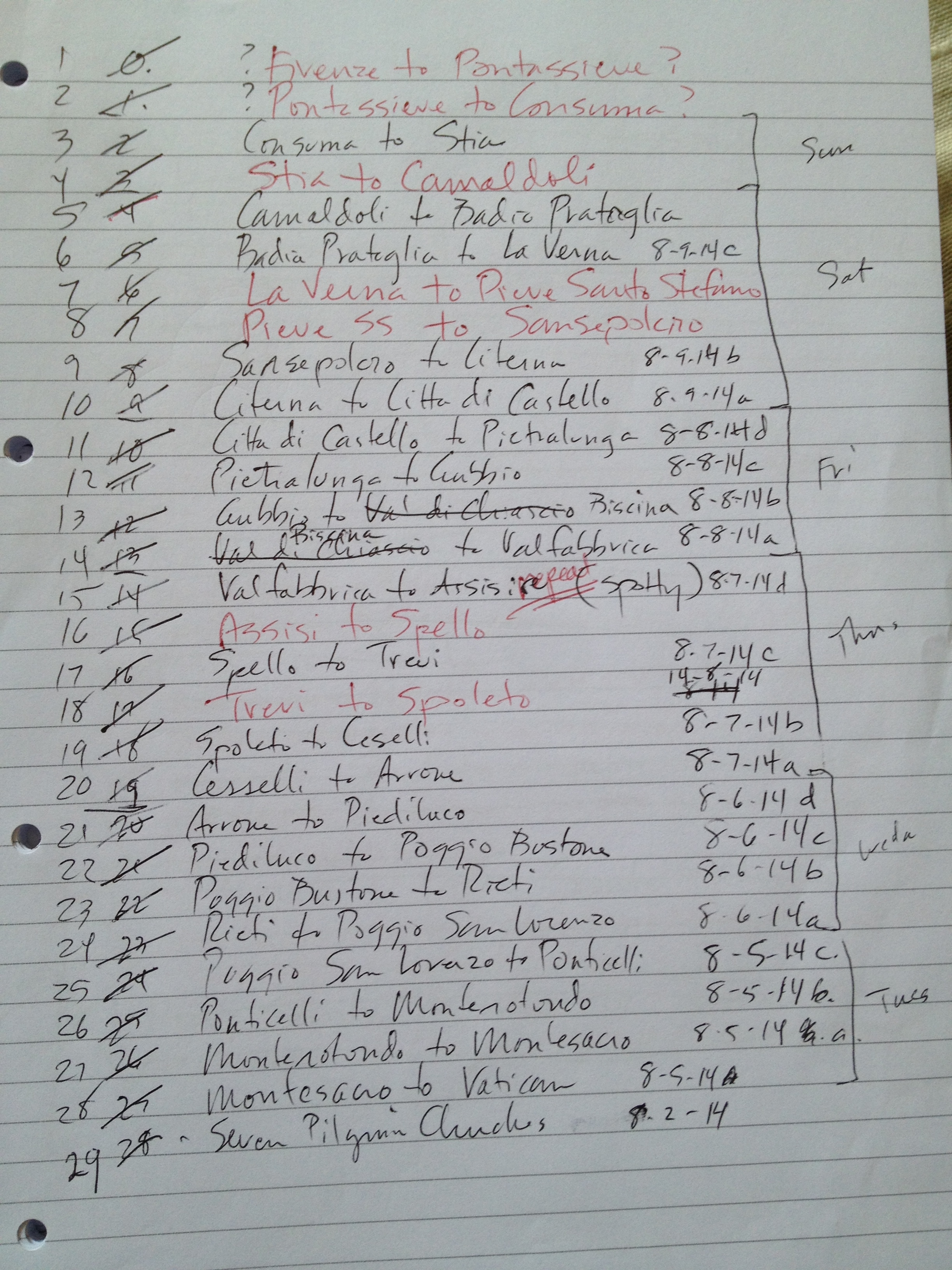
Some have asked for my daily itinerary. I walked 29 separate daily stages, but had to repeat five of them either to find the best route or to create a good GPX track.  Here are the stages of the Way of St. Francis that will be the core of my book:

  • Florence to Pontassieve
  • Pontassieve to Consuma
  • Consuma to Stia
  • Stia to Camaldoli
  • Camaldoli to Badia Prataglia
  • Badia Prataglia to Santuario della Verna
  • Santuario della Verna to Pieve Santo Stefano
  • Pieve Santo Stefano to Sansepolcro
  • Sansepolcro to Citerna
  • Citerna to Citta di Castello
  • Citta di Castello to Pietralunga
  • Pietralunga to Gubbio
  • Gubbio to Biscina
  • Biscina to Valfabbrica
  • Valfabbrica to Assisi
  • Assisi to Spello
  • Spello to Trevi
  • Trevi to Spoleto
  • Spoleto to Ceselli
  • Ceselli to Arrone
  • Arrone to Piediluco
  • Piediluco to Poggio Bustone
  • Poggio Bustone to Rieti
  • Rieti to Poggio San Lorenzo
  • Poggio San Lorenzo to Ponticelli
  • Ponticelli to Monterotondo
  • Monterotondo to Monte Sacro
  • Monte Sacro to Saint Peter’s in Rome
  • The Seven Pilgrimage Churches of Rome
Profile Day 4

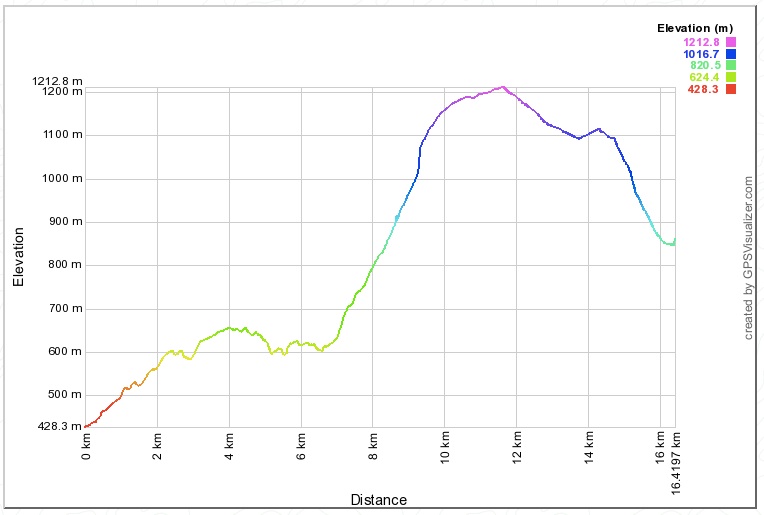
Elevation profile of yesterday’s walk — 800m climb.

This was a tough walk. Tougher than the Camino de Santiago. Yesterday was an 800 meter (2600 ft) climb, and most every day of the first six includes climbs like this. Future pilgrims need to know that this is not for the faint hearted.

All told, though, I’ve loved it — every moment of it. This summer I’ve learned some basic Italian, I’m gotten into decent physical shape, I’ve met new and interesting people, I’ve lived in a charming foreign country for a few months, and I researched the basis of a book that I hope will be helpful for pilgrims who follow after me. The best part has been digging into the geography and culture of this amazing country. I love Italy and I know I’ll be back.

Over the next couple of weeks I’ll flesh the book out by adding helpful and interesting information about each of the places mentioned in the walking guide. When I get back to Seattle I’ll complete the introduction, sort my photos, draw my maps and then, by December 31, submit the corpus to my publisher. But first, I’m accepting the invitation of a friend to visit his family in Catania, Sicily, and on my way back I’m stopping in London to meet my publisher. Two weeks from today, God willing, I’ll land on the tarmac at Seattle and see my favorite walking companion, Theresa, plus my boys and family, for a happy reunion after a summer of walking, work, walking, learning, walking, and adventure.

DSC05313

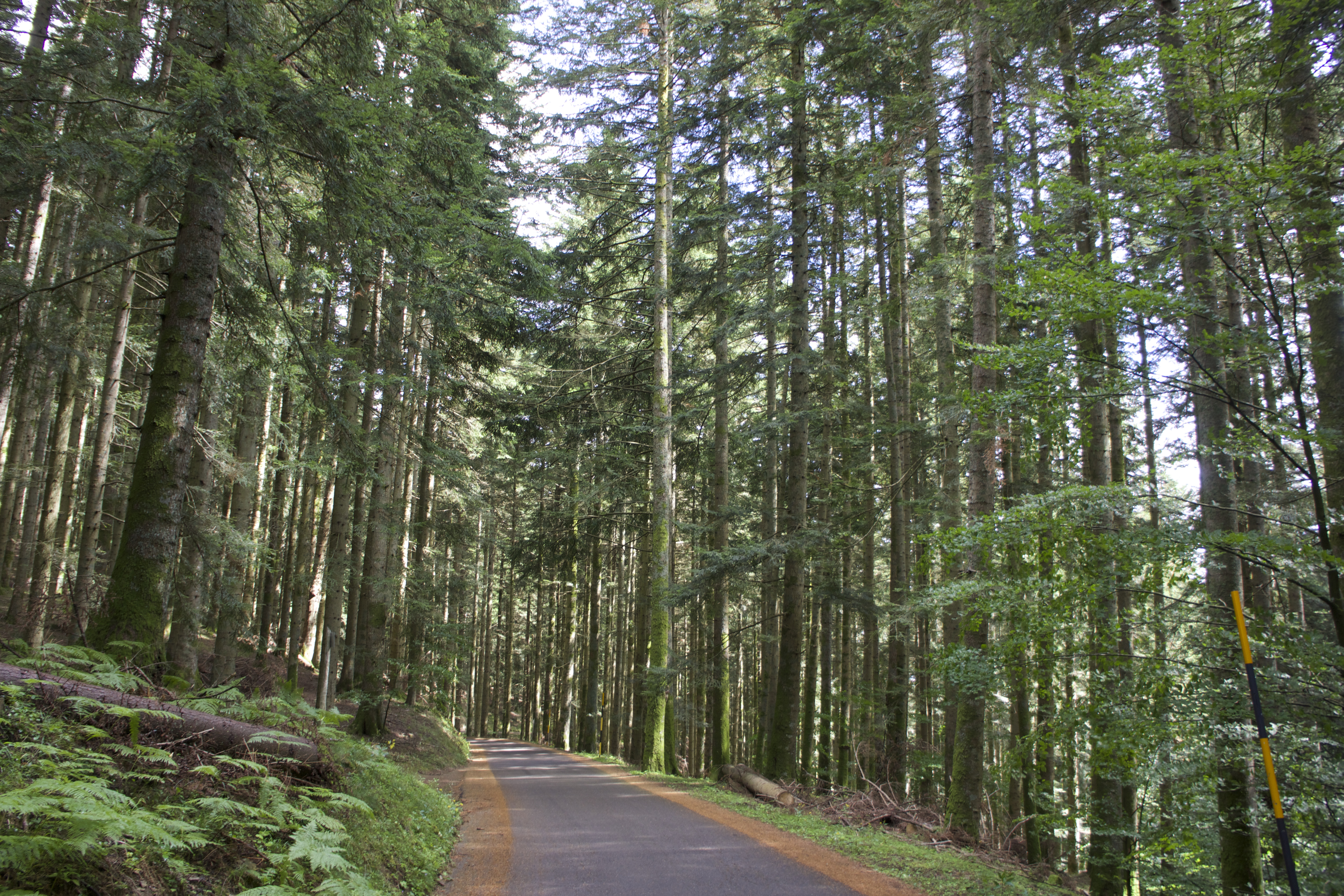
One scene from yesterday’s walk in the Parco Nazionale Foreste Casetinesi, to the Hermitage at Camaldoli.

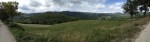
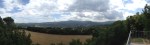
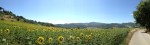
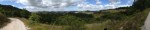
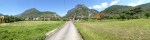
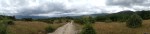
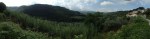
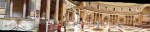
The Via di Francesco in Forty Panoramas

Tomorrow is the last day of walking this year. I’ve covered every stage but one, and I’ve walked some of the stages twice in order to get my descriptions just right. Most days I’ve used my iPhone to take a panorama, and many of those I’ve shared on Facebook. Here’s a compilation of the panoramas, which I hope gives a good sense of what this amazing Via di Francesco looks like.