Unknown's avatar

About Sandy Brown

Pilgrim trek writer and guide from Seattle USA living in Lucca, Italy. See more at www.sandybrownbooks.com

I get by with a little help from my friend

DSC03265

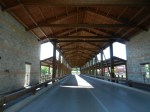
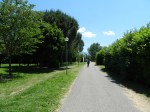
Jacqueline in a covered walkway along the Arno at the start of Saturday’s long walk.

As I sit on my bed with the sound of birds chirping outside the open window and the orange rays of the setting sun glancing off the floor of my room, I take stock of how I’m feeling today and ask the question, do I really get to do this for 30 days in a row?

Following yesterday’s grueling 30 km walk in the searing Italian sunshine I’m tired, my legs are sore from my hips to my heels, the toenail on my left foot is turning blue, I’m suffering from something called golfers’ vasculitis, and I’m missing home and loved ones. But I’m excited that I’ve finally hit the road and I’m starting to feel that pilgrim ecstasy that other pilgrims know. It is the joy of walking that pulls a pilgrim out of bed each day as the trail calls forward to each new day of challenge and progress.

The weekend began on Friday with a 2-hour train trip from Perugia to Florence, where I met Jacqueline of Vienna, a fellow pilgrim from caminos in 2011, 2012 and 2013. Jacqueline has already been a huge help to my guidebook project. She found a German book that describes this track and translated portions of it so I could more easily follow the less-traveled stretch from Florence to Della Verna, where the main trail picks up. In translating it she discovered the primary weakness of this route — there is no easy way to get out of Florence. In fact, the guidebook suggests starting in Florence by getting on the train for 20 minutes and then walking from a place called Sant’Ellero Sull Arno. From Sant’Ellero a person picks up a clearly marked trail to the next town of Consuma.

DSC03282

We stocked up on food at this excellent roticceria, assisted by a proud father and son team.

Well, Jacqueline insisted there must be a way to walk to Sant’Ellero, so she researched it online and decided to fly from Vienna to Florence with the express purpose of joining me for a walk, to prove her theory that the walk can be done without resorting to trains. Of course, we both knew that the primary requirement to end a walking stage is that there be accommodation. We also knew that the best way to see if there is accommodation is to go there and ask.

So…..on Saturday morning, June 7, we set out together from Florence’s Basilica of Santa Croce to walk to Sant’Ellero. A little overshadowed by its neighbor, the Duomo, Santa Croce is the largest Franciscan church in the world, which legend says was started by St. Francis himself. It’s also rumored to have relics of St. Francis — some of his clothes and such. Santa Croce is also home to the tombs of some of the most famous Florentines — Michelangelo, Galileo, Michiavelli, Rossini, and more.

DSC03312

Looking down to Florence in the distance, with the Duomo on the far left.

Jacqueline and I set out after a leisurely breakfast  at 9:00 in the morning. Oops, we missed the coolest part of the day. The weather forecast called for a steaming plateful of Italian heat, and even by mid-morning we had begun to sweat. The GPS track we downloaded from WikiLoc (thanks, Gigi Bettin), sent us along the Arno River, then out of Florence toward Bagno di Ripoli. After about 5 km we were beyond the exurbs of Florence and feeling good. We stocked up for lunch at a great roticceria and, seeing the mountains ahead of us, we began what we knew would be a hard uphill climb.

In fact, the road started to climb very steeply. At a settlement high above the valley called Bigallo we caught our breath at a very fascinating spedale (hostel) for medieval pilgrims who’d chosen to walk to Assisi from Florence and parts prior. This gave us extra confidence that Florence is a great place to begin this trek, after all, we were walking in the footsteps of pilgrims from centuries past.

After lunch we turned left, across from Bigallo, to begin the more remote section of our walk where we’d been told by a bartender in Bagno di Ripoli that we’d find a beautiful path along a Roman road. Sure enough, soon we were on gravel roads, climbing and climbing. Then we came across a stretch of what obviously was Roman pathway, given its ordered and rounded stones. We continued to walk. And walk some more. By olive orchards. Through olive orchards. Through forests of pine. Through forests of oak. Along gravel paths, along Roman roads, and only briefly along asphalt drives. All of the walk under the 90F (33C) Tuscan sun.

Even as very experienced pilgrim walkers we were a little overwhelmed by the distance. Part of it was the sun, another part was that I was stopping every few hundred meters to speak into the dictation program of my iPhone in order to take notes or I was pausing every little bit to take photos. By about 4:00 p.m. we’d already walked 7 hours, and we soon came across a sign that said the next town of any size — Rignano Sull-Arno — was still one and a half hours away. Our final goal of Sant’Ellero was another 3.7 kilometers beyond that. A little despair began to set in.

I started to drag a bit, and Jacqueline trudged on ahead. Finally we came to Rignano. After a tall iced-tea that perked me up a bit I began to ask in my two-week new Italian if there were any hotels in the area. Immediately two men in the bar were on the phone to find us a room for the night at the house of someone who lets rooms. I explained that it wasn’t for tonight we were looking, but for the future, and they left me with a phone number I could call for more info. We also noticed a campground here, as well as a B&B a few kilometers out of town. Progress.

By this time it was 6:00 pm and even Jacqueline was beginning to drag. Still, our goal was Sant’Ellero which also included a train station where we could catch an 8:00 train back into Florence. At a second bar we asked about foot paths from Rignano to Sant’Ellero, but were told the only way to get there was by walking along the highway. We scouted around a bit more before we left Rignano at about 6:30 p.m. for our day’s final walking goal.

All roads lead to Rome, but not all roads were built by Romans like this one.

All roads lead to Rome, but not all roads were built by Romans like this one.

The 3 km walk along the highway was every bit as treacherous as we feared. Cars whizzed by, while we had just the space of the white line and a few inches beyond it as our path. Thankfully, with 1 km left, a red brick sidewalk appeared and we headed off the white line and into Sant’Ellero, noting signs for a B&B 6 km out of town. Here we also found a map mounted on a wall at the train station that clearly spells out the footpath to Consuma, stage two of the grand St. Francis adventure.

Utterly exhausted and a little dehydrated after 11 hours of walking, much of it uphill in the blazing sunshine, we caught the 8:00 p.m. train back into Florence.

Over a dinner of pasta and salad, Jacqueline and I asked ourselves, would pilgrims really want to walk this hard and hot walk, and then pick up and do another hard and hot 25 km (15.5 mile) walk the next day? Especially in heat like this? On the plus side, there are amazing views of Florence and many panoramas of beautiful valleys and farms along the way. A walk along an ancient Roman road is pretty awesome, too. The lack of accommodation is a challenge, though, but a pilgrim can take the train back into Florence like we did — it’s just a €3 transaction and 15 minutes on the hourly train — and then return to Sant’Ellero the next morning by train for Stage 2.

Then we asked ourselves the more personal question: would we have the strength to go on after such a hard day? As I sat there on the terrace of the hotel with Florence active and loud below, I wondered what had brought me here and why I would even consider leaving home and family and church and community to walk a long, hard, grueling walk for 30 days in the hot Italian sun. Would I be in misery for the next month? Would my feet hold out? I laid on my bed after dinner, a beer, and two sips of red wine, knowing I’d sleep well.

When I woke up this morning something strange happened. I found myself asking, where will I walk today? Is it really true I don’t get to continue on the path? Do I really have to wait another three weeks before I pick up at Sant’Ellero and walk to Rome?

My body is tired, but my heart is full. I’m ready to go. I’ve caught the bug again. All those tourists I can hear outside my window in Florence are seeing some amazing sights, but adventure is up the hill in the distance, down it again, across the river and beyond to Assisi and then to Rome. When language school is done, when camino reunion in Vienna is complete, when June 27 finally arrives, I will be ready for the road. And I can hardly wait.

Today I’m thankful for my great camino friend, Jacqueline. She has been a huge help on this project and I can’t begin to say share with her my gratitude for her assistance and inspiration.

Sixteen Miles and one blister — welcome back to pilgrim life

IMG_3746

Pilgrim chic — road ready at 6:45 a.m.

When I got up this morning I wasn’t really sure I wanted to leave my bed, it being a national holiday and all that. But I’d already told Graciella and Luigi that I’d be heading out at 6:30 and I knew they’d think I was a slacker if I didn’t go. So…..out the door I went at about 6:45 for a day of adventure.

Today’s goal, of course, was to research this pilgrimage walking stage — Perugia to Assisi — for my upcoming book. That meant that I’d be walking and dictating in my iPhone while taking photographs and trying not to get lost.

Matter of fact, I didn’t get lost at all, mostly thanks to my GPS. I did discover, though, that I have much more to learn before I’ll be able to figure out the intricacies of this amazing little device. A big thanks to the folks at First Church Seattle who gave this to me as a going away present. I learned too that it’s a different way of walking when you’re walking as a pilgrim guidebook author rather than simply a pilgrim.

Anyway, I made it to Assisi by about 3:00. It’s a great town, truly beautiful. I’ll be back in mid-July to research and write my chapter on Assisi, so for now it was just get some photos and get back home.

Rather than entrust myself to the train schedule on a national holiday I opted to take a spendy ride back to Perugia by cab. As I was driven back to my temporary Perugian home I had time to reflect on the difference between walking 16 miles and riding the same distance in a car. The walk to Assisi was about smells and colors and discoveries and miniature hardships and thoughts of St. Francis who walked this way 800 years ago. The trip back to Perugia by car was mindless. And completely insulated from the world, which I sped through while gazing out the window.

Below: Photos of today’s walk

More snapshots of Perugia, and tomorrow on foot to Assisi

IMG_3745

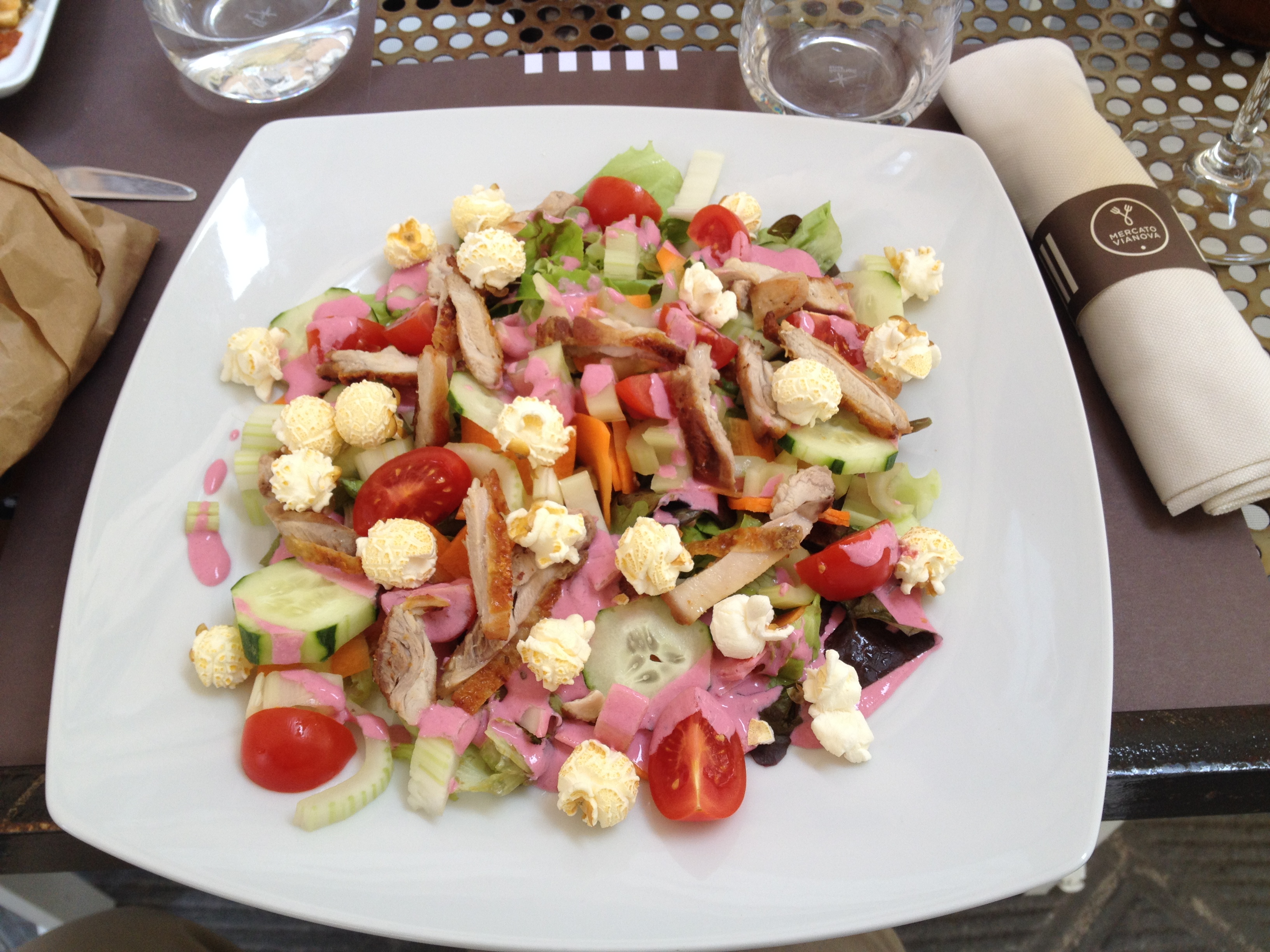
Yes, the dressing is pink and yes that is popcorn on my salad.

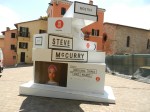
Some days ago Patricia of Holland had said, “Since we’re both in town on Sunday, let’s go to the Steve McCurry exhibit that day.” I said, “Sure,” then completely forgot about it until she texted me this morning as I sat in the sunshine at a café on Corso Garibaldi. I was there, waiting for my clothes to finish drying at the Bolle Blu, a nearby coin-operated laundromat.

When I packed for Perugia I was in something of a quandary about what to bring. I knew I’d bring my hiking clothes for my July/August walking adventures, but I didn’t want to wear hiking clothes for a month of language study in Perugia. I also didn’t want to have a big suitcase I’d have to park somewhere while on camino. Theresa offered a modest sized — though flamboyantly Hawaiian — L.L. Bean duffel bag with wheels and it seemed just right for a modest amount of street clothes to wear while in Perugia. I realize now that having just two pairs of jeans, four t-shirts, three pairs of socks and six undershorts means I need to do wash about every 5-6 days.

Graziella, my Perugian mom, is happy to do my wash, but on the Sunday of a three-day weekend I just couldn’t bring myself to ask. So I loaded up my clothes and wandered off to the Bolle Blu, where it took just an hour (and €8) to have the machines wash my clothes.

With Patricia’s text I now had a somewhat more grand way to fill the day. After dropping off my clean clothes I met Patricia for a rather elegant lunch (see pic), and then headed down the hill with her to see the beautiful photographs of Steve McCurry. We all remember him as the photographer who captured the startlingly purple/blue eyes of the beautiful Afghan girl some years ago. I think the Umbrian Tourist Office commissioned him to take photos of Umbria for use in publicity since, though they were gorgeous, they did have a somewhat Chamber of Commerce quality to them. Still, I’d recommend the exhibit as a celebration of the art of photography and the beauty of Umbria.

After gelato I dropped off Patricia with Esther of Holland and Ibrahim of Canada and headed out on my own to complete the Porta Sant’Angelo Itinerary from the Perugia walking guidebook.

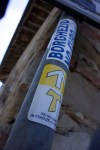
I walked toward the tall tower at Porta Sant’Angelo, noticed the familiar blue/yellow Via di Francesco way marks along the way, and as I walked I began to think ahead to my new plan for the rest of the weekend. Since tomorrow is my last free day in Perugia, and since I promised my editor I’d have a sample chapter to her by the end of June, this is my last chance to research a day’s walk. If I walk from Perugia to Assisi tomorrow I can get the info I need to create a sample chapter on this stage. This means 25.2 km (about 15.6 miles) on foot. I’ll walk there, take notes and photos — especially of Santa Maria Degli Angeli and the Basilica of St. Francis — and then find some way back.

As I returned home late this afternoon I stopped at a tiny store and bought some crackers and fruit for the journey. This evening I’ll pack for tomorrow’s day of walking to the city of St. Francis. I feel a sense of satisfaction and joy that tomorrow, at least, I’ll be a pilgrim again, with the road under my feet.

Below: photos from today’s walk through the medieval market, to the Steve McCurry exhibit, and off to Porta Sant’Angelo.

Perugia walking tour snapshots

dove_s3

Map of the Centro Historico of Perugia.

The Turismo office of the Comune di Perugia has nicely divided the old city (Centro Historic) into five walking tours. Today I had a late start due to rain in the morning, but by evening I’d walked two of them — Porta Eburnea and Porta Santa Susanna. This gave me a great opportunity to try out the camera my friend Robin lent to me, and I can tell I have a lot to learn. I bravely put the camera on full automatic mode to see the effect, and often it’s not too bad.

Below are some photos of my walks, or perhaps I should call them snapshots. Either way, I’m enjoying the opportunity to explore some of the side streets and hidden sites of this lovely town.

Au revoir Maria, and a Friday of goodbyes

IMG_3694

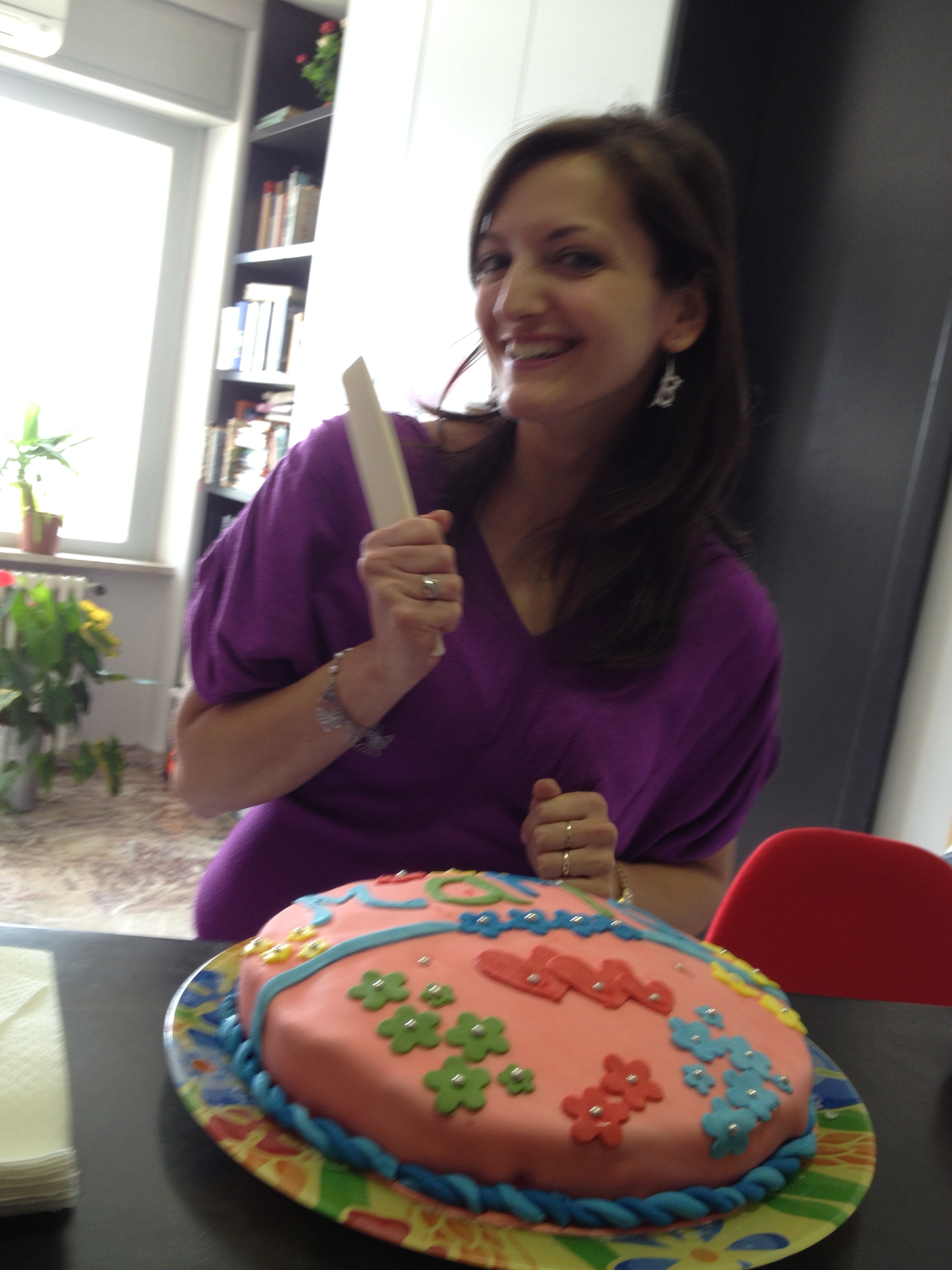
Someday remind me to tell you how they cut round cakes in Italy.

I’m discovering that Mondays are hello days and Fridays are goodbye days at language school. Today before class it was time to eat goodbye cake for Maria, one of our dearest teachers. After class it was time to sing goodbye karaoke for Maria. Before dinner it was time to drink goodbye apperitivi for Maria. However, some students are finishing their classes and leaving as well, so in between goodbyes to Maria we shared a lunchtime goodbye with Thomas, a dinner goodbye with Martino and a digestivo goodbye with Flavia.

Back at my Perugia home, in between goodbyes to people I said goodbye to my room and hello to Thomas’ former room. Though my old room was just fine, Thomas’ has an extraordinary view and a bathroom of its own. Now I can set out my toothbrush and toothpaste just how I please.

I also had time for a walking exploration of Perugia, and I headed to one side of the mountain on which Perugia is located, walking downhill to a section of churches and smaller apartment buildings. As I say hello to Perugia I’m starting to realize that what makes Perugia unique is the relatively large size of its Centro Historic in proportion to the relatively small size of its population. Wikipedia lists Perugia as having a population of just 168,000, which puts it on par with Vancouver, Washington or Sioux Falls, South Dakota. Perugia is infinitely more charming and complex than either American city, I suspect due to the fact that its population has been fairly large over a many centuries, unlike our American towns that sprout and grow overnight. I’m sure it has its sad and seedy areas, too, but so far there is none of that sprawling American car-desert with vast parking lots and superhighways. Thank you, Italy.

After a day of saying goodbye I said goodbye to the final goodbye party at about midnight and headed to my new room. Monday is Italian Independence Day, so that means a three day weekend, followed by some new people to greet when we’re back in school on Tuesday.

Now is the time

Scenes from Perugia

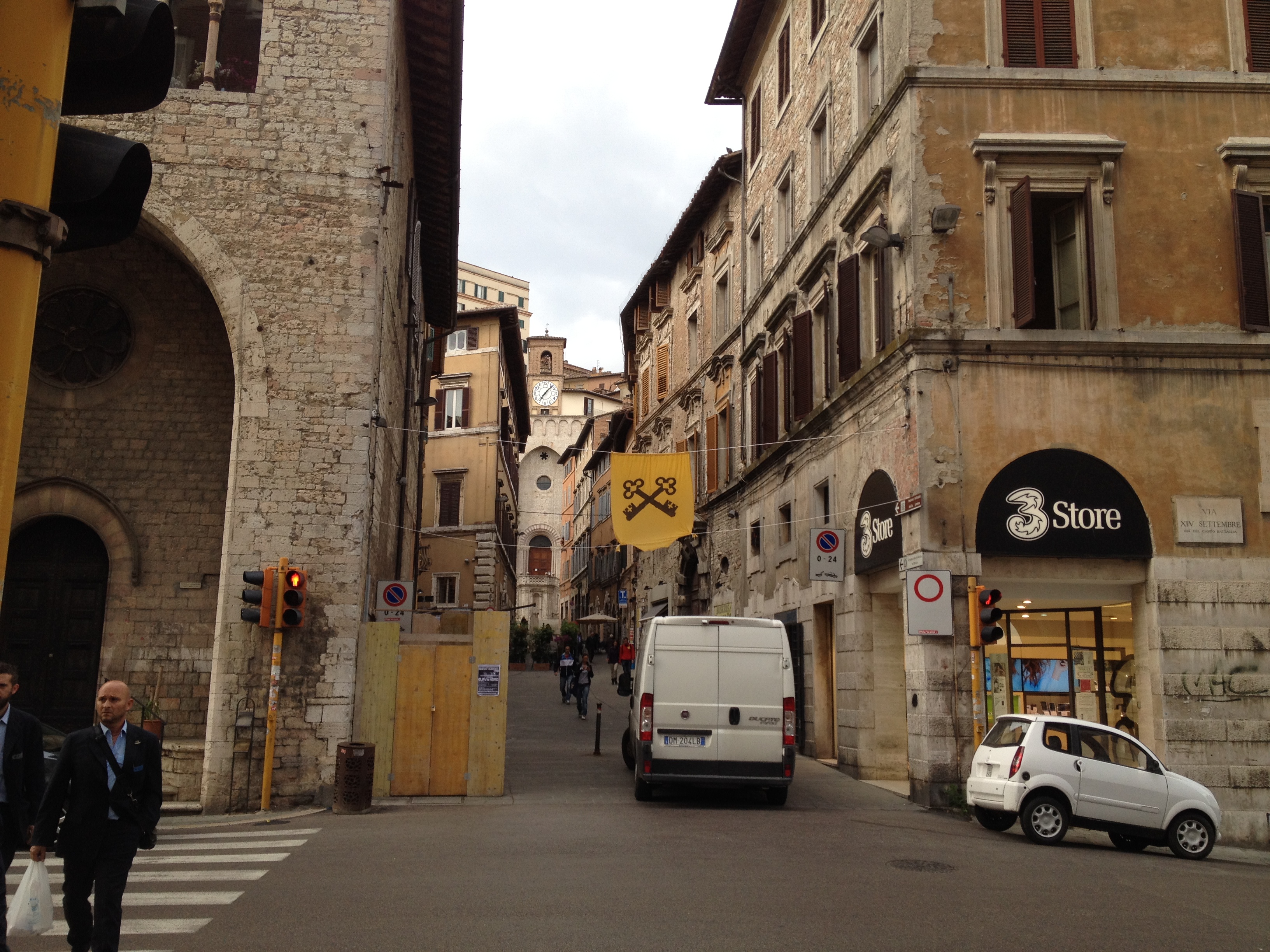
Some scenes from my recent walks along the streets of Perugia. Click to enlarge.

New Italian Words: “Apperitivo,” “Digestivo”

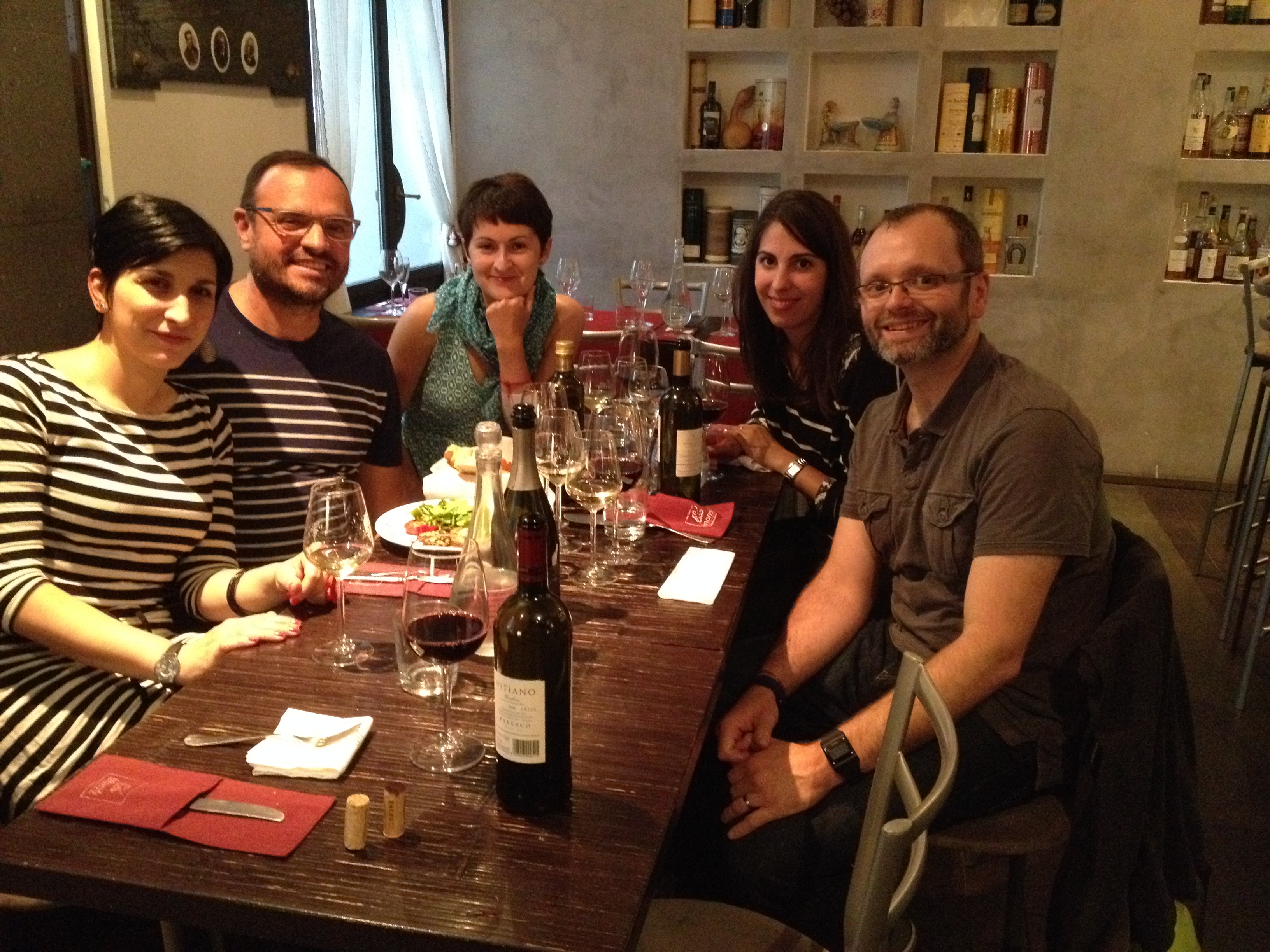
Wine tasting with (clockwise from left) Maria, io, Tamila, Patricia, Chris.

Working hard with (clockwise from left) Maria, io, Tamila, Patricia, Chris.

My daily life has a new normal. When the sun bathes my bed with yellow light I wake up, usually at around 6:00. I check my email in bed and perhaps write a blog post while I wait for others to awaken. When I hear them stir I either get up for my shower or head out to the dining room for breakfast. This involves Corn Flakes, Nutella®, a piece of Italian pound cake, a cafe latte, and conversation with Thomas and Flavia. Once I’ve eaten and showered, it’s back to my room to prepare for class.

At about 10:30 I walk down, down, down from the Centro Historico to Comitato Linguistico, my language school, which is in a pleasant part of town near the modern bus station. There I have a class with my teacher, Maria*, and this week just one other student, Patricia of Holland. The class is exclusively in Italian, though both Patricia and I often slip into Spanish to help us figure out vocabulary or to compare verb conjugations. We begin with review of homework, then work through the study book, then have some vocabulary lessons and conversation. Maria ends the class with a homework assignment, and then students from all the classes often head out to lunch somewhere nearby or at the Centro Historico. After lunch, it’s individual study time or blogging time or time to tour this interesting city.

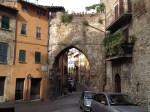
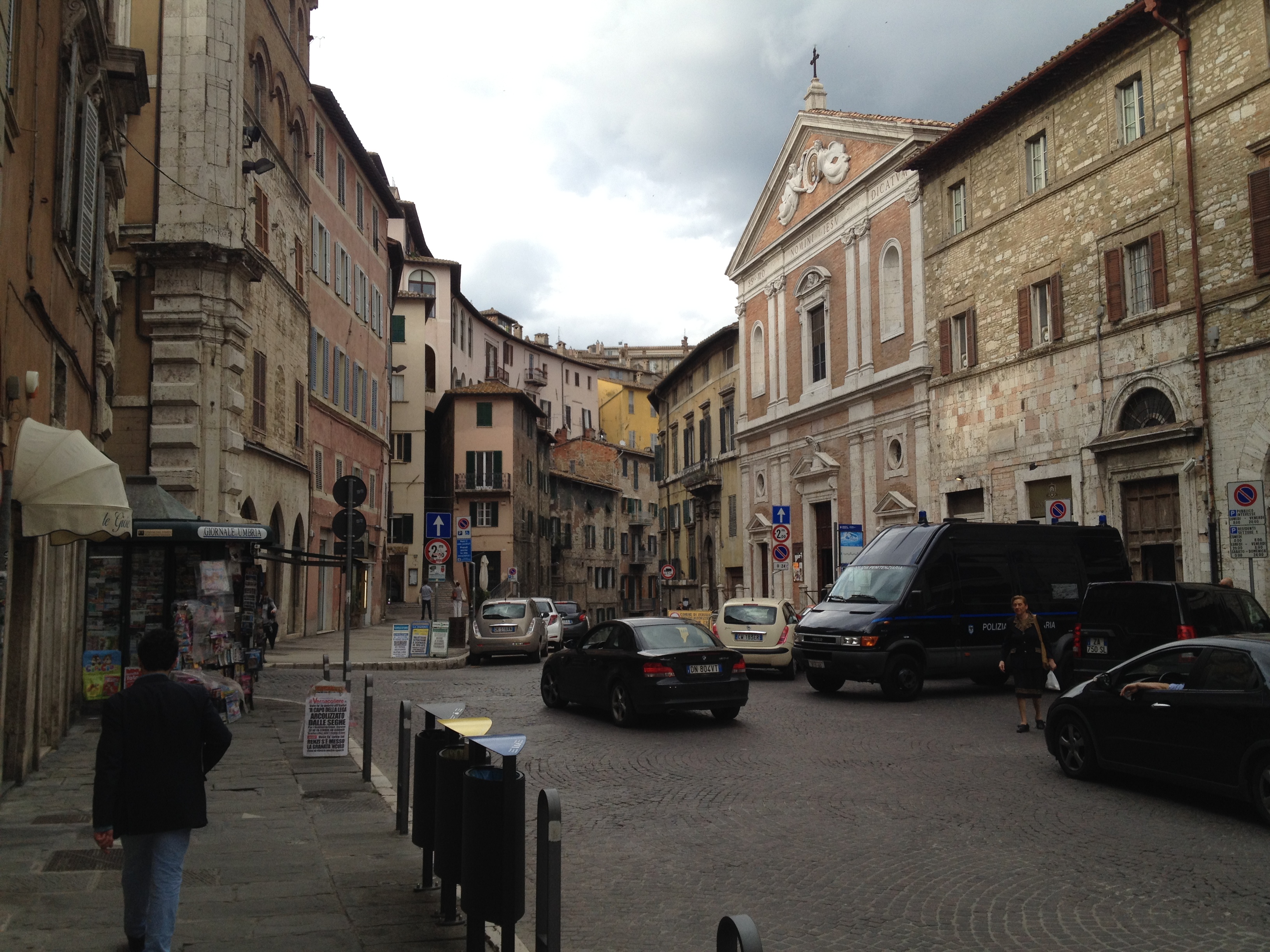
Three arches lead the way to a so far unexplored part of town.

Three arches lead the way to a so far unexplored part of town.

Yesterday I really got down to studying. I went to the bookstore and bought some sticky tabs so I could mark the reference sections of my book, and then for a couple of hours I sat down with my numbers and with verb conjugations to make sure I have a good foundation in Italian.

Almost every afternoon or evening Comitato has an optional excursion for the students. Yesterday a group of us gathered at 19:00 — military time is standard here — and walked to a section of town I’d never seen before, very near a prominent set of three arches, similar to a gate in a city wall. Maria** was our leader, and I and three others sat down to taste Umbrian wines — a prosecco, a white and a red. We must’ve still looked thirsty after only three bottles, so the proprietor had pity on us and brought out some of his artisanal limoncello to help us out. This is hard work, being an Italian student.

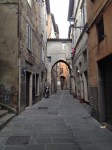
Always another fascinating neighborhood to visit.

Always another fascinating neighborhood to visit.

I have a standing date back at Graziella’s each night at 21:00 for dinner, so I excused myself from our wine tasting and walked back to Piazza Republica, admittedly with my head spinning a little bit from the wines. Back in the apartment, Luigi, Graziella’s son, who has dinner with us each night, must’ve noticed things weren’t quite normal. “Apperitivo? Si?” he asked. “Digestivo. Si,” I responded.

Until I looked them up just now I didn’t realize that I got the vocabulary just a little bit wrong. “Apperitivo” is the Italian word for a small taste of low-sugar liquor that gets your stomach ready for dinner. “Digestivo,” it turns out, is not the word for “wine-tasting extravaganza with fellow Italian students,” but simply means the kind of liquor you drink just after dinner to help your digestive tract enjoy the food you’ve just eaten.

As I think about it, all this common sense gastronomic wisdom seems to have succeeded in making Italy quite the relaxed and stylish country. It reminds me of a video Maria shared in class yesterday.

In spite of my misuse of the words, Luigi seemed to make sense of my vocabulary, perhaps due to the somewhat flushed look on my face. Soon, he, Thomas and I were talking to each other in French, Luigi’s second language and a strong language as well for Thomas. It was an interesting exercise to pull out my high school French, which I last studied in 1974. Still, my French is a little better than my Spanish, and both are much better than my Italian. The little exercise over dinner is a reminder of what it is like to live in modern Europe, where it is assumed that a well-educated person will be competent in slipping in and out of a few languages over dinner.

As much as I was enjoying the conversation in French, I excused myself immediately after dinner to head to my room. I begged off the dessert Graziella had prepared and climbed right into bed, where I fell asleep almost instantly — the result of a busy day of studying Italian here in Perugia.

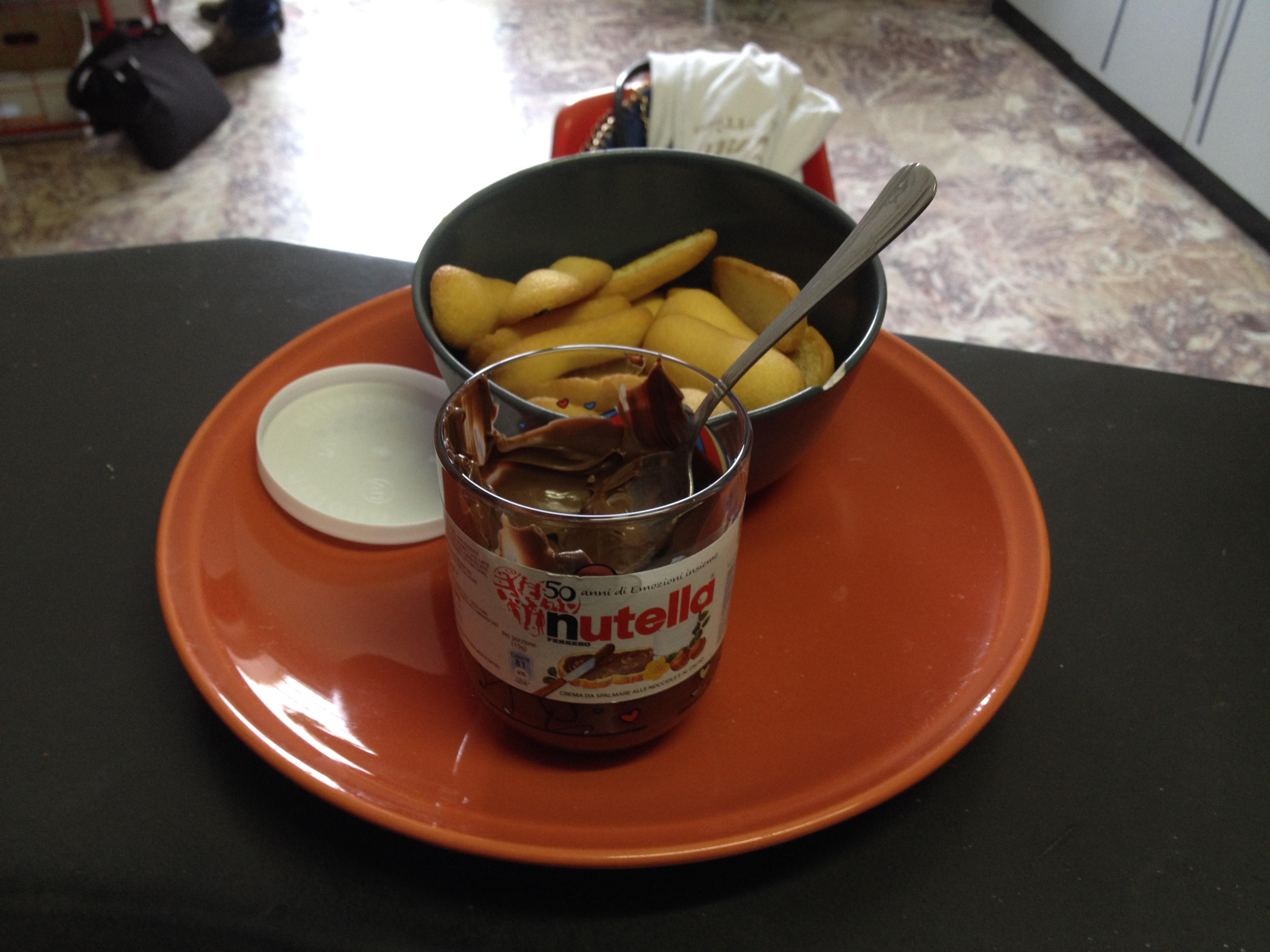
Italy, brought to you by Nutella®.

Italy, brought to you by Nutella®.

*Maria insists that I correct an earlier entry in which I note incorrectly that she is 38 years old. She is only 31, as should be obvious.

**Not the 38-year old, but the 31-year old Maria.

Essere, Avere, Parlare, Scrivere, Dormire, Vetro

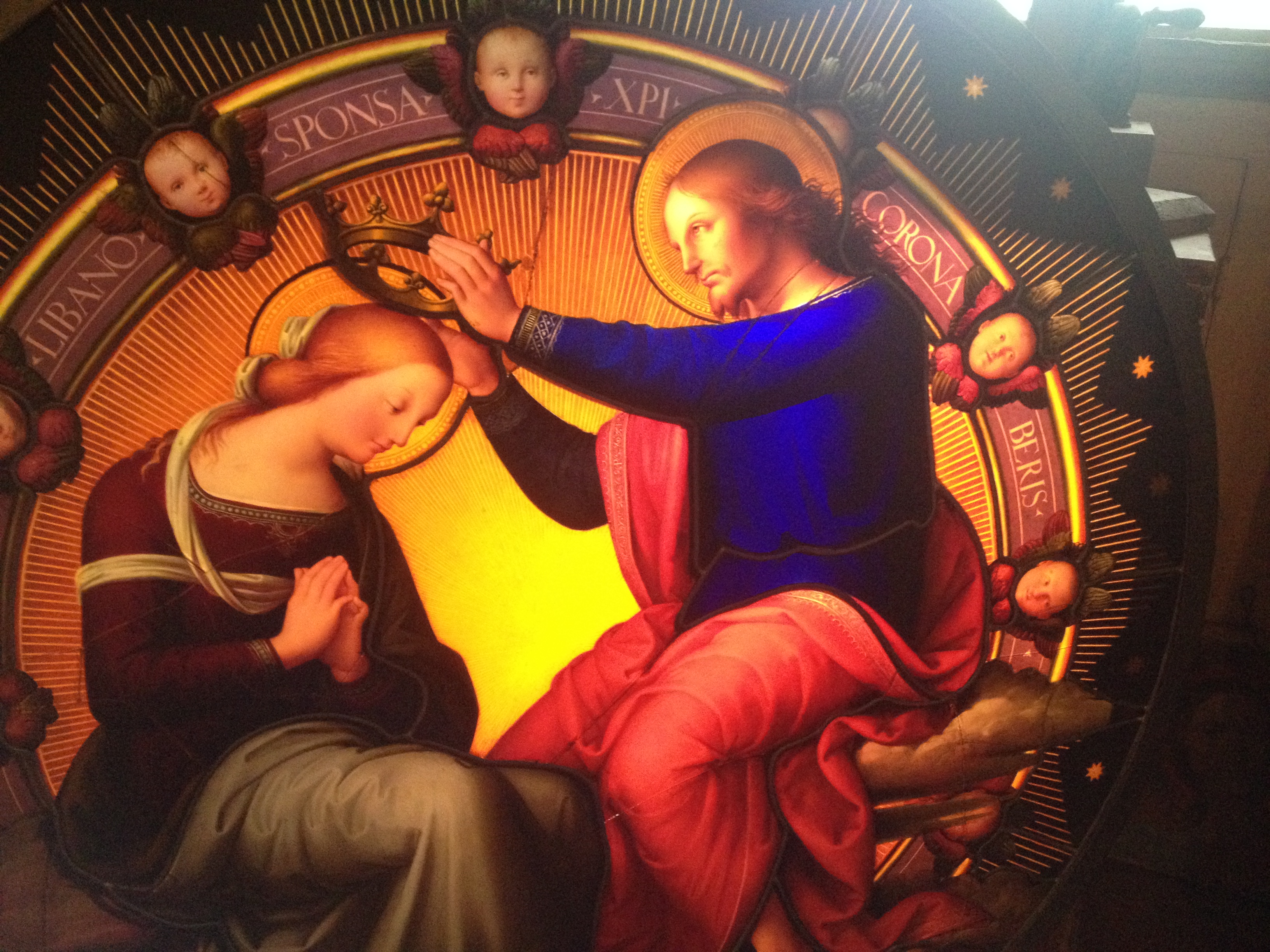
Pretty amazing stained glass.

Pretty amazing stained glass — the process of restoration.

After studying a few languages over the years — French in high school, Hebrew in college, Greek in seminary and Spanish post-doctorate — I like getting down to basics. Tell me how to conjugate verbs, s’il vous plaît. Fill my head with vocabulary, por favor. Pronouns and prepositions, בבקשה. I’d like some adjectives, παρακαλώ. So today was a productive day of learning Italian — we covered many of the important basics. Before class I reviewed essere (to be), and avere (to have), then in class we moved on to present tense of regular verbs with the three main endings: parlare (to speak) represents the “-are” family; scrivere (to write) represents the “-ere” clan; and dormire (to sleep) fills the bill for the “-ire” group. So if I were being a good student right now I would drop the blog and instead be reciting in my mind: “parlo, parli, parla, parliamo, parlate, parlano; scrivo, scrivi, scrive, scriviamo, scrivete, scriveno, dormo, dormi, dorme, dormiamo, dormite, dormono” etc.*

Instead I had lunch, went on a tour of a stained glass restoration shop, took a nap, and updated you on my life via this blog.

IMG_3664

A slide of typical old city Italian life just a block from our lunch stop.

I dined with Thomas, Patricia, Roxanne and Dieter at Piazza Republica for lunch. Afterward I joined a group of about 8 of us for an excursion to a stained glass restoration company. Although the tour was exclusively in Italian, I could clearly make out that the glass was beautiful, it was difficult to restore, that the building housing it was very old, and that this company’s glass is in lots of famous churches, and also a cemetery in Los Angeles, California.

Before going on I should announce that I do know a little something about stained glass. In the mid-1980’s at the Fall City United Methodist Church I was honored to lead the congregation in installation of beautiful windows, produced by Perry Stained Glass Studio in Issaquah. They put together some gorgeous windows for the church, a real highlight of the old, 1890’s building. Then when I was in Wenatchee I led in the restoration of its leaded glass windows, once again by Jim and Liz Perry. Then as pastor in Seattle our building committee chose Mark Eric Gulsrud as designer for two, beautiful, contemporary windows. Jim and Liz built them and they are just lovely. In between all of this I briefly took up stained glass as a hobby, but more importantly I often visited Jim and Liz in their studio while they were laboring away on windows for my churches. They built a beautiful small window for me, too, which I still have an will hang when I have just the right place for it.

Glass has been in the blood of her family for five generations.

Glass has been in the blood of Madelena’s family for five generations.

So, I was looking forward to seeing how the Italians do glass (vetro). Our little group from the school arrived at a bit past 4:00 in the afternoon and were greeted by a mid-30’s Italiana, Madalena, a fifth generation glass maker who is justifiably proud of the traditions of her glass-making family. She welcomed us into her family’s home/shop and as we entered we walked past shelves containing file boxes of correspondence going back over 250 years.

She took us through the earliest shop, a small room with an ancient oven for glass, followed by a larger studio with designs from the early 19th century, then into a more modern studio where glass currently is restored. I was intrigued to see that the company does make some of its own glass, but was particularly surprised to see that the shop makes its own lead came. I’ve only ever seen the mass-produced variety.

I have never in my life seen a stained glass window with this amount of detail and beauty. Truly awesome.

I have never in my life seen a stained glass window with this amount of detail and beauty. Truly awesome.

Most impressive of all, though, is the 19th century glass in the realistic style. In the past I have not been a big fan of this kind of art glass, which relies on a great deal of surface painting to achieve its effect. But a life-size window that depicts a woman in a blue dress is mind-bogglingly detailed and vivid in its colors — quite extraordinary and far beyond anything I’ve seen in this style.

Once our tour was over I headed with our group up the hill to Centro Storico, as the historic center of Italian cities is usually called. I wandered through the large bookstore off the Piazza Republica and to a gelato place for an irresistible sweet, then I hit the sack for a much-needed sleep. Ah, yes. Dormire.

Dinnertime came with a tap on the door from Thomas. Graziella had prepared another feast of pasta as primi, followed today by chicken for me and beef for the red meat eaters. I’m sad to say that Thomas and Flavia have only two more days with our little family. Presumably Monday will bring a couple of new students to share Graziella’s airy apartment. I’ll be the senior Italian student then, which should be scary to contemplate. Flavia has already advised me to put in a request to move to Thomas’ room, which has its own bathroom as well as a panoramic view of the city and the green hills beyond.

Oh, one last highlight of the day. There’s always a treat on the reception desk at our school. Today it was ……

Nutella®, as omnipresent in Italy as espresso.

Nutella®, as plentiful in Italy as espresso.

*Note to my Italian-gentsia friends, I’ve intentionally made one error. Can you find it?

Amici in Bici and Amici con Gigi

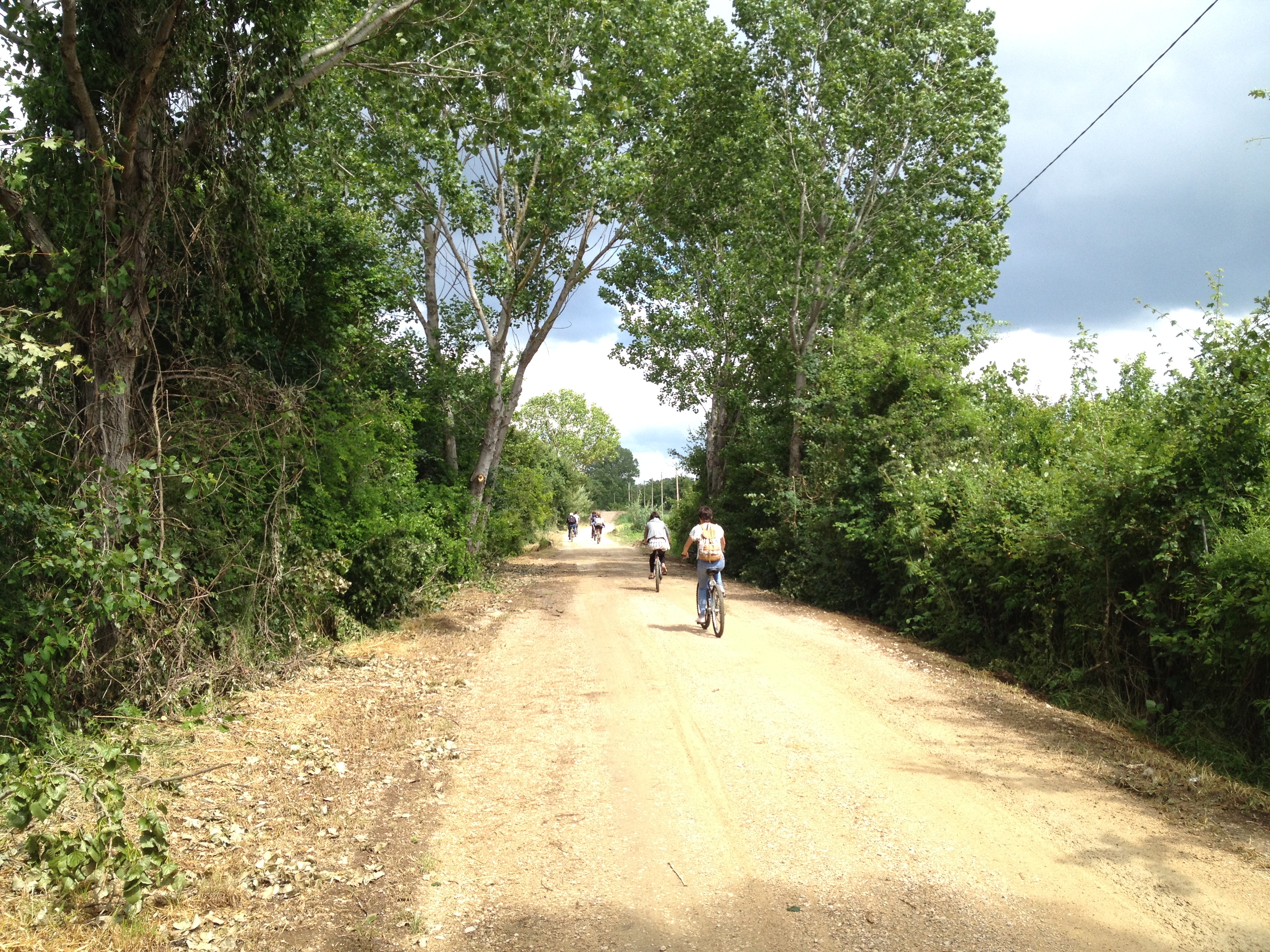
Biking near the shores of Lago Trasimeno

Biking near the shores of Lago Trasimeno

Yesterday began with a puzzle — could I get to school on my own without getting lost? My class is now starting at 10:00, while Thomas heads to school for a 9:00 class, so without my guide today I would have to figure out the serpentine roads from Via dell Streghe down the hill to Comitato Linguistico, near the bus station. Google Maps was little help — it doesn’t know any of the side alleys and most of the stairways that shorten the trip. Still, I managed to make it in under 20 minutes, only about twice as long as it took with Thomas the day before.

When I arrived I learned from Frederica, who runs the school, that my class would be shortened since there are only two students. That means we’ll start now at 11:00. Once our teacher, Maria, arrived, Patricia and I went to work on some very basic but helpful material — what letters make what sounds, conjugation of the verb “avere” (to have), and some basic descriptors about people — work, education, marital status, etc.

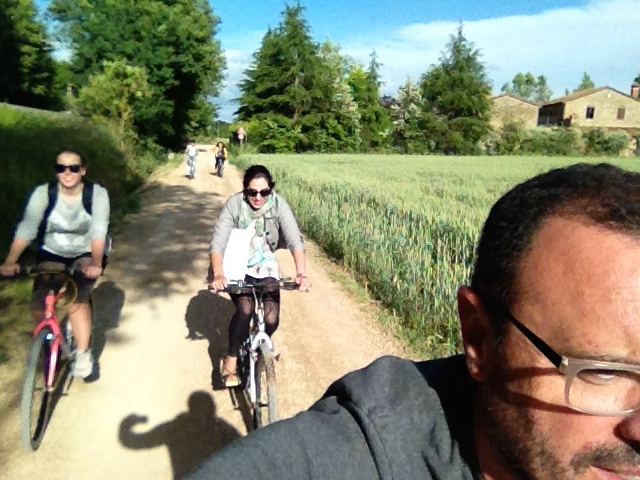
Our biker gang outside the Touro train station.

Our biker gang outside the Touro train station.

When class finished at 1:00 I was starving, so I decided to head across the street for a quick slice of pizza before our bike excursion would leave at the prearranged time of 1:30. After two quick slices I returned to the school at 1:25, only to find that our bike group had already left. Frederica showed me to the bus so I could catch up to them at the train station, but when I arrived at the train station none of my schoolmates were there. To me this didn’t seem like too much of a problem, since it was raining hard and I now had two good excuses to go home and get some anti-jet lag sleep. I gave it one last try by calling Frederica and, while on the phone to her, Hugo, our guide for the trip, miraculously appeared in front of me. The other students had disappeared across the street for their own slices of pizza. Hugo apologized for leaving without me and I apologized for stepping out for an early lunch. Soon all 10 of us were gathered at the now sun-drenched train station, ready to head to Touro Sul Trasimeno, about 20 minutes away, for our bike trip.

I took on a hitchhiker.

I took on a hitchhiker.

After walking from the station to a bike rental shop we headed out along a dirt road near the lake in bright sunshine. I think we all enjoyed the combination of natural beauty and exercise. We did have a couple of accidents, the worst being a spill by Tamila that resulted in a few scrapes and, I’m certain, some bruises too. Roxanna’s bike pedal fell off, so I traded her bikes, and then Delia became exhausted and hitched a ride on the back of my bike for the last kilometer. This all contributed to helping me feel useful. We enjoyed a beer and gelato near the end of the trip, then jumped on the train back to Perugia.

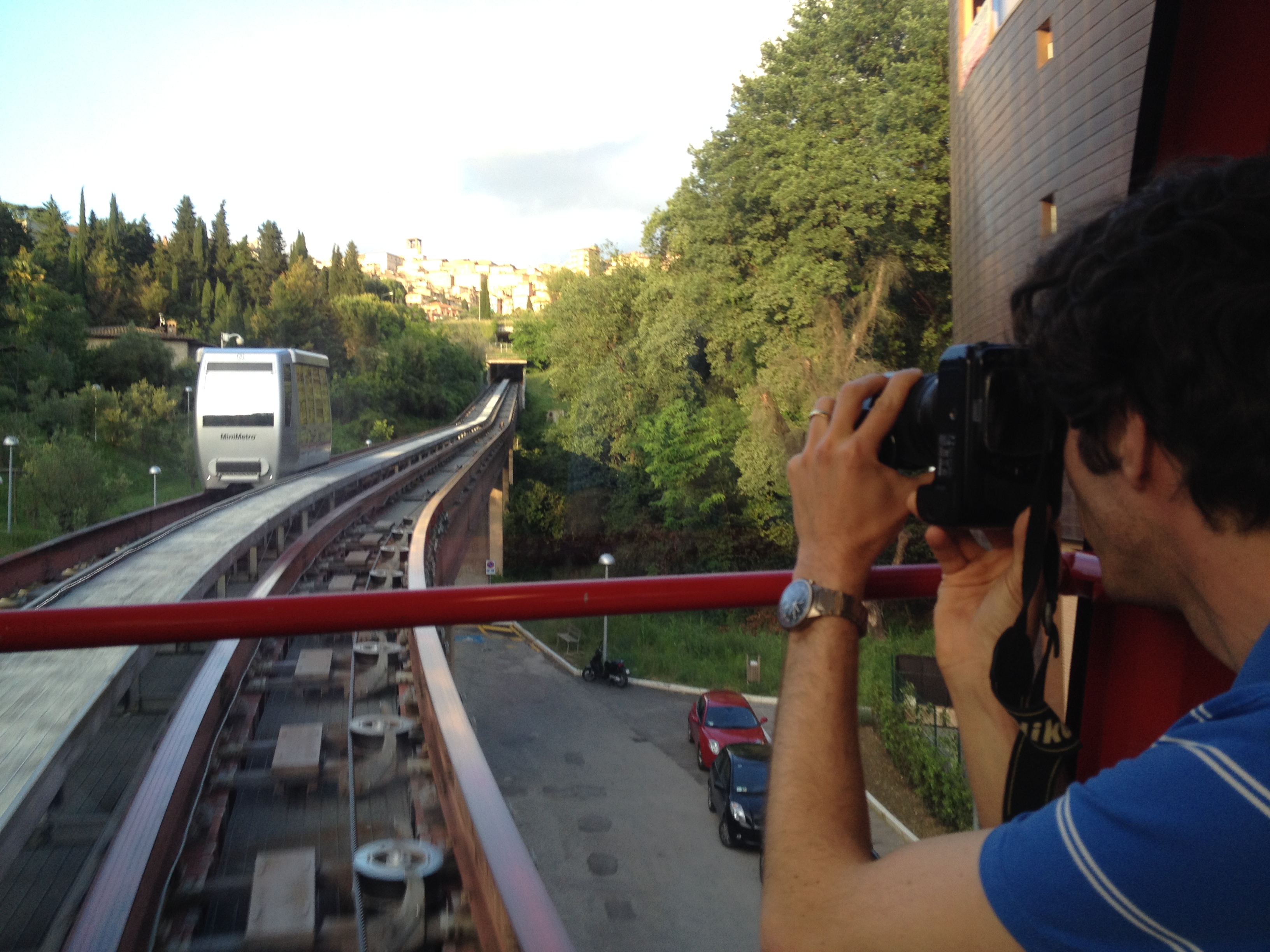
A photo of Thomas taking a photo of the MiniMetro.

A photo of Thomas taking a photo of the MiniMetro.

Back in town we explored one of the amazing features of the Umbrian capital — the MiniMetro. It’s a light rail system with tiny cars that transport passengers up and down Perugia’s big hill — from the train station nearly to the top of the old city. It has its own tracks and tunnels and is a gleaming, modern example of how to enhance the pedestrian experience and keep people off the roads.

After marveling at the MiniMetro I made it back home at about 8:00 along with a bag of soap, shampoo and other supplies from the Farmacia. Graziella had prepared heaping plates of “bow-tie” pasta in red sauce followed by some tasty cod as a second act. I cleaned my plates and then headed out at 10:00 p.m. to meet with Gigi.

As I had researched the Via di San Francesco I came to understand that there are three main tracks, the most well-funded one being sponsored by the Umbrian Office of Tourism. It’s well-marked by the familiar blue/yellow signs and has an excellent website, full of helpful information. After posting about my trip on my blog and others places I somehow soon was making Facebook friends with people in the Tourism office. I was told I had to meet Gigi (Gianluigi) Bettin, who has taken on the Via di San Francesco as his primary work. He had been following my blog and texted me just after I arrived in town, inviting me to meet and discuss all things cammino. Earlier today I’d set up a meeting for us at 10:00 p.m., the earliest my busy social calendar would allow.

Gigi (left), me, and Ciso, talking serious pilgrim talk.

Gigi (left), me, and Ciso, talking serious pilgrim talk. Gigi’s book is in the foreground.

We met at the fountain in the main piazza and Gigi had with him a gentleman named Ciso B_______, a government official who supervises the Tourism Department and other offices for Umbria. He’d run into Gigi on the street just before our meeting and Gigi invited him along to meet me. It was great to know Ciso, since it had been his decision that in 2008 set in motion the creation of the Via di San Francesco. Gigi was hired as a result, and he was responsible for commissioning the way marks and setting in place the website and infrastructure that created this cammino. I felt honored to spend time with these two gentlemen who’ve pulled together what I believe is a truly excellent pilgrimage walk.

As we talked, Gigi and Ciso showed a lot of interest in the post-Florence and pre-Rome stages I’ve included in my itinerary. They agreed that walking from Florence to the start of their itinerary at Santuario della Verna could be challenging. They also agreed that the walk into Rome needs more signage and infrastructure. I encouraged them to recognize that their Franciscan pilgrimage presents an attractive option for the 250,000 people each year who’ve walked the Camino de Santiago and are looking for their next great adventure.

Gigi also shared an interesting detail about his book, La Via di Francesco. His co-author is Paolo Giulietti, a local Catholic bishop who also serves as chaplain for the Italian Santiago confraternity. Don Paolo’s partnership closely connects the pilgrimage to the Catholic Church, which is a real plus for religious pilgrims. Gigi clearly has a great appreciation for the genuine spirituality of this man and I hope to meet him while I’m here. In addition to encouraging me to meet Don Paolo, Gigi invited me to several upcoming meetings — one with the Italian Santiago confraternity in a couple of weeks, and one with Italian pilgrims who’ve completed the Camino de Santiago, the Via Francigena and/or the Via di Francesco. One is here in Perugia and the other is in Florence in a couple of weeks — I’ll have to see if it can fit either onto my crowded calendar.

The subject of the Italian confraternity reminded me of my experience at the Albergue San Nicolas at Puntetitero, run by the Italian confraternity, on the Meseta in Spain. I’d walked there almost exactly three years ago, arriving in the evening after a long and somewhat waterless walk that had begun 37 km (23 miles) earlier that day. Gigi’s eyes sparkled as I told him the story. The place is now my favorite albergue, infused as it is by the joy of the Italian hospitaleros who put on purple capes and wash the feet of each weary pilgrim before serving them a meal of tasty pasta and wine. Their attitude is very Christlike, spiritual, and loving — and their attention makes San Nicolas one of the highlights of the Santiago pilgrimage, brought to you by Italy. I see this same love of pilgrimage in Gigi and Ciso and I look forward to a partnership with them in helping others discover their creation, the Via di San Francesco.

The busy-ness of the day is keeping me from being homesick, I know. I’m missing Theresa, missing the church, missing Seattle. But today was a day of new friends — “amici” — on “bici” (bikes) and with Gigi.

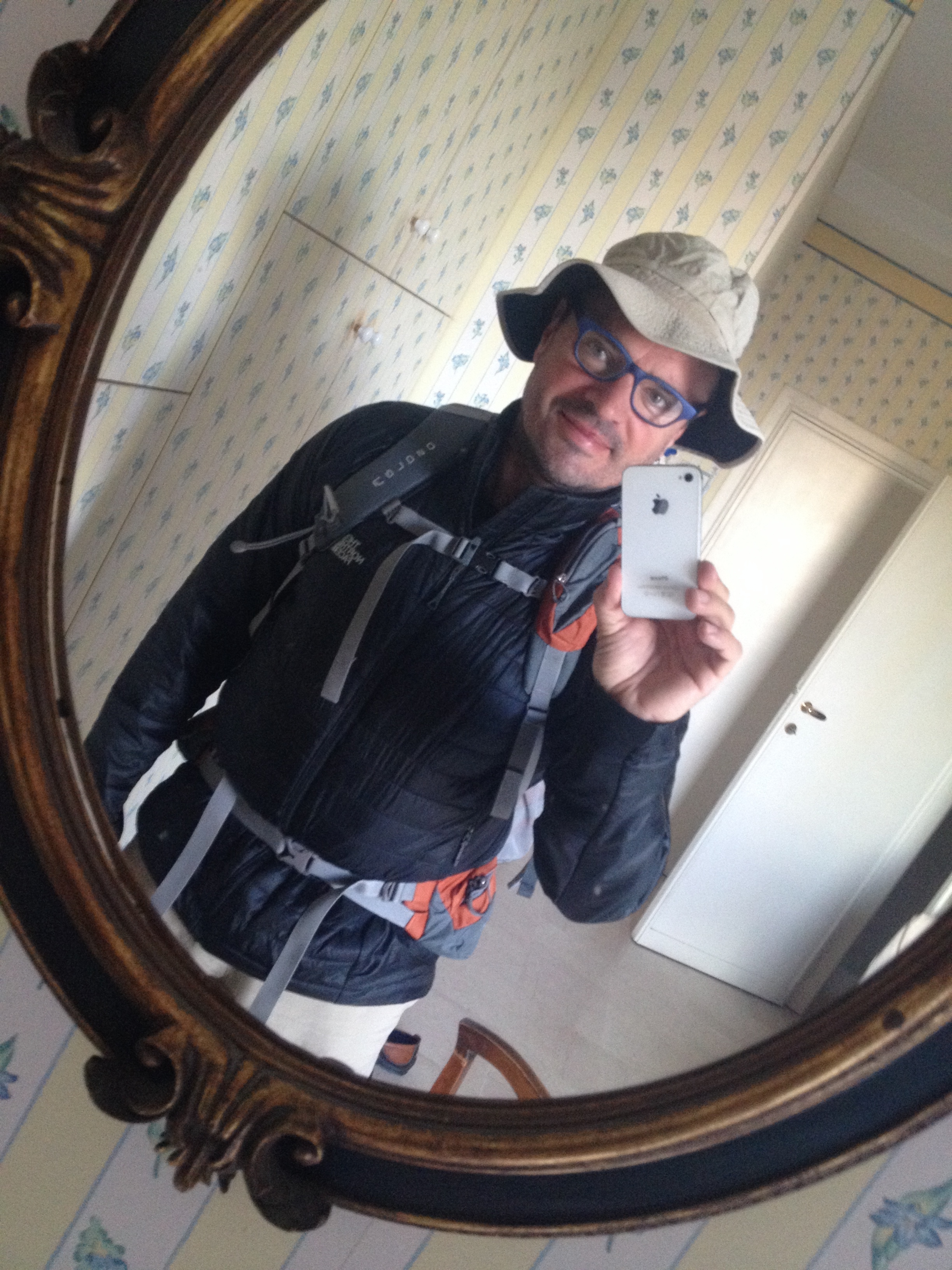
Exploring new territory in the Art of the Selfie

Exploring new territory in the Art of the Selfie

Look out — My head is about to explode

IMG_3604Today my head wants to explode — so much information about the Italian language in so little time.

The day began at the usual hour — 4:00 a.m. when for some reason I’ve been waking up. This time I managed to force myself back to sleep, and I reawakened at 7:00, refreshed and ready to begin the day. The rest of the apartment — including my hostess Graziella and my two fellow students Thomas and Flavia — was still fast asleep. I caught up on a Facebook argument I’m having with an atheist back in Seattle and then headed to the showers after I started to hear people stir. After my shower Grazielle had a breakfast of toast, cake and peanut butter ready (no Nutella®), which I washed down with a caffe latte.

School secretary Giulia waves from behind the Comitato Linguistico desk.

School secretary Giulia waves from behind the Comitato Linguistico desk.

After breakfast I went back to my room to see if I could catch Theresa at home while she was still awake. We talked on FaceTime and it was great to see her face and hear her voice. By the time we were finished, Thomas was ready to head to school, so we walked down the hill together to Comitato Linguistico, our language school, Thomas leading the way.

Comitato is housed on the fifth floor of a 1970’s era office building just above the main Perugia bus station, and its quarters are cozy, modern and friendly. I met Giulia, with whom I’d had several email conversations over the last months, and was oriented by Frederika, the owner. She showed me around and described the optional excursions students can take. I signed up for every one, including a city tour this afternoon, a bike trip to Lake Trasimeno tomorrow, a stained glass restoration tour Wednesday, a wine tasting Thursday and an Italian movie on Friday — so many excursions that I had to mark them in my iPhone calendar. After finishing this task I discovered my class wouldn’t start until 10:00, which gave me time for a second breakfast at a nearby cafe.

When I came back I met my first teacher, David, a friendly young Perugian. My fellow students in class are a young Dutch woman, Patricia, and an American woman from Fresno, Delia. She seems to have a lot more Italian than Patricia or me, so today’s lessons were elementary for her, challenging for Patricia and me.

David and me with our grammar book.

David and me with our grammar book.

David walked us through some basics. Pronouns, conjugation of “to be,” a couple of prepositions, and some vocabulary — all in one hour. In our conversation time the first question in Italian was “where are you from?” followed by “how old are you?” and “where do you work?” The first question was easy. My answer to the second question led to some surprised looks, which I took as flattery. The answer to the third question was the one I’m still trying out. “Sono scrittore” (I’m a writer). Then I described my plan to write a guidebook, to walk from Florence to Rome, the address of my blog, etc.

At 11:00 it was David’s time to transition to another class, and Delia left to join a different class too, likely more advanced. Patricia and I were then introduced to Maria, a 31-year old teacher from southern Italy. She was full of laughter and jokes as she led us through vocabulary words. The general topic was “Details” and we learned how to describe information about people like their work, hobbies, musical preferences, favorite color, favorite beverage and food, sports, languages they know, marital status, and general personality traits. Soon Maria, too, was asking my vocation, and when I answered, “Sono scrittore,” she unfortunately asked, “How long have you been a writer?” Thinking back to the immigration officer in London who’d negotiated the answer with me I responded, “Four days.” She would have none of that, and before long I was describing my work as a Methodist pastor for 34 years. Soon I was also sharing in halting Italian about divorce, girlfriend, children, languages I’d learned, educational attainment, etc. Patricia also shared, as did Maria. We enjoyed much laughter as we learned about each other. Maria had ruled that English was forbidden in class. Spanish, however, would be acceptable, which was a great relief. Both Patricia and I spent much of the class speaking and hearing in Español. I’m not sure either of us can separate the two languages quite yet.

DSCN0323

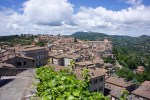
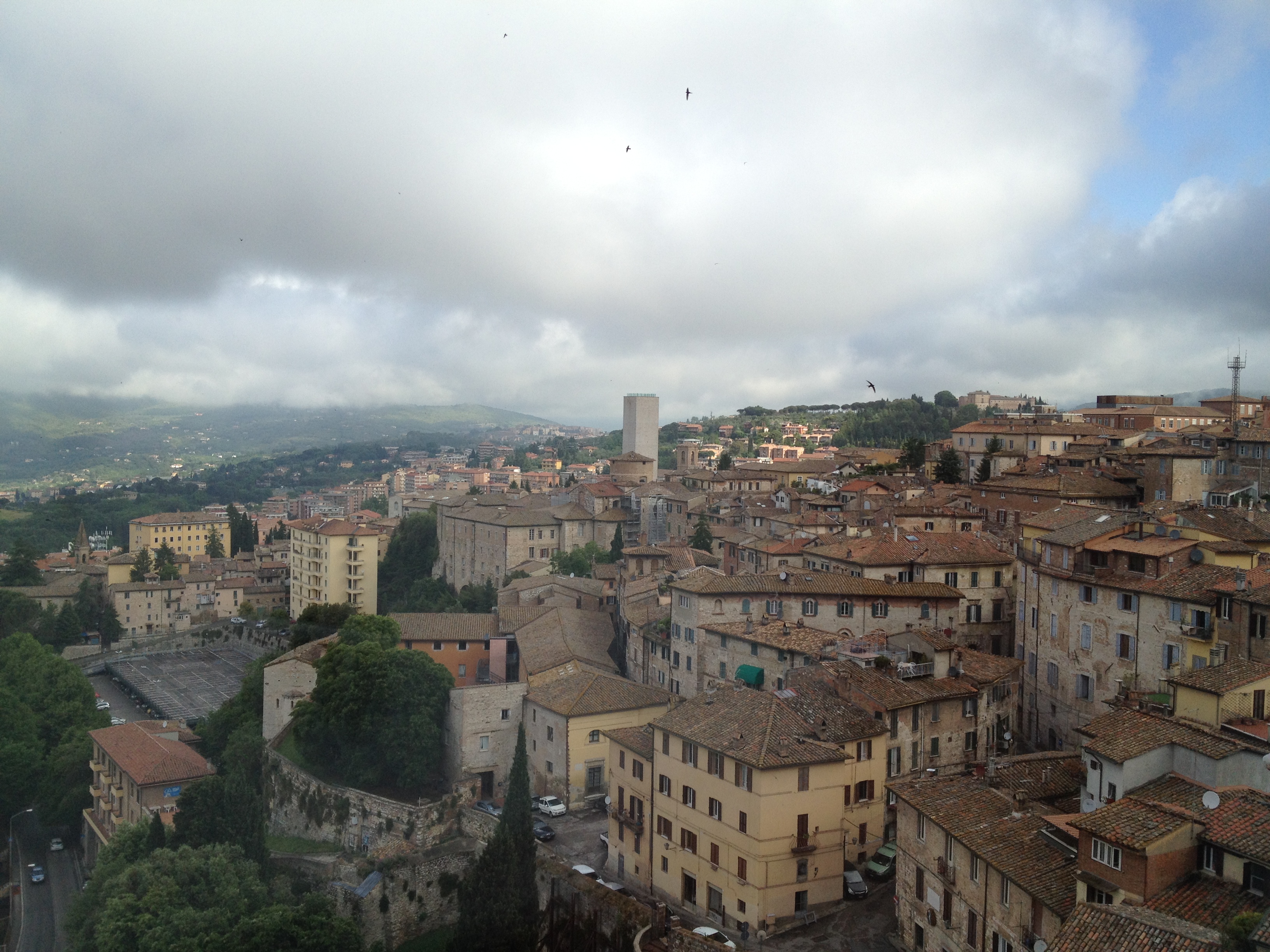
View of city rooftops.

After class Patricia and I walked up to the main pedestrian area and sat for a quick lunch. She’s a communications student at university in Amsterdam with a boyfriend of 5 years. She reminded me that I’d told her I had a 2:00 meeting, so I jogged down the street at 2:01 to meet Kenneth Miner, a Camino de Santiago pilgrim from Oklahoma with whom I’d been chatting on Facebook and on this blog. Kenneth was inspired to walk from Assisi to Rome after reading last year’s blog entries and he heads off tomorrow from Assisi. He’s something of a medical miracle, having had leg bones on both sides replaced in surgery last year.

After lunch I headed home to blog a little, then took a quick nap before my 5:00 p.m. tour of the city with other students. David served as our guide and walked us through the Papal Fortress and many other sites in town, after which we gathered over drinks in a hip bar. As we sat and I listened to other students talk I couldn’t help but feel very old and very tired. My head was about to explode with so much input all at once. I decided to believe that if I can survive these four weeks I will come out knowing some Italian.

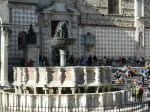
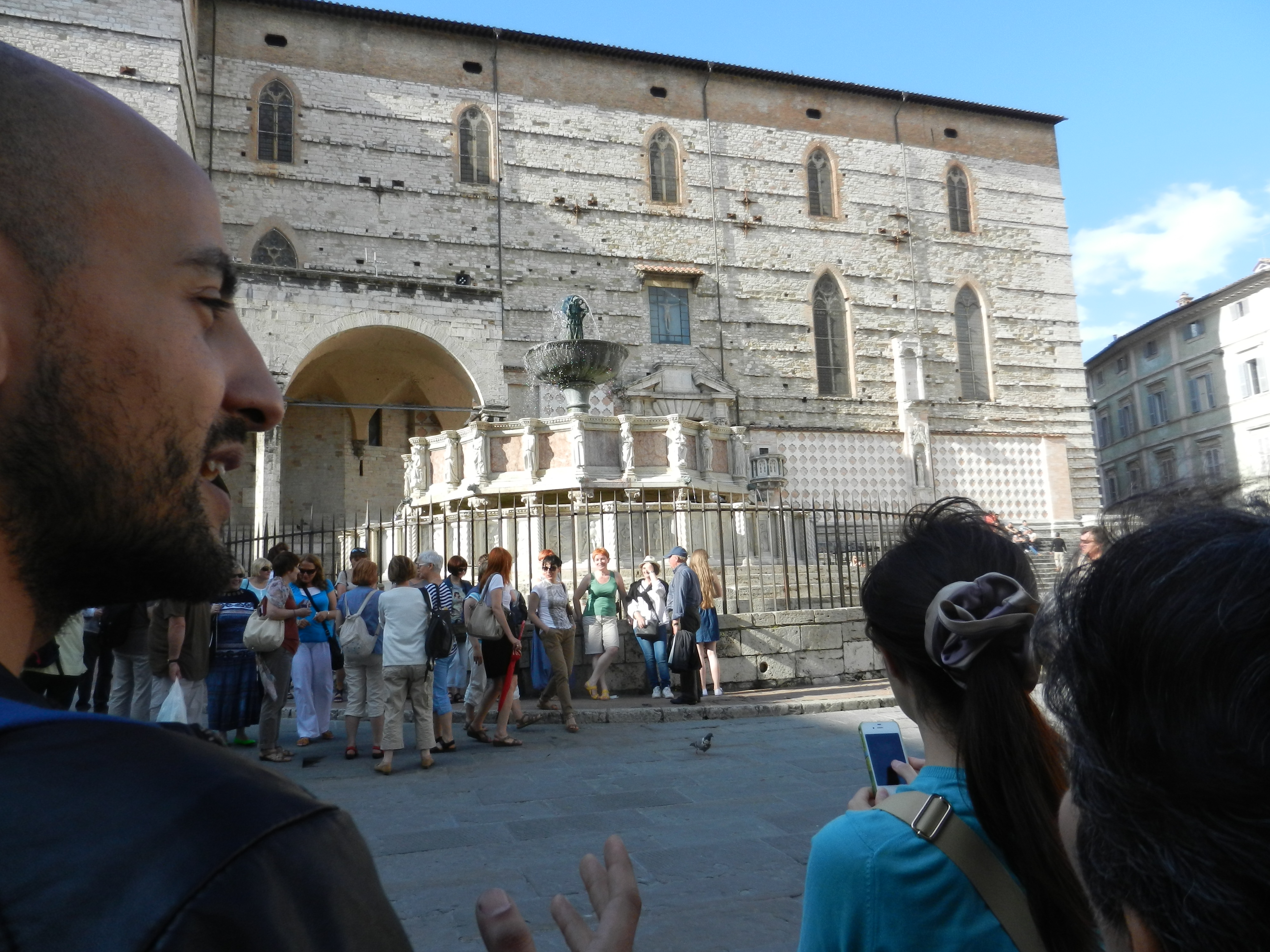
David shows our group the fountain at Piazza 4 Novembre in the heart of Perugia.

David shows our group the fountain at Piazza 4 Novembre in the heart of Perugia.

After the tour I headed back home, ready for dinner. I’m longing to speak only in English for awhile, but as I walked I had Italian phrases running through my head and I was starting to think about how I would tell Graciella that I may miss dinner tomorrow night due to a bike trip to Lake Trasimeno. Funny that the words I should say in Italian came instantly into my head. Maybe some will indeed be sticky enough to be there when I need them over the next months.
Dinner included an Italian monologue on the topic of dinosaurs by Graciella’s grandson, Alesandro. He’s a bundle of energy, which is much more than I am after a hard first day of Italian. Graciella, who’s hosted many students, asked in Italian if I was tired. I answered honestly. She slowly and knowingly nodded her head as she swallowed a bite of salad. “Il primo giorno è sempre il più difficile.”

Along with bread, water, a bottle of local white wine, and all of the plates and utensils I couldn’t help but notice a jar of Nutella® sitting alone in front of my plate. Graziella picked it up, showed it to me, and said, “Look what I bought at the store today.”