Why Don’t “Our” Catholics Have Explosives?

Day Nineteen: Luarca to La Caridad — Over pizza last night, when I wasn’t talking to Gail back home by phone, I made myself useful by updating Martin on new developments in the English language. Since most English speakers are in the USA it’s high time that Brits like Martin caught on to current usage of our common tongue. Truthfully, it was good fun to share conversation with an articulate Englishman like Martin. Occasionally he did have to stop for a moment and define some exotic English word. We both knew, of course, that his use of the King’s English is far superior to my West Coasty slang and he can get me giggling by saying something completely silly in his tweedy lilt.

Since Martin wanted one more day to rest his knee he decided to stay in Luarca another night and meet me midday tomorrow in Tapia de Casariego, or “Tapioca” as we’ve come to call it. That will give him another day of rest followed by only a couple hours walking on his first day back. So I awoke at 7:15 and bid adieu to Martin just before 8:00.

Outside it seemed just perfect for a 30 km (19 mile) day — clear, blue sky and moderate temperature. I found a panaderia (one of the few Spanish stores open on Sunday) and bought a pastry to help me get moving. The tasty little treat was finished well before I reached the top of the hill above town.

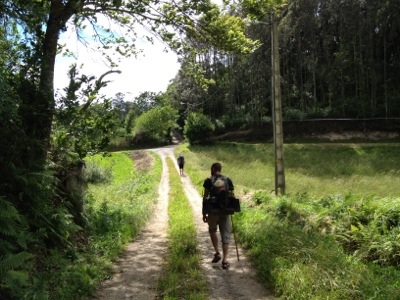
The camino was very clearly marked out of town and I had no problem making it up to the N634, which the camino would more or less follow again all day. Occasional crossings of this highway were interspersed with quiet strolls through dairy farms and fields of newly sprouted corn.

In a couple of hours I was in Pinera, where a kind barkeeper offered to make me a racion (snack sandwich) of pollo a la parrilla (grilled chicken). It was delicious, and I washed it down with a small glass of beer.

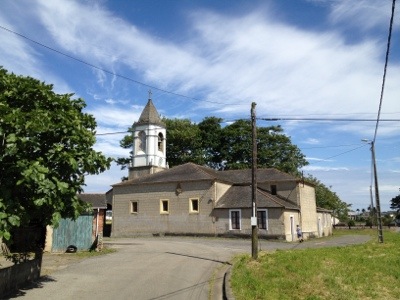
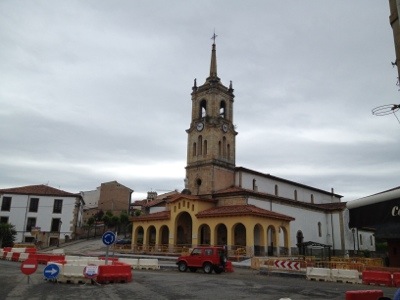
About 100 meters past the bar I heard the sound of church bells from the ancient little church just down the road. I’d been hoping to have the opportunity to go to church today, and the sound of church bells calling from the distance has always evoked in me thoughts of what medieval life must have been like.

Two men standing by the church noted that I’d turned into the church yard rather than onto the camino and they pointed me back to the trail. But I asked them if Mass was soon, which they said it was, and they waved me into the church.

I was about 30 minutes early for the service, so I had time to study the little, stone building. It was much wider than it was long and had a central dome over the worshipers. The main altar was in front of an elaborate, gilded reredo and the side altar had a more modest reredo of carved wood. Opposite the side altar was a Santiago Matamoros scene — my beloved St. James slaying a Muslim.

Although the scene is 1000% politically incorrect, I always feel a little embarrassed affection for Santiago Matamoros. He was seen on a white horse, slaying Moors in a dramatic battle of the Reconquista 1000 years after his death, but today we shake our heads at the inevitable remaining statues that depict the scene. Still, he’s a part of Spanish history, a part it would be dishonest to deny.

A nice altar boy noted my presence and kindly offered to stamp my pilgrim credential. A few minutes later the little church began filling with people. At precisely noon the 100 or so present fell silent, a woman coughed, and the priest appeared from a back room. The worship began and I realized immediately I’d set myself in the middle of the choir. All the women around me erupted into exuberant singing.

Rural Spanish churches seem to share a common concept of “choir.” About a dozen women of all ages sit at the front of the church and sing the worship songs in loud, unison voices. Their husbands sit quietly and respectfully in the back pews. The priest and the women seem sometimes to be in musical dialogue as the service progresses.

The Mass proceeded as normal, with the exception of the sweaty pilgrim sitting in the choir pew. I’m sad to say, though, that my quick sandwich and beer made it hard for me to stay awake during the sermon. I was awake enough to notice that the sermon text very oddly was from Holy Week and was about the Last Supper.

But the oddest part of the service came when the priest announced the Hocus Corpus (“This is my body”) which as always was followed by the ringing of a small bell. Today, however, the bell was followed by something like this:

Riiiiiiiiiiiiip BOOM!

A baby started crying, and then the priest said, “This is my blood shed for you.” Ring, ring. And then:

Riiiiiiiiiiiiip BOOM!

I couldn’t believe my ears. It sounded like there was a small cache of explosives just outside the door and they were being set off precisely at the most dramatic moments of the Mass.

After everyone received their wafer (no wine today) the remaining host (the blessed bread) was put by the priest into the clear center of a sun-shaped silver and gold vessel. Six men came forward and picked up poles that support a silken canopy and another picked up a pole with a red flag. The rear doors of the church were opened, bathing the priest and altar in sunlight, and then he, the men, the host, and everyone else got up and walked out of the building.

As they walked out there was the sound of:

Riiiiiiiiiip BOOM! ….

…. a sound which rang out at least another dozen times, to the accompaniment of bells ringing and babies all crying anew at each explosion as priest, congregation and host paraded once around the building. It turned out that a dark-haired man was setting off fireworks from his car as part of the religious festival. He’d light the fuse, it’d rocket into the air (Riiiiiiiip) and then explode in a BOOM! that echoed through the whole valley.

When it was over the priest and host were escorted safely back into the church. The first question that came to my mind was, “did everyone count their fingers and toes so we can be certain no one was injured?”

The second question was, “why don’t our Catholics back home have cool fireworks like this?”

Party over, it was time to get back to walking. After another 7 km I made it to the riverside town of Navia, where I had a salad for lunch. Then I headed on to Jarrio, where I met a nice Hungarian man named Carman, and where, unfortunately, it started to rain.

By the time I got to La Caridad I was dripping wet. I found the lux rural hotel, Casa Xustes, and am comfortably ensconced in a room full of antiques, my clothes drip drying onto towels in the bathroom floor. Apparently there’s an Italian restaurant 150 meters away, so between rainstorms I’ll head there for pasta.

Just 10 days left of this camino — I can’t quite believe it. Today, though solitary, was a good day of reflection and meditation. I’m adjusting to the balance here between solitude and fellowship. I’m also missing home, family, pets, and church friends. But I’m thankful for this adventure and am enjoying how each day contains a surprising, new delight.
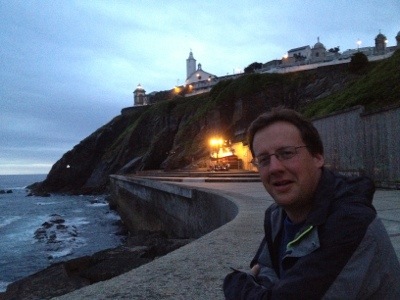
20120617-182808.jpgMartin on the pier after pizza. Note church and lighthouse above.
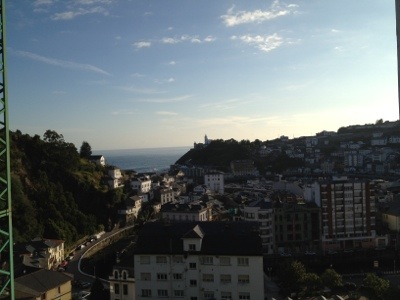
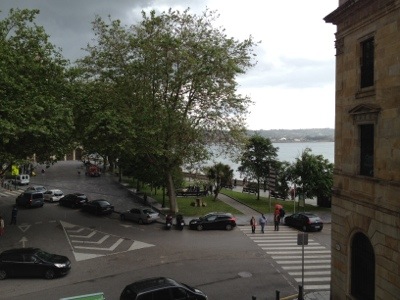
20120617-182924.jpgLuarca sleeping in on Sunday morning.

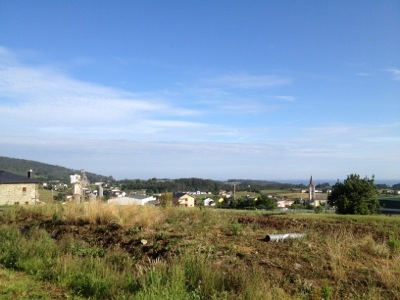
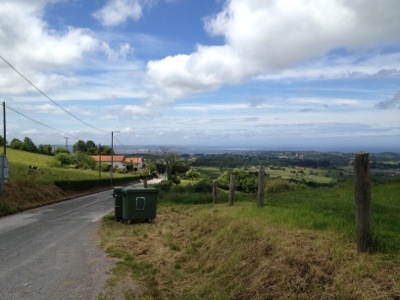
20120617-183710.jpgLandscape near Otur.

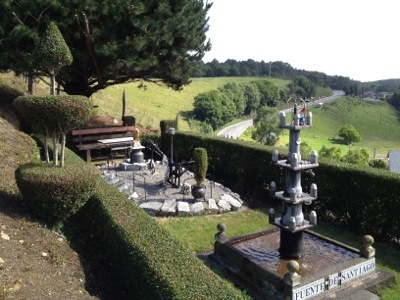
20120617-183748.jpgPersonal park for pilgrims. Thank you!

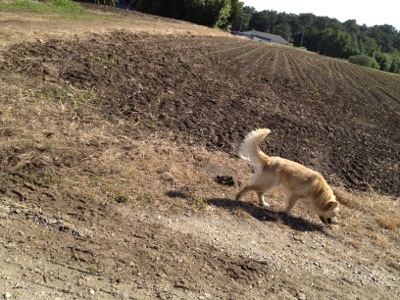
20120617-183844.jpgSweet yellow dog walked 1 km with me.

20120617-183936.jpgPinero church bells called me to mass.

20120617-184054.jpgChurch’s Santiago, slaying the demon Moor.

20120617-184148.jpgProcession pauses outside church for explosives.

20120617-184232.jpgPriest and posse make it safely back inside.

20120617-184324.jpgWatch your step, pilgrim.

20120617-184412.jpgNavia bridge.

20120617-184452.jpgHungarian Carman at a Santiago fuente.

20120617-190948.jpgNot sure you can make out the heavy rain coming down outside my comfy hotel room.

Playing Chicken

Day Eighteen: Cadavedo to Luarca — The morning started with a pleasant coffee and conversation with Julian of Honolulu who was staying at the same hotel. At one point in our talk he mentioned that he would stay at Cadavedo in order to wait out the rain.

“Rain?” I said.

“Yes, it rained torrents beginning at about 2 am this morning and it’s still raining. Didn’t you notice?”

I jumped up from my coffee to look out the hotel front window.

“My room looks out to the pasture and it just looked a little foggy,” I said. And then I saw what he meant. We were in the midst of a deluge, a gully washer as we call them back home.

I told Julian I was still planning to walk the 18 km to Luarca today, but I admit that as I returned to my room to pack my things I felt a little envious of his decision to remain in the dry comfort of the hotel.

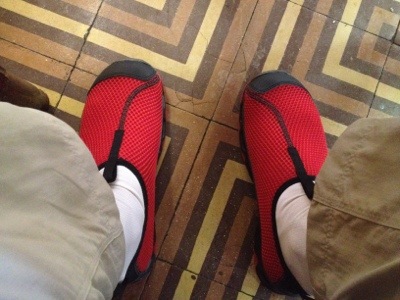
Since I’d decided to walk anyway it was now time to make a rain plan. First, I needed to choose what to wear. I settled on long pants, long sleeved technical T-shirt, wide-brimmed hat to keep the rain from running down my neck, GoreTex jacket. My pack would have its rain cover on to keep it dry. I wanted to keep the insides of my boots dry, so I decided to try wearing my red recovery shoes (aka, ruby red slippers) and sock liners on my feet. My boots could then stay dry in my pack, but be available if needed. I also would put my iPhone into the waterproof plastic envelope I’d brought just for this purpose so that it could stay handy in an outside jacket pocket for photos and GPS consultation.

Second, I would need to decide which way to walk. Yesterday’s ups and downs through muck and rivulets sounded like trouble waiting to happen. I determined instead that I would take the chicken way out and walk along the road. It would be a dreary, boring four hour walk, but at least I wouldn’t be slipping and sliding through mud and thorns.

With those issues settled I set out from the hotel into the driving rain. The outside of my jacket was instantly soaked, but my arms and core were warm and dry. My pants were quickly wet, too, but I was very pleased that they still kept my legs warm and my ankles quite dry. I realized I would be able to change to my boots when needed and not worry about water running down my bare legs and filling my boots, as it had on last year’s camino when I was caught in a rainstorm wearing shorts.

I headed out of Cadavedo toward Villademoros, noting the road sign for cars that measured the remaining distance to Luarca at 15 km (9.5 miles) — a short distance, but a long walk.

Queruas was a rainy blur as I passed it. Before Canero I switched from the N632 to the N634 highway as directed and immediately noted that it was narrower and had many more tight curves.

At a bar/cafe in Canero I was pleased to see Michael and Stefan from yesterday. Michael’s ankle is fine and we talked briefly before they headed out. I kept my wet gear on and stood dripping at the coffee counter as I had my second cafe con leche of the morning.

I headed out, about 100 meters behind my two friends, and noticed a police car slowing down to talk with them. Soon the Guardia Civil officer drove by me and instructed me, like he had with my friends, to walk on the left side of the road for safety.

With all due respect to the Spanish national policeman, we pilgrims are rather sophisticated when it comes to playing chicken with cars. On a curvy, narrow road like the N634 the most dangerous place to be in a tight turn is on the left side. Speeding oncoming drivers are hugging the outside of their lane (our walking strip) in order to avoid oncoming cars. A pedestrian in their lane is in a precarious spot if he/she is in the oncoming lane when two cars are passing in the curve.

An experienced pilgrim approaches a tight turn in the outside lane where he/she can see what’s coming, then at the middle of the curve, if there are no cars, the pilgrim crosses onto the left side — after the curve. To be honest it’s all very dicey however it’s done. Almost enough to make a pilgrim take the pilgrim pathway.

As the rainy walk wore on I noticed that most drivers carefully gave a wide berth to me as a pedestrian. They usually put on their turn signal and moved slightly into the other lane so I wouldn’t have to stand in the weeds as they passed. In fact, the only truly scary driver was the one who came up from behind me and startled me with a loud honk and cheerful wave.

As the kilometers dripped away I could tell by the increasing density of homes that I was getting closer to the comforts of Luarca. At the outskirts of town the rain started to diminish and I moved off the road to the now-paved camino path. At a church bench I changed to the heavenly comfort of dry socks and boots, then was rewarded for my perseverance after a couple of km with a brilliant view from above the Luarca harbor.

I picked my way down the slippery, wet streets, texted Martin, and met him for chocolate churros and then lunch in the beautiful harbor. He’s feeling somewhat better, but will probably need another day at least of rest. His smiling face was a welcome sight to behold.

Martin had chosen a delightful room in a handy pension and after lunch I snuggled into bed for a warm and dry nap with promises of pizza tonight for dinner.

20120616-182737.jpgThe goal: Luarca.

20120616-183000.jpgLandscape, through rain and plastic camera protector.

20120616-183051.jpgTrain bridge through rain, etc.

20120616-183133.jpgStefan and Michael in rain gear at Canero.

20120616-183228.jpgWoulda jumped in on any other day. Cueva Beach.

20120616-183344.jpgFirst sight of lovely Luarca.

20120616-183443.jpgLuarca’s inner harbor.

At Least No One Got Hurt (Too Badly)

Day Seventeen: Cordillero to Cadavedo — After dinner last night we agreed that Martin would take the train ahead to Cadavedo or Luarca due to his knee problem. I got up and gathered my things at 7:00 while Martin snoozed in the bed next to me. Along with being a skosch jealous that he was able to sleep in I was also concerned about his knee and sad that today’s long stage would likely be done alone.

I had a quick cup of coffee and some toast and jam in the garage-like breakfast room of the hotel and set out on my own to finish yesterday’s stage. The French guidebook sends pilgrims on a 39 km journey from Aviles to Soto de Luina. We had cut the stage short by going only 28.2 km to Cordillero. So my plan for the day was to go to Soto de Luina then continue on to the guidebook’s next stage: another 23.6 km from Soto de Luina to Cadavedo. This would mean a longish total of about 35 km (22 miles), but I felt good and I knew this would allow me to keep to the itinerary.

I walked downhill out of Cordillero, skipping the core of this workaday slash touristic fishing village where Martin and I had taxied last night to enjoy a seafood paella. I came to the busy N-632 highway and crossed it carefully to avoid speeding cars during the morning rush. Here I misread the guidebook, missing the turnoff and instead faced into traffic for a longer-than-required sojourn on the road. After a few km the “old” N-632 appeared next to the “new” one. I saw a yellow arrow and switched to the old one. This “old national,” as it’s called, snaked its way next to the camino all day.

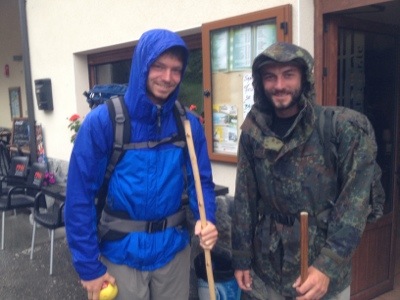
I caught my first sight of the ocean at Marino Restaurant, took a photo and applied a Compeed patch to a new old blister. Just as I was finishing up, two pilgrims joined me. Michael, 30, is from Bavaria and is finishing university and heading into computer game programming as a career. Stefan, 22, is from Ottawa and is also a university student, just having finished a semester of study abroad in Madrid. The two would be great walking companions through what promised to be a long day.

After introductions and a few km together we were lost. The camino markers took us to a spot under the new A-8 freeway bridge then left us at a construction site. We wandered around for 10-15 minutes, noticing a road below us but not sure how to get there. Michael bushwhacked our way through the undergrowth and voila, there we were at a 12 foot (4 meter), nearly vertical embankment. Before I could say, “uh-oh!” Michael had gracefully slid down the bank. Next was me. I threw my pack down to Michael then slid on my bottom to a landing made somewhat softer by Michael catching me before I nearly made a face plant in the asphalt. Stefan was next and he also gracefully slid on his rear to the asphalt. We emptied our shoes of branches and dirt, thanked our various deities that none of us was hurt, and consulted the iPhone GPS to see just where we were. As it turned out, within 500 meters we found ourselves at a camino detour sign and back in business.

So here’s how the day, in general, shaped up. Imagine that the “old national” highway is a long snake winding itself in loops for today’s 35 km. It finds its elevation then traverses hill after hill at that level, slithering out toward the coast until it finds a valley, then snaking its way inland until a small bridge can allow it to cross the inevitable creek. The road is beautifully maintained and blessedly free of cars since the “new” N-632 uses expensive tunnels and high bridges to cover the distances straighter and faster.

Then, imagine that a pathway connects each loop of the serpentine road by leading walkers down a few hundred feet to the valley floor then up a few hundred feet to the road again. This path is the Camino del Norte. You walk: a) along the road to b) a path down to the creek, followed by c) a path up from the creek, then to d) another stretch on the road, usually e) with a village. This pattern was repeated under sunny skies through the villages of Soto de Luina (coffee stop), Albuerne, Novellana (lunch stop), Castaneras, Santa Marina, Ballotas (beer stop), Tablizo, El Ribon, El Friera, and finally Cadavedo itself.

Thank heavens, many of the descents and ascents were on good, gravel pathways. But sometimes the paths were muddy and sometimes, particularly through meadows, the paths were clogged with thorn bushes and stinging nettles. Fortunately, Michael and Stefan used their walking sticks to slash away at the worst of the thorns or gently hold them back for me so I could pass.

I warned the two guys that at the first sight of a swimmable beach I wanted to throw off my pack and most of my clothes and jump in the water, so we kept looking for and hoping for a beach to appear. After Ballotas we were rewarded, or so it seemed.

At the bottom of our umpteenth descent the path had taken us to within 100 meters of a deserted beach. We walked down to the water, noting the powerful wave action, and decided it was best only to get in to about our knees. The cold surf was refreshing, but the rocks were painful on our bare feet, and as Michael stood in the water the powerful waves smacked a rock against his ankle bone, causing it to bleed and swelling up his ankle bone like he had an egg under the skin.

We were now suddenly concerned that our watery revery might have led to a camino-ending accident for Michael. I gave him alcohol and a bandage for the wound and Stefan lent him his sandals so that he could keep walking without having to wear his boots. We carefully walked our way to the final villages before Cadavedo, then said our goodbyes at the entrance to town.

Michael said he felt well and I shouldn’t worry as we split up for the night — they to stay in the albergue and I to try to find a hotel where I could convince the staff to do my laundry for me.

I found a room a few hundred meters later with a staff willing to do laundry chores and was delighted to see Julian of Honolulu there too, enjoying a class of wine. We shared dinner later and agreed to meet in the morning before walking together to Luarca. There I’ll rejoin a recuperating Martin, who I hope will be well enough to walk with me the rest of the way, and throughout the day I’ll be thinking of Michael, hoping his ankle is ok.

20120615-193242.jpgMorning light at El Pito church across from our pension

20120615-193359.jpgFirst sight of water today.

20120615-193548.jpgAll smiles after sliding down the embankment to the roadway.

20120615-193705.jpgLovely town of Soto de Luina.

20120615-193754.jpgLunch at Novellana with Michael (left) and Stefan.

20120615-193912.jpgFirst view of our personal beach.

20120615-194003.jpgSteep climb down to the water.

20120615-194044.jpgBack on the trail into Cadavedo.

That’s What I’m Talking About!

Day 16: Aviles to Cordillero — After lunch today a beaming Martin jumped in front of me, pointed his walking stick at a forested hillside and shouted, “that’s what I’m talking about!” Then he pointed across the road to another gorgeous hillside and said, “and that’s what I’m talking about!” I couldn’t help but laugh at his sudden, un-English (perhaps cervesa-fueled) outburst of enthusiasm for the beauty of the Camino del Norte.

And why not celebrate? The day was beautiful, lunch was tasty and plentiful, beds and showers were only a couple hours away, and we were looking to enjoy dinner in a picturesque fishing village on the Northern Spanish coast.

We agreed last night that we would leave at 7:00 this morning in order to get a fairly early start to our day. By the time I awoke, Martin had already finished his shower in the oddly quiet albergue. Most mornings some pilgrims are up at 5:00, rustling their bags and heading noisily out the door. This morning, Martin and I oddly were the first ones out the door, even at that hour. As we headed into downtown Aviles we both feigned outrage at the lazy habits of the sleepy pilgrims we’d left behind, both secretly wondering if maybe they knew something we didn’t.

After coffee (tea for Martin) and croissants we followed the scallop shell markers out of Aviles, passing an ancient church on our right, then walking through suburbs of modern apartment blocks to the outskirts of town.

After 20 minutes or so we found ourselves at a vista overlooking the town of Salinas and the ocean beyond. We climbed down a hill into this prosperous, upscale village and then, in what would be the story of the day, we climbed back up again. On this particular up/down we missed the French guidebook’s suggestion to walk along the beach.

The day’s ups and downs continued through Barrio de las Cruz, Santiago del Monte, El Castillo (no food here for starving pilgrims), Soto del Barco (at last, food), Muros de Nalon (cervesa time!) and finally, Cordillero.

Spain clearly did not design its towns with the needs of foot-weary pilgrims at heart. If it had, the villages would all be in flat valleys and the mountains would be background scenery there strictly for our viewing pleasure. Instead, each town is at the peak of hills that seemingly increase in elevation at the close of each day, with valleys in between that somehow deepen simultaneously, forcing pilgrims to use all their physical and spiritual energies just to make it to the day’s end. On the good side, the undulating track allows for many great vistas and much strenuous exercise.

But on the bad side, even the ebullient Martin was humbled by the hills. He spryly climbs them, his feet and pole-equipped arms combining in an breathtaking display of pure Britannic power and efficiency. But his bad knee suffers on the many downhills, and we’re both starting to wonder if he’ll need some rest in order to continue.

Martin is excellent company and he would certainly be missed. Through the day we talked about theology, about memories of last year’s Camino Frances and about odd British permutations of the American language (such as “wingeing poms,” being “gutted,” “lorries,” etc.). Though theoretically we’re both English speakers I occasionally needed a little explanation to understand just what Martin was talking about. Which of course was part of the fun.

We arrived at our pension at about 5:00 pm after a very full day of walking and talking. To protect Martin’s knee we took a short taxi ride to and from the nearby fishing village for dinner and will follow that with prayers and medications and a good rest. If the knee isn’t ready for walking in the morning we’ll consider putting Martin on the train to advance a day or two ahead.

20120614-202002.jpg

20120614-202041.jpg

20120614-202053.jpg

20120614-202013.jpg

20120614-201935.jpg

20120614-201950.jpg

20120614-202030.jpg

A Thumb’s Width of Green

Day 15: Gijon to Aviles — To welcome him back to the Camino I suggested to Martin that we have dinner at Peggy Sue’s American Diner, just a couple of blocks from our hotel. Martin agreed and our American meal there was a true treat. From the burgers, fries, shakes, ketchup, music, lemonade to the Coke in glass bottles — everything was flawlessly reproduced from 1950’s vintage America. I was thrilled, and I think Martin was at least a little entertained by my joy at this little reminder of home.

Though Martin worried that his snoring might keep me up, in reality he was quiet as a clam last night and I think we both slept quite well. We were up and out by 8:00 under high clouds with a light but chilly wind. After a kilometer or two we stopped at a modern cafe and took an as yet unearned rest over cafe con leche and croissants.

The French guidebook warned that today’s stage is the worst of all stages on the Camino del Norte because of the industrial areas at the exit to Gijon and at the entrance to Aviles. As we left Gijon it became clear why. Martin, the optimist, looked ahead at the vast factory sprawled before us and the power lines above and pointed to the green hillside visible in the thumb’s width distance between the two. “Just ignore the top and the bottom and focus on the thin strip in the middle,” he wisely proposed.

And he was right. It’s very possible one could focus on the enormous smokestacks or the mounds of raw materials or the busy freeway full of roaring cars or the shoulderless highway that makes pilgrims compete with vehicles for space or the unspeakable odors emanating from the factories or the dust blown into one’s eyes by giant trucks kicking up clouds of dust.

Instead, why not focus on the thumb’s width of green? Indeed, in the middle of the day we spent at least two hours walking through quiet farmland. We came to a lovely church at Santa Eulalia and met a nice German pilgrim there. We dined at a truck stop with an American pilgrim named Julian and enjoyed a great lunch. We had a fine conversation about theology that I’m certain will be continued over wine during the next days. And we came to a town that is described as one of Northern Spain’s best examples of a medieval city. Tonight we’ll head out for dinner and try to discover why that is true.

So, as the Camino del Norte’s worst day, it didn’t seem half bad!

20120613-165557.jpgMartin, showing off his authentic American burger at Peggy Sue’s diner.

20120613-165706.jpgA big pipeline carries something to or from the big industrial site.

20120613-165848.jpgNice French women at the roadside pilgrim refreshment bar, set up by a kind local at the “Santiago 350 km” mark.

20120613-170056.jpgTruck stop cafe with a great lunch menu.

20120613-170206.jpgMore, dangerous roadside walking. Pilgrim beware.

20120613-170340.jpgExterior of Aviles albergue.

20120613-174227.jpgChurch at Santa Eulalia.

Gijon: A Pomegranate of a City

Rest day — From the outside, a pomegranate looks plain and ordinary, but open it and inside is compartment after compartment of shiny, jewel-like seeds. So it is with Gijon, a pomegranate of a city.

I decided that today, my second rest day in this seaside, industrial town, would be about finding new camp shoes. For the uninitiated, these are the shoes a caminoist brings along in his/her backpack for times other than hiking. They need to be super lightweight and extremely comfortable. A year ago I bought a pair which now, sadly, have started to come apart.

So I set out to shop Gijon, not expecting to enjoy this town I’d never heard of before the camino and that hadn’t impressed me yesterday.

What I found was another example of a livable, pretty and enjoyable European city. While its albeit ancient history precludes it from having the typical medieval, walled center, it has a combination of parks, beaches, retail areas, and outdoor cafes that make it a fun place to be. I discovered that each time I turned a corner I would find myself in another pomegranate-like compartment filled with jewels. The secret seems to be a series of parks and plazas sprinkled liberally around the town, often linked by pedestrian-only streets.

I took pictures, gawked like a tourist, wandered inside churches, watched people, fed pigeons, sampled the local cafe con leche, planned my dinner, and found some bright red camp shoes. On sale!

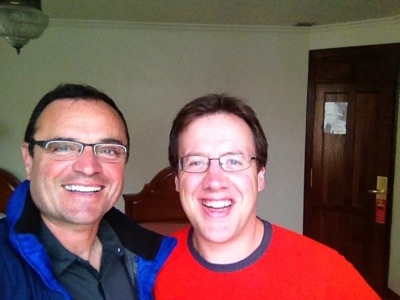
Best part of the day, though, was when Martin arrived. After he arrived after a bus ride from Logroño we started catching up on events since we last met and then planned dinner at Peggy Sue’s American Diner around the corner. Tomorrow we’ll walk through the industrial areas of Gijon to Aviles, apparently another delightful Spanish city.

20120612-123711.jpgGijon settles down for dinnertime.

20120612-123734.jpgPeggy Sue’s American diner — with Heinz Catsup in bottles.

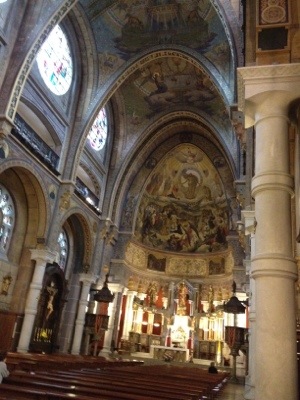
20120612-124021.jpgAmazing church interior off Calle Begona.

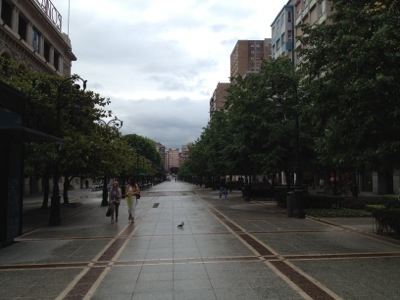
20120612-124105.jpgPedestrian mall and park. Every town needs one of these to make it walkable.

20120612-124219.jpgStylish cafe with free WiFi and Parisian feel.

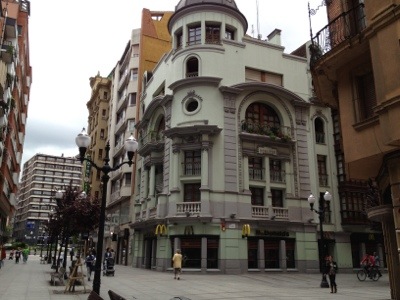
20120612-124310.jpgStreetscape — old and new delightfully joined together.

20120612-124404.jpgdos hamburguesas todas de vacuno, salsa especial, lechuga, queso, pepinillos y cebollas en un panecillo con semillas de sésamo.

20120612-124913.jpgI’d heard he and the other two men I admired most caught the last train for the coast. Got there and opened a bank?

20120612-125200.jpgMy new, ruby red slippers.

20120612-181726.jpgHola, Martin!

Spa Day!

Day Thirteen: Deba to Gijon — After three long and difficult days since Llanes I welcomed a short stage today. My plan was to get a hotel 4 km away in Gijon and wait there for Martin’s arrival tomorrow night. That gives two full days of rest. Ahhhhh.

As I look back now over the last three days I can see why I was complaining so much yesterday. My daily average of 31 km (21 miles) in the three days since Llanes is just too fast on this terrain. Last night I was drained of all energy and was starting to feel like this camino was a punishment, not a holiday.

So, spa day! After a 6-8 km walk from the campground/albergue at Deba through the suburbs to the old city center I found a nice hotel on the Plaza Mayor for not too much € (this is still offseason) that has a spa tub! I spread out my things in the spacious room, opened my window that faces the nearby beach, and luxuriated. Later on I walked the beach promenade, looked for lunch,(a challenge during siesta time) and basically hung out. Hooray!

I also took some time to take stock of this camino:

    13 days walking
    327 km (204 miles walked)
    Daily average of 24.8 km (15.5 miles)
    Almost exactly at the halfway point of the 700 km planned distance for this camino
    Looks like Santiago is achievable by the 26th or so, which works out great with my flight back home

Enough calculations and evaluations. Time to get back to my primary goal for the day: rest. Tomorrow’s plan will be finally to get in sync with Spanish mealtimes. For example, this lovely hotel’s restaurant opens for dinner at the very un-American hour of 9:00 pm, which about the time they close back home.

20120611-130648.jpgAbove from left: Jose of Madrid, Mone of Hungary, Karina of Austria. All fellow campers at Deba.

20120611-130706.jpgDeserted mansion before Gijon.

20120611-130720.jpgShells in Gijon’s sidewalks make it harder to get lost.

20120611-130733.jpgThe promenade along the eastern peninsula of Gijon’s old city.

20120611-130744.jpgView out the window of my pretty, spa day room.

Complaining Day

Day Twelve: Sebrayo to Deba (Gijon) — Today was the most grueling stage of any on this year’s camino and to make it even worse I hadn’t brought enough water. By midday I was parched and exhausted. By the end of the day I was begging for mercy. So today I will give myself the luxury of complaining about everything.

I awoke this morning at 5:30 to the sounds of multiple pilgrim alarms going off amid the 14 bunks of the Sebrayo albergue. One, probably belonging to a pilgrim who was upstairs eating breakfast, went off every 10 minutes, begging its absent owner to wake up. Finally at 6:30 I got out of bed, quietly packed my things, and headed out for the day’s walk.

I knew I was lacking two things as I left. 1) I hadn’t had my credential stamped by the hospitalera — she had apparently appeared 2-3 times in the evening, but because I was late getting in yesterday I’d missed her each time. 2) I hadn’t bought water. Many pilgrims just use albergue tap water to drink, but I don’t really trust it in these rural, farm-animal rich locales. So unless I’ve purchased a 1.5 liter bottle the night before (which I hadn’t) I rely on what’s leftover in my CamelBak (which wasn’t much).

Nevertheless, I headed out alone at 7:00 to walk the 30 km (18 miles) to Deva, just shy of the major Asturian city of Gijon.

Within 20 minutes I was surprised and delighted to hear John of Calgary’s voice asking if he could join me. Of course! I’d said my goodbyes to him last night, knowing he was headed to the Camino Primitivo today. So it was an unexpected treat to have him for a couple of hours before the Primitivo splits off to the south.

The first thing we did was get lost. John, 25, is an automation programmer, mountaineer, snowboarder and motorcyclist. That gave us plenty to talk about. And talk we did, right past the turn off. We kept on walking — on a steep uphill — realizing we hadn’t seen a way marker in some time, but deep in conversation. When we arrived at an intersection with no way markers at all I asked a local where we were. His response, “You’re lost!” He gave us directions back to the camino but instead we consulted my iPhone map and took the car road to Villaviciosa. Our detour had turned a 75 minute walk into 2.5 hours.

We arrived thirsty for coffee and not sure how to find our way back to the trail in this town of 10,000 or so. We stopped at a hotel, planning to ask for directions, and convinced the hotel dining room’s waitress to serve us breakfast. After coffee she kindly loaded me down with cookies and muffins for the road (John is gluten intolerant) and sent us off with a stamp for my credential and directions to the camino. A few minutes later we were on a gravel, pedestrian walkway heading out of town.

Unfortunately, in about 30 minutes (near Grases) we reached the junction with the Primitivo and it was time to say a final goodbye to John. He has been a great walking companion on and off for nearly my entire camino and I will miss him. A kindly Spanish pilgrim (whom I later came to know as Jose of Madrid) took a photo of us standing at the junction marker, pointing in our individual directions.
After Grases the camino wandered along a local paved road to the town of Nievares, where it took a very, very steep climb of 400 meters in just 5 km (1300 feet in about 3 miles) to Alto de Cruz. Unfortunately the sun was out, which meant I was sweating like an I-don’t-know-what, with only a few ounces of water in my pack. Shoulda bought water in Villaviciosa. The climb lasted forever and I saved my last swallow for the summit.

Immediately after reaching the top the wind changed to cold and the downhill trudge began. Many pilgrims feel the downhills are harder, more punishing to the feet, than the uphills. This one was on pavement so it didn’t seem too bad to me, but I was still very thirsty.

At the bottom of the hill I came to a large restaurant, Casa Pepito, and I celebrated my successful climb with a big salad and a plate of fried eggs and French fries. I was stuffed when I left Pepito’s but I figured I would just take it easy for a few km to let the big lunch settle, which would’ve been a good plan except that another huge hill awaited.

This one wasn’t polite enough to be on pavement. This new, insult of a hill was on muddy/rocky/slippery earth. My heavy, fatty lunch turned into a brick in my stomach as I walked each slow step upward. This time I had water, but my stomach was in no mood to receive it.

I finally reached the second summit and followed the road, then path, downward and downward toward the day’s goal of Deba. The last kilometers are always the longest, and these were no different. They were nicely punctuated, though, by a kind man who was barbecuing his dinner and who offered me some of his chilled, local cider. Asturians are proud of their cider and they pour it, this man included, out of the bottle from a height of about 4 feet above its receiving glass. It makes for a fun show and the cider does a good, low alcohol, job of quenching thirst. I briefly considered whether my stomach was ready for it and then immediately bottoms-upped the glass and thanked the kind man.

At about 4:00 I arrived at the Deva Albergue, which is situated in an enormous campground full of children playing soccer, swimming, or playing basketball. I took a luxurious camp shower and gathered my dirty clothes (i.e., all of them) and headed to the coin-op laundry. Spain and Italy were playing their Europe Cup game as Seth of Wisconsin and I chatted. Mone soon joined us, along with a tall multilingual Austrian woman named Karina. We pilgrims are clumped into small wooden cabins spread out over a hilly lawn, each with about six beds.

After a huge chicken dinner — I ate a lot today — I complained about some people making too much noise outside the cabin and went to bed.

OK, it was a tough day and I needed to complain a little. In reality I’m enjoying myself and meeting great people. Tomorrow I’m planning two rest days in Gijon as I wait for Martin. I know by the end of my long weekend I’ll be ready to face more walking. And hopefully I can manage them with less complaining.

20120610-221132.jpgGoodbye to John at the crossroads.

20120610-221232.jpgBig pool at the Deba albergue/campground

20120610-221218.jpgFirst view of Gijon

20120610-221145.jpgNote the distant valley floor from whence I walked.

20120610-221201.jpgCasa Pepito’s for a welcomed lunch, followed by yet another climb.

20120610-221123.jpg“Lost Caminoist,” photo by John Stoner.

In Paradise, Lost

Day Eleven: Ribadesella to Sebrayo — Last night ended up being surprisingly social as I visited over a nightcap with the five Spanish women. I think we all had fun, but I’m not sure since I understood only every other word. They seemed to really like it when I bought us all a round of drinks, so I might have hit on an international language understood by all.

After a nice sleep in my lovely but tiny room I awakened at 7:15 and was on the trail by 7:45. I stopped for coffee and a croissant at a cafe near the Plaza Mayor then headed across the bridge to the west side of town, which features a long promenade along the beach. This was a great start to the day, though I had to snuggle inside my rain jacket to stay warm in the wind.

As it turned out, from Ribadesella to La Isla is one great stretch of countryside. The path overlooked beach after beach, many with surfers taking advantage of the high waves. At the town of Vega I stopped with Linda and her boyfriend from France (both of whom I’d met at on our first boat crossing and also at Guemes). I showed her my “Things Scatalogical” blog post and she erupted in shock and then laughter, which of course made me worry that I’d crossed a line into bad taste. But maybe that topic is part of a humorous international language that everyone understands — or maybe bad taste is the same in many cultures?

Anyway, Vega and its surrounding countryside made a big impression on me. Though it was starting to rain, the views of beach after beach — all seen from the vantage point of green pastures with sheep and cows and horses — was just amazing. I could live here in this paradise. But I think I’ve said that almost every day. Perhaps in Vega what got me was the California surfer vibe, like what California must’ve been like 75 years ago. Few houses, great waves, quiet beaches, and a beachside cafe for a cheap beer between waves.

The coastal path continued through the town of La Isla, where tourism has brought crowds and the inevitable subdivisions of vacation homes. As I left La Isla for the town of Colunga, after crossing the car bridge and walking again along the highway, I noticed a sign advertising the region: “Asturias: Parais Natural” — Asturias: Natural Paradise.

With apologies to the ghost of John Milton, if there’s a paradise I am going to get lost in it. No sooner had I seen the sign than I followed the way markings to a dead end. The yellow arrow directed me to an empty subdivision (property boundaries and sidewalks but no homes) and I tried one path after another to pick up the trail. On my last attempt I found a location that sounded a lot like the description in the guidebook. So I took it and stuck with it until it dribbled into nothing. I got out my iPhone and used the GPS feature and I saw where I should go — to a road across three pastures, each with its own electrified fence.

After deciding not to test the fences’ voltage I took another stab at finding the right road and this time ended up at the freeway, a great way to get to Colunga if you could pole vault the highway fence and have your mom in a car waiting for you. No such luck on either count, so I checked the map program, saw what looked like a road in the satellite photo, and took it. Almost two hours after losing my way I found my first camino marker. I was back in business.

I knew, though, that this was now going to be a very long day. The distance was to be 32 km (20 miles), but my 2 hour detour added distance and time to my day. When I arrived at Colunga at 3:00 with three hours left of walking to Sebrayo I had to decide whether to reduce my planned distance for the day or press on and get in late.

There was just something about Colunga that didn’t appeal to me, though it does have a pretty church. But the idea of missing my goal didn’t seen right. So after a cervesa, a chocolate croissant and a mystery meat sandwich (he said in was ground chicken….) I headed on to Sebrayo.

Past Colunga the camino follows grass and gravel trails and small, paved roads through tiny hamlets. In one tiny town its little church building was consecrated in the year 921. A nice neighbor lady let me in to take photos. Because of the tree cover and recent rains the paths were often quite muddy.

At 6:15 I pulled into the tiny village of Sebrayo, whose only business is its pilgrim albergue, and who should be in the entry but Amelia of Berkeley! I enjoyed a happy reunion with her, Flarent and Julien, along with Nacho of Barcelona (our interpreter at Guemes), John of Calgary, two new Americans (Seth and Jeff) and the nice French couple from Brittany.

Since Sebrayo has no businesses, pilgrims have a choice of waiting for the grocery truck at 19:00 or walking 10 minutes through mud to a restaurant in the town on the next ridge. The truck held no enselada mixta or huevos fritos, much less vino tinto, so John and I walked the muddy ten minutes to the restaurant.

Assuming it was one km away, that would make my day a 32+8+2=42 km (26.25 mile) day. Literally a marathon distance.

Making the day’s goal was nice, but even nicer was having a chance to see the people of our “wave” of pilgrims who are now leaving the Camino del Norte for the alternate route to Santiago, the Camino Primitivo. Tonight is a goodbye to Amelia, Julien, Florian, John, the French couple, etc. It’s possible I’ll see them in Santiago, but no guarantees. So, some sad goodbyes at the close of a long day of being lost in paradise.

20120609-231048.jpgClockwise from bottom left: John of Calgary, Jeff of Boston, Julien of Quebec, Amelia of SF, Seth of Wisconsin, Florian of Amsterdam

20120609-231034.jpg1,100 year old church interior.

20120609-231028.jpg1,100 year old church exterior.

20120609-231015.jpgLuscious landscape.

20120609-230941.jpgBeach near La Isla.

20120609-231001.jpgColunga church.

20120609-230930.jpgBeach near Vega (i.e. paradise).

20120609-230918.jpgVega, beautiful Vega.

20120609-230856.jpgGoodbye Ribadesella.

20120610-070834.jpgRemote albergue at Sebrayo.

Things Scatological

Day Eleven: Llanes to Ribadesella — So far the waymarking in Asturias is not impressive. Last night as I was hunting for dinner I saw one of the blue and yellow Asturian way markers, so this morning I went back to that point, assuming I would find the route. Nope. So I got out my Google Map app on my iPhone and followed its “beta” walking directions out of town. Apparently “beta” walking directions mean they are actually driving directions, because I was immediately on the main auto road out of town.

I walked along the shoulder until the town of Poo and, pun intended, directions got even crappier from here. I saw a scallop arrow on a tiny street, followed it, and once again ended up at an intersection with no marker for where to go. So again I resorted to the iPhone map, which emptied me out along with Poo itself onto the AS-263 highway, a busy two lane road with no shoulder and apparently no speed limit.

I learned that the most dangerous times for a pedestrian to share a narrow, shoulder-less road are: a) when the sun is at your back, b) when there are lots of slow trucks, and c) when it’s Friday and everyone is in a hurry to get out of town for the weekend so they are madly passing slower cars. Today, all three conditions applied, so I found myself simply hoping that God would get me out of Poo alive.

I suspect that EU-enforced austerity measures have led Spain to lay off their roadside maintenance crews. The result is that the tall, unmown grass at the road’s edge is annoying and dangerous. The grass and weed stalks are scratchy on the arms and legs, forcing the pedestrian farther out onto the road to avoid them.

After a harrowing transit on the roadside I found myself in Celorio and back on the camino. Here the track joined back up with the GR-E9 and hopped from gorgeous beach to more gorgeous beach. I took a second breakfast (my first being some leftover fruit and pastries) from the dining room of a pretty hotel (in the next village of Barru) with a spectacular view of a small, sunny and beautiful beach. I thought to myself, “I could stay here for a day ….. or a summer,” but I dragged myself onward from my sunny reverie.

Back on the now well-marked trail (courtesy of the GR system) I was passed by two colorful Italianos and then passed a middle-aged French couple. In a few moments I heard the sound of rapid talking and turned to see Amelia, Julien and Florian (from the Mad Men motel) approaching. Julien stayed behind at first to visit in his native tongue with the French couple and Amelia and Florian and I enjoyed our reunion and continued ahead.

The remainder of the day was spent in the delightful company of these three youngsters. Amelia, 28, is from California and has a degree in Government from Skidmore. She’s hoping to be a counselor of some sort and plans to begin a PsyD degree this fall. Julien, 28, is a physical therapist in Quebec and he had taken the option of a 20% pay cut that allows him 7 months’ vacation every few years. Florian, 20, is Dutch and presently in college. He worked recently for a circus in Amsterdam. Amelia serves as “mom” for “the boys” and ensures they all have enough to eat. She settles any disagreements and determines the schedule for the day. It’s a cozy, familial arrangement that benefits them all.

We walked together on green, shady paths with gentle inclines to the town of Nueva, where the bartender of a shaded cafe on the main street allowed mis amigos con su comida to join me at my table. While I devoured a tiny racion of chicken sandwich (kitchen closed at the early hour of 12:30) they unwrapped a meal of bread, cheese, chips and jam while Amelia apportioned each his allotment of ham.

Before leaving, Amelia excused herself to use the restroom, at which time the men teased her about needing plumbing to do her business. She responded, “oh yes, for you men the world is your toilet.”

True. Accepted pilgrim protocol when the need arises is for pilgrims, male or female, to find a private bush. We each carry our own role of toilet paper for just this moment. Obviously men have it a little easier most of the time out in the bush, but Amelia’s sharp reply to the men brought a smile to my face in a day that had already contained some scatological thoughts.

With abundant conversation amongst us four the kilometers quickly ticked away. Amelia and I worked to impress the other two with our fluency in American culture, at one point singing through the songs of Wizard of Oz, Dorothy’s — I mean Amelia’s — favorite musical.

When we arrived at Ribadesella, since the three were going another 5 km, we exchanged emails, at Amelia’s kind suggestion, took pictures, and said our goodbyes. I hope I’ll see the three again soon, before they head off this track to the Camino Primitivo.

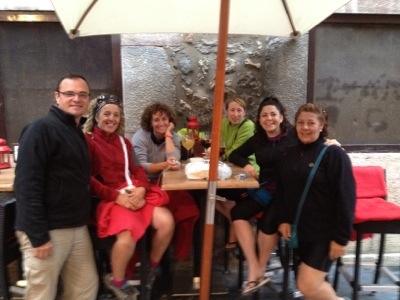
An added bonus to the day: as I was searching for a hotel I stumbled into Begona, Anna, Pilar, Annabelle and Nuria. This is their last day on the camino and I’m sad to see them go. At their suggestion I took a room at their hotel and perhaps tonight I’ll see them again and say my goodbyes to them, too.

Post script: After shower and a nap who should I see but Amelia and the boys, who choose to stay here in Ribadesella after all. Now there’s more chance of conversation tomorrow with these great young folks.

20120608-193743.jpgNarrow road out of Poo. Look out for your life!

20120608-193830.jpgAhhh, the beaches.

20120608-193854.jpgCafe for lunch.

20120608-193902.jpgJulien with giant sandwich.

20120608-193915.jpgWalkers.

20120608-193926.jpgWalkers, Two

20120608-193933.jpgFrom left: Florian, Amelia, Julien.

20120608-193801.jpgMorning by the sea.

20120608-202142.jpgCaminoist (for Shannon)

20120608-213350.jpgLas 5 amigas conmigo por un ultimo foto.